Tania Candiani (Mexico, 1974) intervenes in the vast field of reality with a rigorous and affective interdisciplinary work arising from a tenderness that is undoubtedly political, a work created in conjunction with others and for others: especially the makers of things. She has woven the past of neighborhoods and trades in cities distant from her present and from art itself, in personal poetics of techniques and sciences that denies obsolescence and rescues labor. In the weaving of spaces, stories, and sounds, she spins the chronology of objects to see and hear what they were or could have been, and what they tell us today. Her task is to recreate what has been silenced, abandoned so that it resonates in a way never heard before. She translates, in short, the music of the world, found in unique languages that are never just theirs. She regularly translates the sounds of the places she travels to the landscapes and the stories invented collectively, the architectures, the objects of labor, and their ignored voices. And she spins them with astonishing naturalness—and in the multiple mediums that encompass her overflowing artistic production—within the totality of her oeuvre: a polyphonic atlas in the Candiani language, which keeps extending wherever she goes. Her journey encompasses places like Mexico City, Tijuana, and Oaxaca (Mexico); Bogotá and Honda (Colombia); Cuenca (Ecuador); Havana (Cuba); Gdansk (Poland); Saint-Cirq-Lapopie (France); Vitoria-Gasteiz (Spain); Taichung (Taiwan); Cochin (India); Venice (Italy); Dufftown (Scotland); Moscow (Russia); Ohio, Phoenix, and Cincinnati (United States).
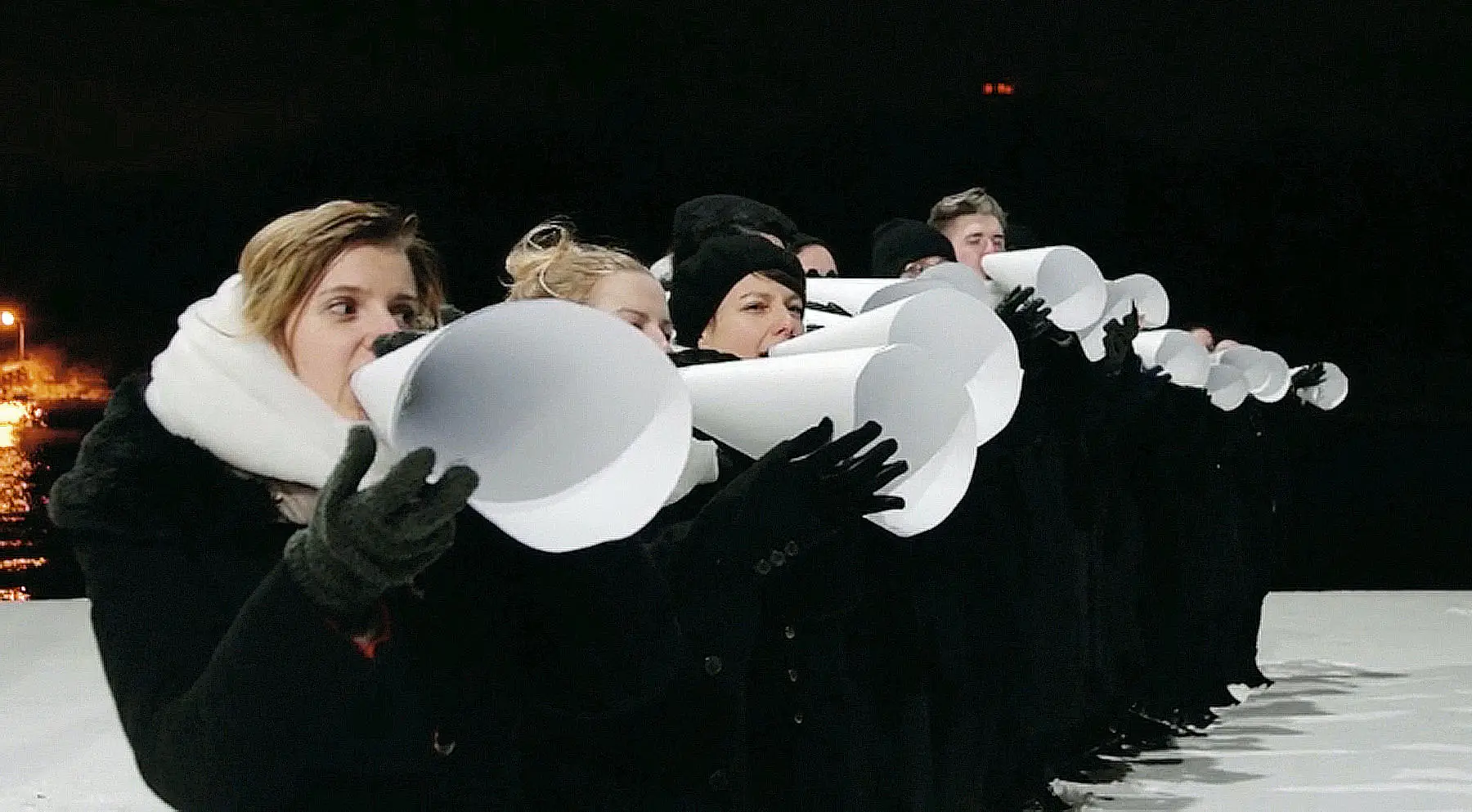
According to Candiani, all things have sounds and are susceptible to being spun. Therefore, she has invented—always in collaboration with others—ways to translate the shapes of ships and geographies into sounds, or the noise of machinery into human voices; and many of her pieces resonate with the sounds of crafts going back centuries and from distant continents. Only in her language is it possible to translate loom threads into resonant strings; or luxurious plans of historical buildings into patterns of clothing, as she did with the New York “Classic Six,” so different from the Nonoalco Tlatelolco Complex, in Mexico City, with its insurmountable distance between imagined and inhabited space. Or to transform the unrealizable dreams of the women who live in Tijuana’s maquila neighborhoods into beautiful painted or stitched facades. Or to return the lost forms of river basins in a sound cylinder that contains the random music of Ancient Rivers, Intubated Rivers, Dead Rivers (2019), among many other amazing translations. In her language, what ceased to be—factories and machines, buildings, projects and inventions, even memories in foreign languages—invade time all over again in a present where everything revives and resonates with the beautiful music of things that are not only spoken about but also manufactured. In the performance and video installation Language as Sound / Syreny (2018), with the collaboration of the 441HZ choral group in Gdansk (Poland), the voices of ancient ships, wind, and water were recreated, like sirens calling for the sailors. “That live-action took place in Nowy, a port that is no longer important; the chorus sang for ’the arrival of the ships.” In Gdansk, she designed a choreography with ghosts, and for the Atlas for New Port (2014), she placed posters of bygone shops of leatherwork, watchmaking, bakeries. The posters remained there for years. Candiani has also summoned dead inventors who added instruments or devices to the world, and which she has revived in her way. Workers and artisans of countless trades have taught her to listen and to fabricate the music of all things.
Lessons in seeing, hearing and flying
Candiani learned an essential lesson the day her father, Luis, stopped during a road trip just to show her the moving reflection in a pond of trees shaken by the wind. To watch him measure space, despite the noise of the constructions he was in charge of like an architect, was also an amazing educational experience. It taught her what that a pair of hands can create. Candiani, an only child, did not study art but letters, although she liked to paint beside her father while he did the same. She still sees him as her teacher. Her mother died when Candiani was only fourteen years old, and the memory of her presence is marked by the sound of her sewing machine when she was healthy, and time flowed until it frayed abruptly. To sew is to restore what is gone, to build the present by gathering what is distant and, finally, to resume what has been interrupted.
Candiani arrived in Tijuana in the 1990s and joined the artistic groups of the border area, that “other country,” with a feverish atmosphere of interdisciplinary exchanges. Life consisted of doing projects together at a pace influenced by the North. She discovered that painting was— just like the writing she had abandoned—”a path of self-knowledge.” She went vertiginously from geometric abstractions to dense self-portraits, full of layers of paint, before embarking on a journey that became truly urgent for her. The idea that the limits are far away if you have wings was born when, at a banner biennial, she placed a photographic self-portrait rising to the sky on a huge swing. Installed on a platform in a warehouse, a pair of wooden wings allowed people hoist with pulleys and project themselves next to the portrait of a woman seen from behind. But when she completed her first flight lesson was with her solo show “Gordas” (Fat Women, 2002), instead of the paintings that the Tijuana Cultural Center expected, she presented white canvases delicately embroidered with a black thread. Here she began to project a vital, new horizon of possibilities. By sewing fabrics together, she discovered her power as an installation artist, regained the rhythm of a vital chain, and went openly spinning to explore new paths, without ever getting too comfortable. All that meditation, resembling the constant breathing of needlework, led to a well-known photographic series for which she used household objects—pans, cutlery, brooms—to portray her Warriors (2003): women armed to their teeth with fierce imagination. The work emerged during an art residency at the Bemaha Center in Omaha, Nebraska, in 2003. In a place filled with industrial materials, she decided to work with “objects that were already loaded with the meaning of what is domestic.” Then, she learned to use the language of things: a knowledge she has not ceased to expand.
When curator Príamo Lozada invited her to a textile factory in Puebla, an emblematic space of abandoned promises of modernity, she recalled the fairy tale where everything is filled with thistles after a curse. She set out to give it life with the continuous sound of the work of her machine and the echo of what she had heard. This is how La constancia dormida (Sleeping Constancy, 2006) emerged. For this piece, she machine-embroidered her diary, comprising hundreds of meters long and containing words heard from old seamstresses. She also made twenty-eight dresses—one per day—including one that from the neck to the hem of the skirt had the words “La historia” (The Story). A lesson on how to sew threads to narrate in different ways. This work was crucial to her practice of using archives of all kinds and historical memories “as materials,” just like a fabric open to constant reinventions.
The manifold tongues of things
Tania Candiani dives into the past to rescue objects and artifacts discarded by the suspicious obsolescence of a civilization that builds and buries things at a dizzying rate. Fascinated by ancient inventions and by the relevance of extraordinary and complex ideas that were never carried out, she has reconnected past and present technologies by working with blacksmiths, composers, scriptwriters, video makers, and engineers, who have helped her in her enormous task of translating the music of the world.
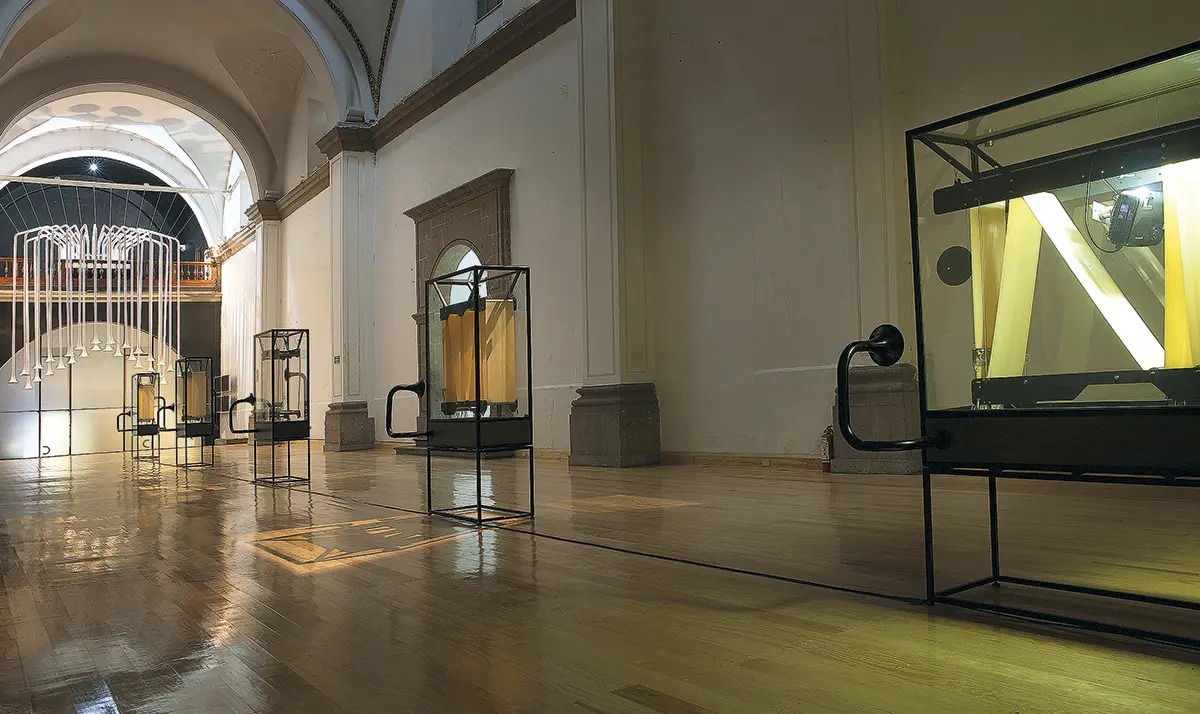
Jesuit inventor Athanasius Kircher and his Musurgia Universalis (1650) inspired her work Five Variations for Phonic Circumstances and a Pause (2012), curated by Karla Jasso for the Alameda Art Laboratory in Mexico City. With the help of dozens of collaborators, Candiani transformed the “archeology of sound artifacts” into large pieces capable of expanding the act of listening to unthinkable possibilities. One variation is Organ, a talking device with a resonance system and two keyboards: one musical and the other alphabetic, like a typewriter. Each key is a musical notation that simultaneously plays a syllable in Spanish, English, or Russian. The Embroiderer, on the other hand, “is programmed to listen and weave secrets that the visitor whispers in confessional modules.” The voices become word processors that record typographically, and the secret is woven cryptographically. As for the Sound Stories, domes emit sound interpretations of graphic novels, created by sound engineers, and also the conversations between Bernardino de Sahagún and the Aztec elders, interpreted by the artist Iván Edeza. Bell Tower was built with speakers that at six o’clock in the morning begin to emit sounds and voices that at certain times increase their intensity, evoking not the call to mass, but to insurrections. Pause brought together nine writers who told a story “in person” to one of the few scribes who still work in Mexico, thus revitalizing this dying profession. The project won the Award of Distinction in Hybrid Arts at the 2013 Prix Ars Electronica. The following year, invited by the Flora ars + natura residency program to a town situated on the banks of the Magdalena River in Colombia, she filmed herself sailing in a boat with a phonograph, evoking Fitzcarraldo. It was “an effort, as strange as it is beautiful, by Westerners who try to haul a ship on a mountain, ignoring the soul of the jungle.”
On the various forms of flying
Fascinated by flying devices as metaphors for her urge to go beyond what is possible, Tania Candiani embarked on extensive research to create works such as the installation Balloon Competition, Lyon 1784, after diving into the archives of the hot-air balloon competitions of yesteryear. For Flying Boat (2016), she reconstructed a boat with balloons as imagined by a pioneer in 1670, replacing the copper spheres with helium balloons. And after getting on her flying boat, she ascended.
As a participant in the group show “The Seriousness of Matters” (2016), she experienced zero degrees of gravity at the Yuri Gagarin Cosmonaut Training Center in Russia. She proposed to recreate a seventeenth-century dysfunctional invention and make it fly. For the exhibition “Srishti Outpost,” in Calcutta, she devised a “flying temple” named Vimana (2016). She built it with bamboo, coconut fibers, and paper: a suspended space and an echo of the mystical and aeronautical treatise written in Sanskrit a thousand years ago. For her solo show “Captive Ascension” (2018) at the Museo Universitario del Chopo, she made a magnificent installation of a black-and-white balloon. It evoked not only the aeronautics in Mexico but also the museum’s building itself, whose structure had been constructed for the Industrial and Commercial Exhibition at Düsseldorf, Germany, in 1902, and then relocated. The globe, floating and captive in the center of the room, was also a reflection of what was happening to her artistic practice: “My system had already become a formula, very beautiful and effective. This is why I ended that way of translating. I could have continued to do for the rest of my career, but I escaped.”
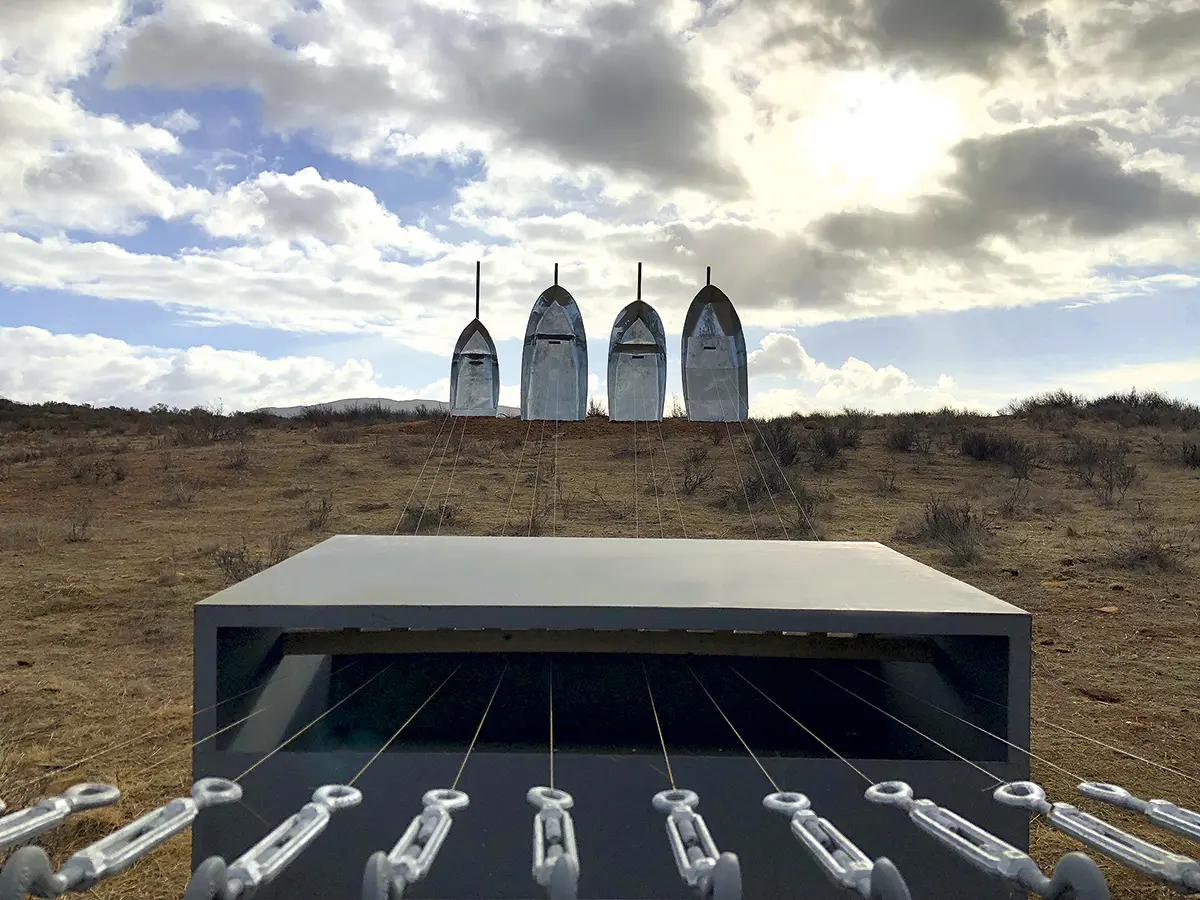
By contrast, her sculpture Eolian Harp (2018), installed permanently in Mexico’s Guadalupe Valley, is a remake of an ancient instrument meant to be played by the northern winds. She used boats as acoustic resonators that quantified the time when this semi-desert was under the sea: a way of recovering—or translating—the history and geography buried in atmospheric music.
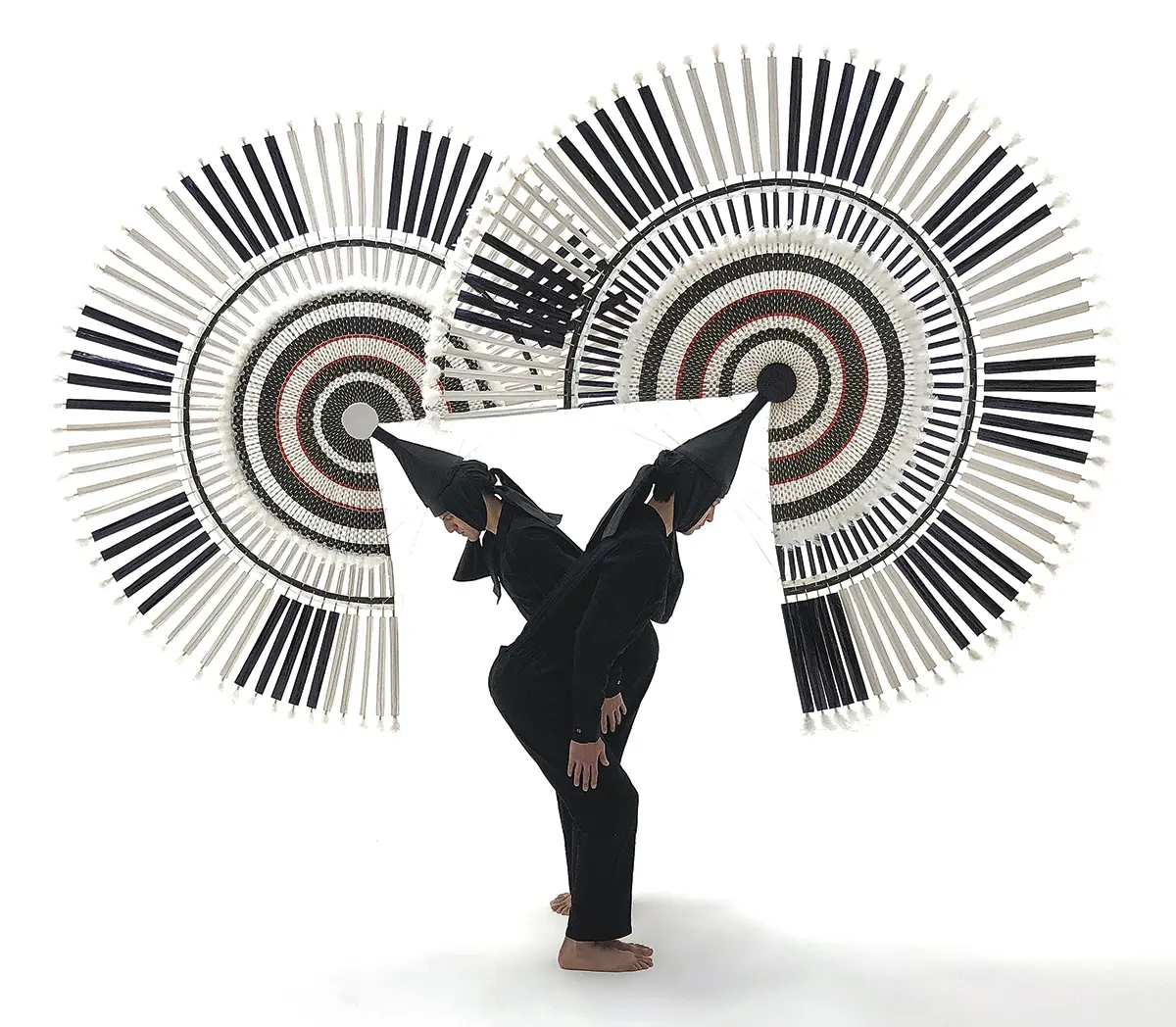
There is another way to fly: to extract from the past means to trace the present and ascend collectively. In Reverence, from the series “Penachos” (Plumes, 2019), she recorded a choreographic performance in a video that reinterprets the ancient Dance of the Quetzals. She transformed the traditionally colorful clothes of two Mexican gods that are enemies, Quetzalcoatl and Tezcatlipoca, into black-and-white garments worn by two dancers. In the dance, they manifest reverence for each other and bow to the cardinal points, “recognizing themselves equally and celebrating their differences.” The color red—meaning “blood and fire,” the skin tone of the solar gods’ faces in the codices—is preserved in the headdress, giving life to another time. That was the reason why Sally Tallant, curator of “Platform” in the 2019 Armory Show, included the piece in her project “Worlds of Tomorrow” as a key to traverse this time of political uncertainty. In parallel, The Sound of Labor (2019), the work that Candiani considers “a sonata in four pieces,” exalts the value of sound elements associated with labor. The unusual and experimental nature of the “music” of this piece arises from an installation with a choir of fifty women who, with their voices, interpret the sounds made by four industries and their bygone machinery. Their song thus interrupts the continual shrinking of the workforce.
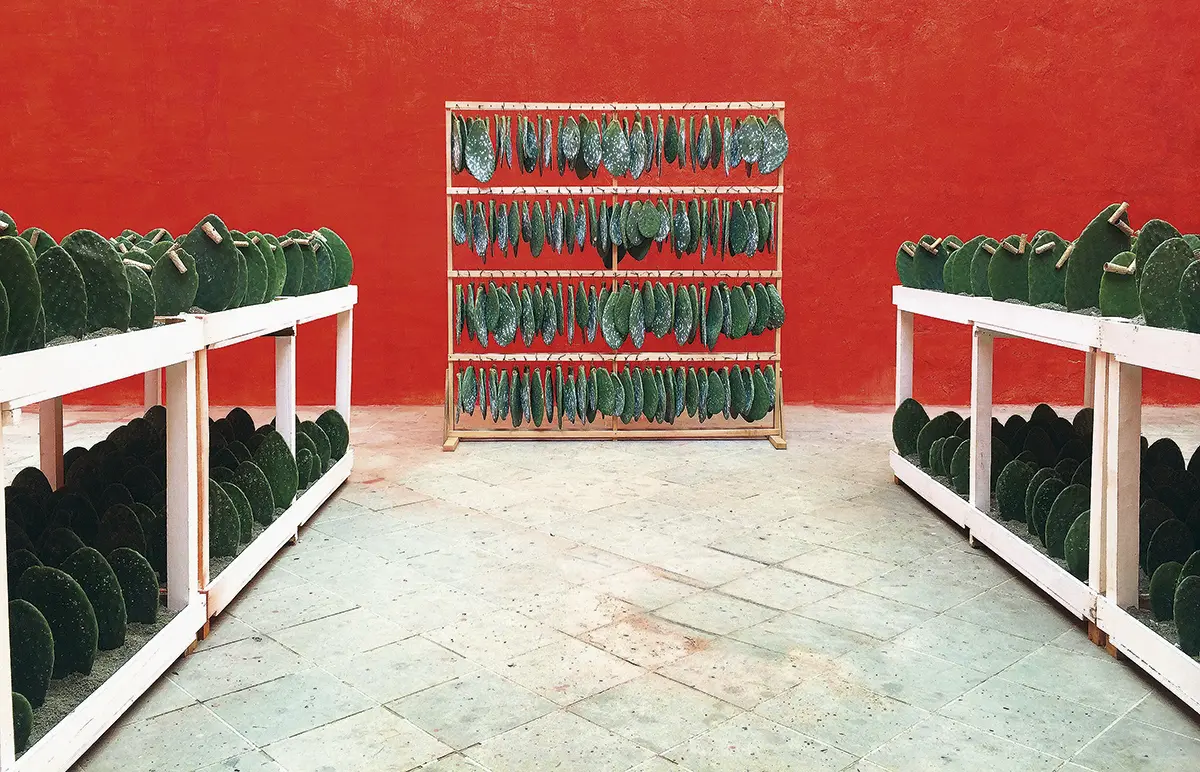
Tania Candiani does not wish to take a dead hare to the museum, but rather living labor to revive the paralyzed institutions. In La molienda (The Grinding), one of the performative installations created for her exhibition “Chromatics” (2015), stones for grinding the cochineal—from which carmine red dye is produced—were activated by the work of eighteen women and the different sounds and rhythms each one created with her grinding. The pigment obtained and the video recording are residues of the fundamental action: to occupy the museum space with the living sounds of labor.
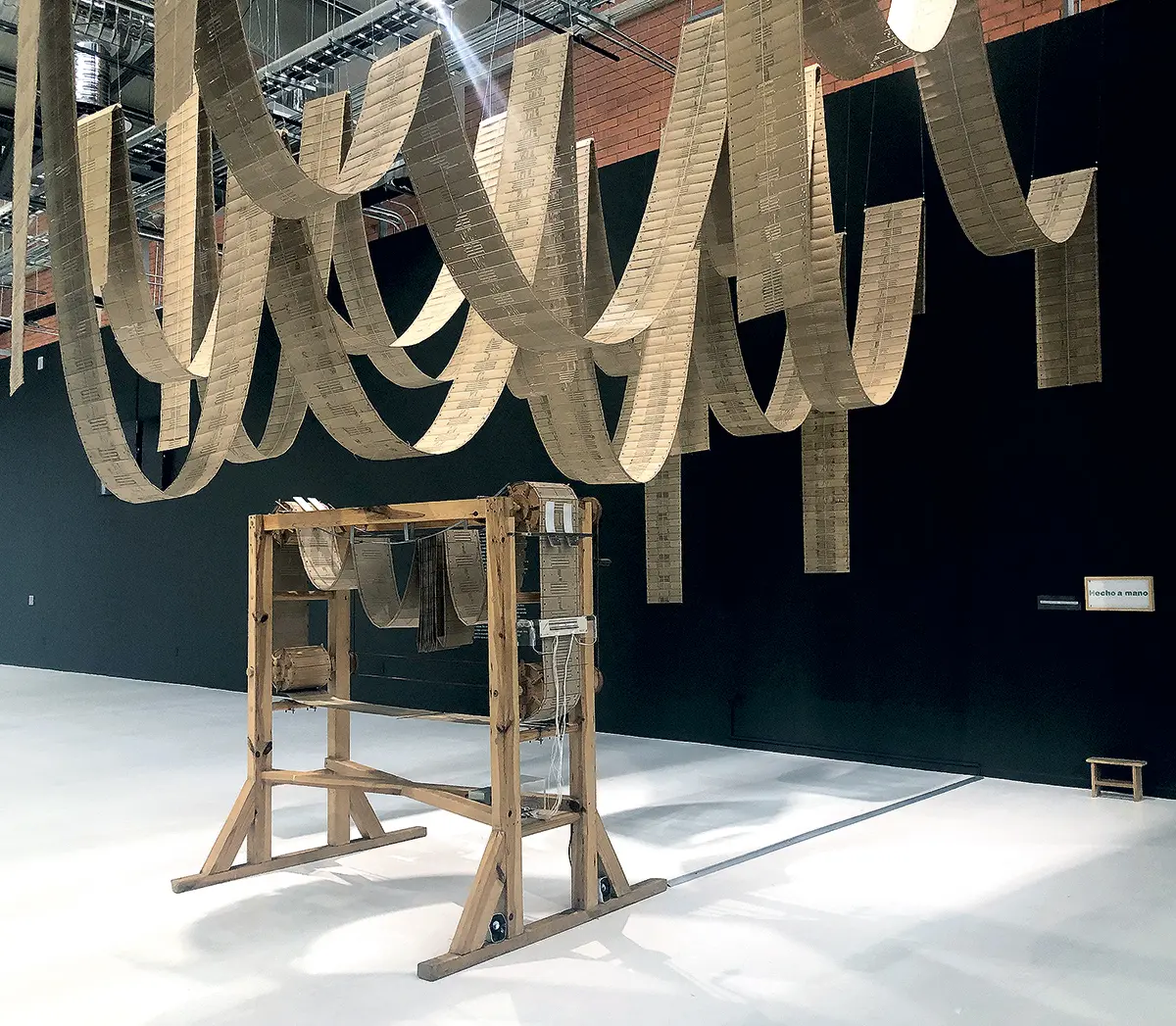
Looms have given rise to some of Candiani’s most moving installations. At the 2011 Cuenca Biennial (Ecuador), curator Katia Cazar discovered that in the ultramodern Tosi Factory, the owner had preserved some old mechanical machines. Candiani used one of these to embroider—following the card punching system—one hundred meters of labels with the phrase “Hecho a mano” (Handmade). “The machine knitted my phrase for hours,” she explained. Artisan Dario Quinquiche also participated by embroidering the instructions for the use of that machine, which resounded like another song dedicated to a manual trade that is disappearing. He then devised, along with masters Saúl Moisés Revilla and Jesús Ramírez from the Inti Workshop of Laudería, the way to transform the skeleton of an old loom into a stringed instrument of the 14th century, and that is how Zanfona en telar (Loom Hurdy-Gurdy, 2015) was born. “The friction of the strings connected to pedals that change their tone coexists with the basic operation of the loom’s combs.” Invited by Anita Dube to the 2018 Kochi-Muziris Biennial (Calcutta), she asked a Mexican luthier and Indian musicians to build a musical instrument assembled on a loom, which can be played on both sides and resonates with the sounds of the guitar and lute: String Loom. It is not just about imagining a future that translates ancient craft techniques into the language of other arts, but about hearing the sound that the world can make when the threads of diverse cultural voices connect to create a polyphony that teaches us to fly together.
ADRIANA HERRERA