Sheroanawe Hakihiiwe (1971), a Venezuelan indigenous artist from the Yanomami ethnic group, just had his first solo show in Europe, and he gave it the powerful name of “Urihi Their,” which denotes his home (the jungle itself) and the “community” that harmoniously brings together the elements and living beings he paints. Geographically, the Mahekoto-Teri community is located in Platanal, in the Alto Orinoco municipality of the Venezuelan state of Amazonas.
In this remote place, Sheroanawe exerts his extraordinary capacity of observation, panning his diaphanous gaze to trace the essence of all that manifests itself before his eyes and that as an artist he translates through his consistent signature style.
While Yanomami men and women usually decorate their bodies, and women paint baskets depicting their rich worldview, neither their founding myths nor their traditions have ever been captured on surfaces such as paper or cloth. The Yanomami cosmos constitutes an intangible heritage that has been transmitted orally for hundreds of years.
The fascinating story behind Sheroanawe’s artistic journey began in 1992, when his Pori Pori community met Mexican artist Laura Anderson Barbata, who was visiting the region to work on one of her personal projects. After Anderson was accepted by the community, she began to lead the “Rainforest Paper Project: Yanomami Owë Mamotima” (The Yanomami Make Paper). That same year, the project succeeded in integrating community members, including Sheroanawe, to work in applying sustainable solutions to such needs as recording, collecting, and preserving their history, as well as recycling paper and creating environmentally friendly sources of income.
Once initiated in this creative practice, Sheroanawe transferred to paper the graphic and visual compendium of his culture. With the guidance of his mother—also an artist—he was able to visually condense concepts such as ‘an earthworm path,’ ‘a butterfly,’ ‘a large caterpillar,’ ‘eggs,’ ‘a ceiba tree,’ or Konopo Hena (a konopo palm tree), for example. The resulting graphic synthesis allowed Sheroanawe to convey broad ideas from unique references.
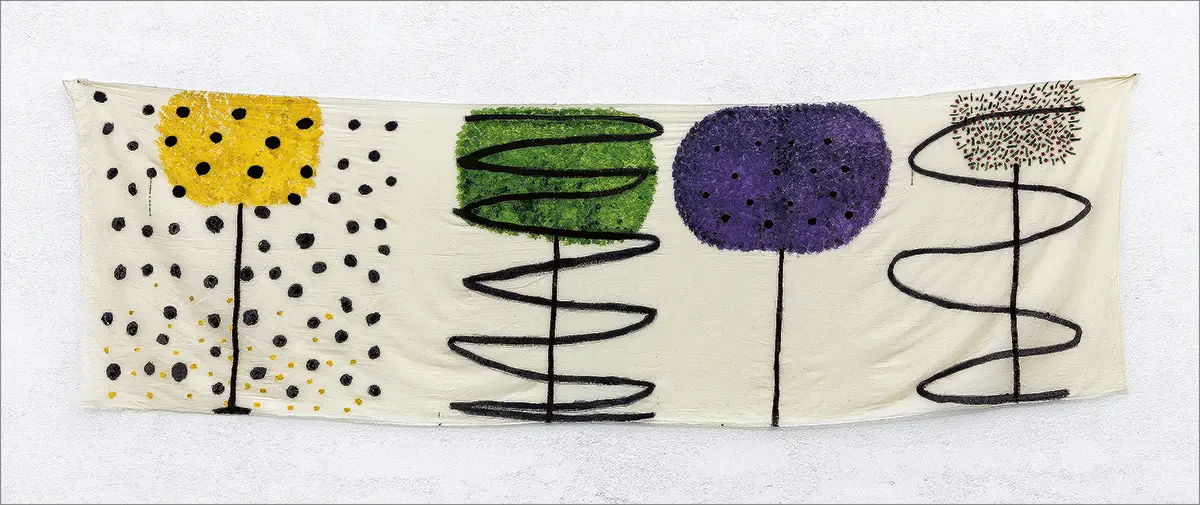
The exhibition at Kunsthalle Lissabon began with Sheroanawe’s new series of three large panoramas entitled Urihi Theri (Jungle/Community) and painted on cotton fabrics in 2021. These spectacular landscapes, stretched across the room, measure up to 4.5 meters wide. They represent the jungle by juxtaposing elements such as Seiseimi Kona (to sing like cicadas) with which Sheroanawe articulates the composition, along with transparencies that notably augment its plasticity. The Urihi Theri series not only comprises a masterful work of synthesis, but also includes visual textures and vivid industrial colors that decode the leaves of “his trees”. Other valuable pieces in the exhibition included the representations of Wakari (sweet fruit) and Hareremi Kaweiki (insect beard), rendered in acrylic on paper.
The power to communicate and genuinely articulate his impressions with a reduced palette has enabled this artist to become a real “voice.” Far from being an “outsider” artist, he is gaining the respect and recognition he deserves. However, it is essential to remember the loyalty with which Sheroanawe represents his community and that his work on paper is a result of the collective research led by Anderson three decades ago.
Between March 1992 and December 2001, Sheroanawe and his community produced and completed Shapono, a valuable six-page book written in the Yanomami language and illustrated by the children of Por Pori in plates created with natural fibers and recycled materials. Shapono narrates the Yanomami founding myth, starting from the establishment of the first communal house, according to the teachings of the creators: the twin brothers Omawë and Yoawë. Impossible not to be reminded of the founding myth of Rome by the twin brothers Romulus and Remus.
In 2000, Shapono won the Best Book of the Year Award in Venezuela, granted by CENAL (Centro Nacional del Libro de Venezuela). Today copies of this volume belong to prestigious public and private collections such as Princeton University’s Cotsen Library Collection in New Jersey, Parsons School of Design’s Gimbel Library, and The New York Public Library’s Spencer Collection, in New York, as well as The Library of Congress and The Latin American Book Collection, in Washington D.C.
Around the year 2000, Laura Anderson invited professor Álvaro González Bastidas, head of Venezuela’s Heritage Conservation Sciences Unit of the Institute for Advanced Studies (IDEA), to become part of the paper and book publishing project. The result was a second book, Iwariwë, a legend on the origin of fire, with Sheroanawe as its Project Director. This volume is currently on display at The Center for Book and Paper Arts, at Columbia College Chicago, in Chicago, Illinois.
In 2012, Sheroanawe created a third book, Poreawë (The Plantain Man), together with ten artists from Great Britain and the United States, at the Taller de Artes Gráficas (TAGA) in Caracas. Sheroanawe enjoys the support of his gallery, which has faithfully followed his trajectory.
Through this exhibition—the international window which has been opened from Lisbon—Sheroanawe shared, after almost thirty years of preparation, the vast graphic vocabulary he conceived within his community. “Urihi their” is a relevant show because it allows other publics to connect with the worldview of a vulnerable and remote culture such as the Yanomami. A culture that has respectfully and exemplarily managed to live in harmony with its environment.
ELISA RODRÍGUEZ CAMPO