Luis Adelantado presents Sastre (Taylor), a solo exhibition of works by Rodrigo Sastre. The title of the show comes from the clothing items that the artist has been producing. The gallery, located in Mexico City, is the site of the exhibition organized as part of the ZONA MACO Art Week, held between April 27 and May 2, 2021, which extended its run through the end of October due to the pandemic.
Rodrigo Sastre’s project can be understood as an homage to the many workers who collaborate in industry and in the manufacture of physical objects, focusing in his case on fashion, printing, and comics. It also prompts introspection about the meaning of serial production, exacerbated consumerism, and our detachment from everyday objects. The intention of Sastre’s work can be appreciated in his practice of intervening surfaces and in his recourse to printmaking, along with his particular vision about the meaning of new throwaway habits adopted among fashion industry consumers, whose easy substitutions denote a lack of attachment.
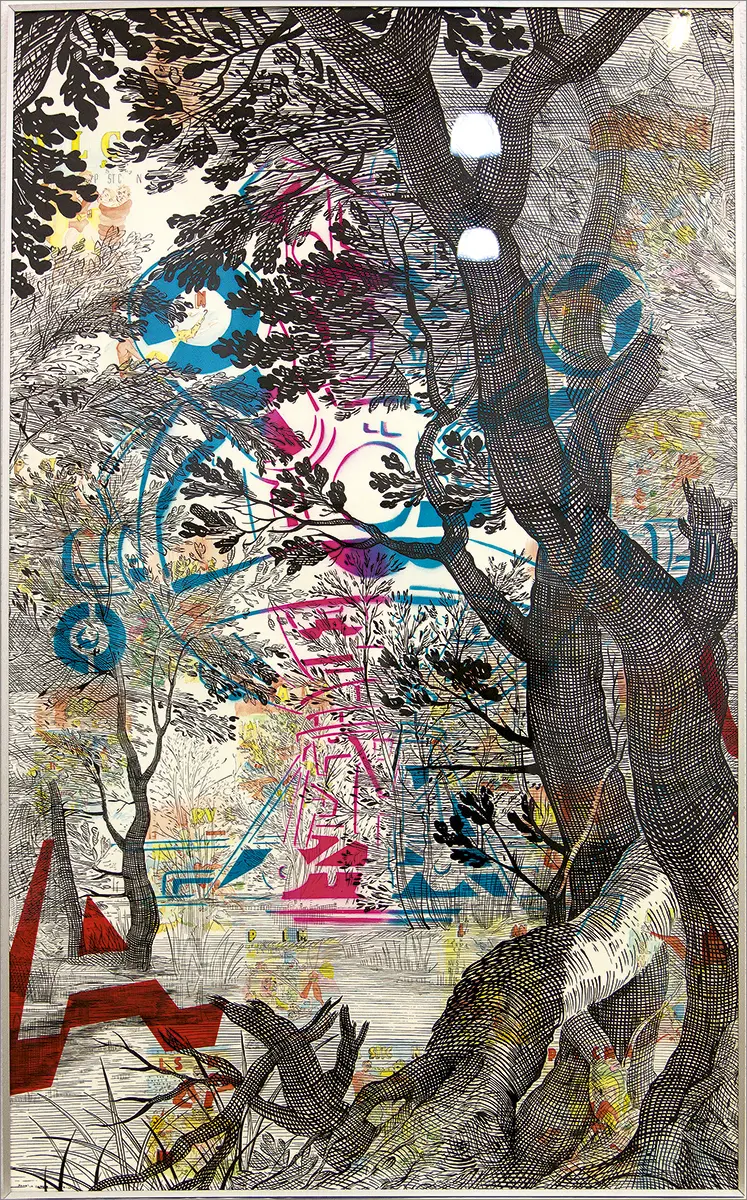
The show features a selection of works on cotton paper, book pages, and fabrics—in some cases made into clothing items—created from a matrix produced using an industrial cutting machine and intervened with spray paint. These practices result in textures that resemble the markings left by xylography gauges, which give Sastre’s creations their tactile feel.
The exhibition’s setup is based on the artist’s process: the first work the visitor encounters in the gallery lobby belongs to an earlier series and, although intervened, is still a digital print, yet it provides a framework for Sastre’s more recent productions. Inside the galleries, the new process of laser fabrication is immediately apparent. The artist displays the plates he began to produce in 2020, using traditional printmaking techniques.
On cotton paper, Sastre’s method begins with the intervention of the material, which is later transferred to the plate. Seeking results aligned with traditional printmaking, Rodrigo Sastre collaborated with printing workshops that followed classic production processes.
The works on exhibit break through the gallery’s monochrome environment by adding light in subtle hues of blue, pink, and orange, as well as the colors of the materials used as stretcher frames and support elements. The principle behind the works finds its foundation in André Malraux’s book on the Imaginary Museum, while the images originate in Jack Kirby’s comic strips. Kirby’s working methods interest Sastre for the way in which they make the result digestible and accessible for all to interpret. Everything, then, connects with comics, but not only in terms of characters that belong to the imagination of several generations, such as the Fantastic 4 or Batman, but also in terms of typography, environments, onomatopoeias, and setting and stage elements.
Such well-defined style generates a unique sensation in the viewer’s mind, taking him or her to an era when comics were tools for entertainment that were gaining positions within the realms of design and art, vitiated only by mass production, and which have accrued even greater value for that intrinsic quality as collectible objects that motivate remembrance, taste, and a certain nostalgia for the past.
While Sastre’s work alludes to all such processes of serial production, the function of which is to reach the greatest number of users thanks to their ease of reproduction, one of its signal achievements is breaking with that paradigm by eliminating large serial runs and imbuing his works with the character of the unique.
Sastre seeks out the intersection generated by the creation of a unique work that nevertheless comes from printmaking, thus retaining the potential for repetition. His work delves into the idea of the repetitive, of memory, of how we remember, keep, and reinterpret things. But it also pays tacit homage to teamwork, underscoring the relevance of individual contributions by many participants in order to produce a result, and it calls attention to consumerism and to the obsolescence that we instill on objects, as we render them irrelevant.
HÉCTOR TAPIA