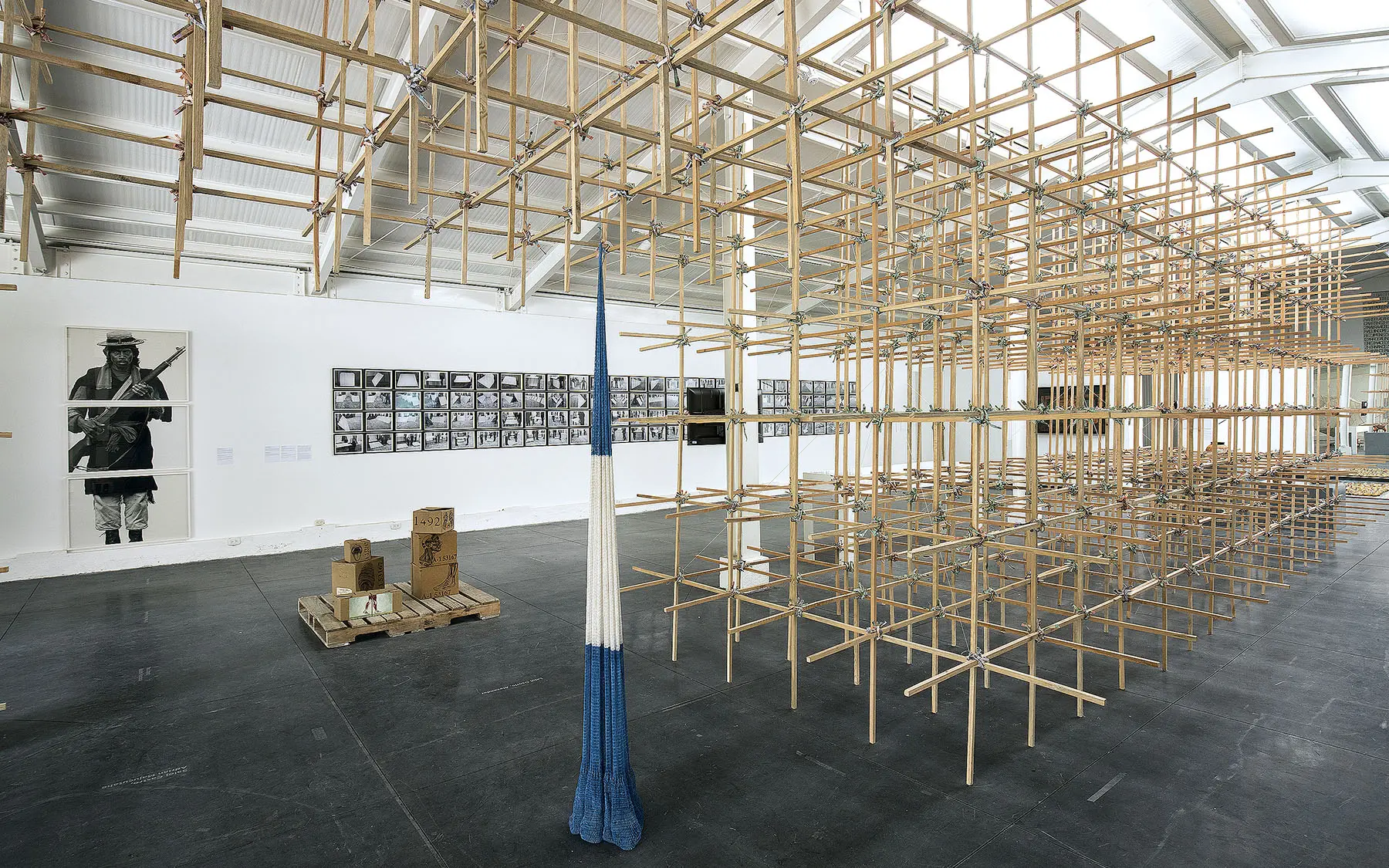
In a year marked by an increasingly acute health crisis, as well as crimes, forced exiles, and government scandals, Guatemala is celebrating the bicentennial of its independence from the Spanish Crown. This evident tension between crisis on the one hand and celebration on the other, is the starting point of “República” (Republic), which will remain open to the public until January 7, 2022, in the recently inaugurated Nueva Fábrica, in Antigua Guatemala. The contemporary art on display is one of the most significant collections in the region. In the wall texts and during his guided tours, curator Hugo Quinto raises issues such as the fictitious nature of the homeland, the state’s responsibility for the persistence of war, and possible future narratives. In a sizeable, albeit porous way, Tally Sticks by Santiago Montoya—a huge structure made of thin wooden pieces that appear to be held together by strips of paper money—divides the central space between works dealing with urban and rural issues. Displayed in an open space leading to a patio, the forty-six pieces don’t seem crowded. The distribution is not linear but circular, allowing for many formal and thematic associations, thus expanding the horizon of interpretations beyond what the ambitious curatorship has articulated.
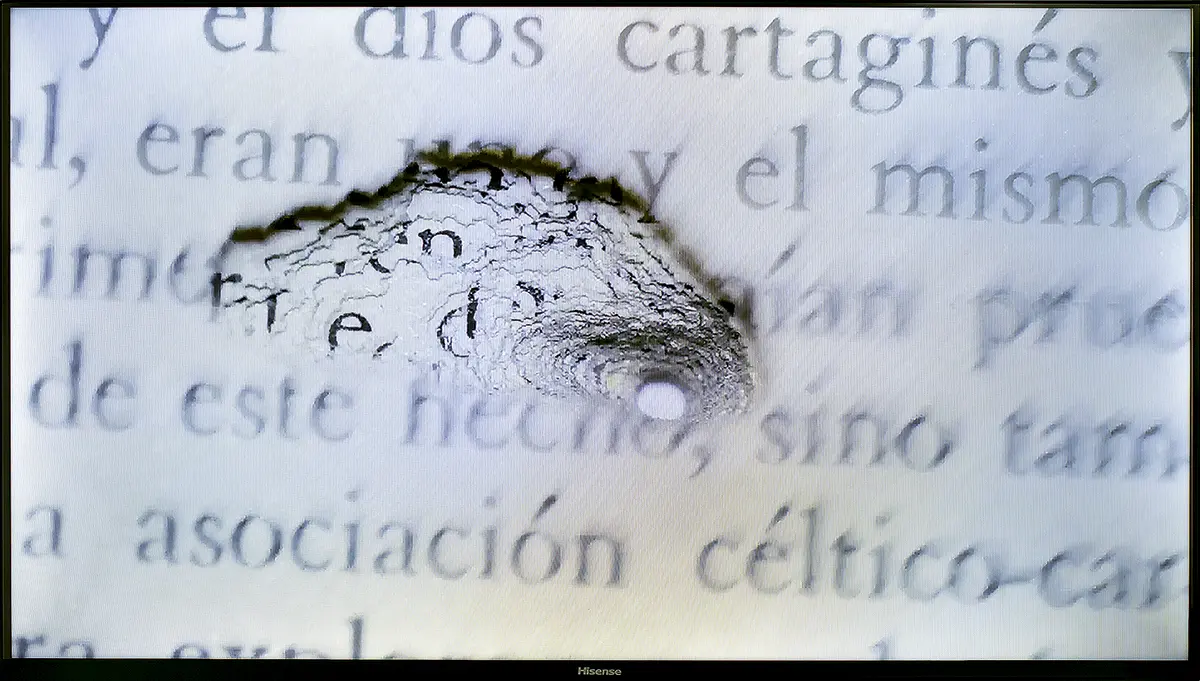
This is because the show not only wishes to expose the violence and inefficiency of the nation-state since its foundation, but also to propose new paths of conciliation and growth, sowing hope in another type of republic and, therefore, of citizenship. Spanning four decades, the pieces direct our attention to endless contexts and conditions of production and circulation of subjects, objects, and bodies. It is worth mentioning that more than one piece explicitly refers to Guatemala as a historical, economic, and religious project, as well as a bureaucratic and symbolic production. This is the case, for example, of Fernando Poyón’s Alternative Uses for a Flag: a fishing net with the national colors, hanging in the middle of Montoya’s structure at the center of the main room. Or the moths that corrode national documents in Lourdes de la Riva’s video Artificios (Devices), placed right at the entrance of that same room.
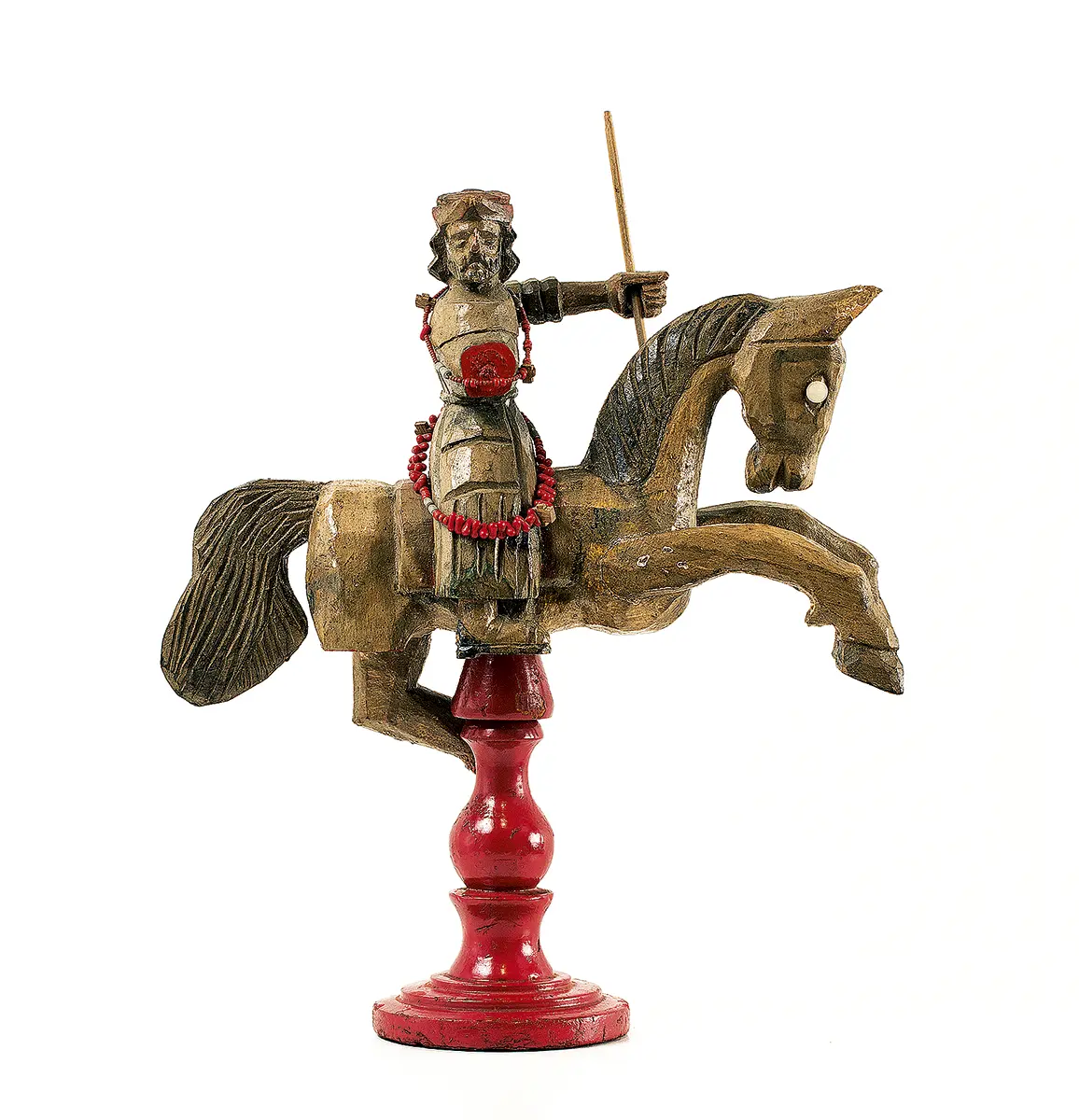
Despite being relatively small, a sculpture of Santiago de los Caballeros on his horse, intervened by Roberto Cabrera, also stands out in this room. One of the rider’s arms and two of the horse’s legs have been cut off and the stumps painted red. Although Guatemala’s capital city was baptized under his name during the colonial regime, this time, the Catholic saint also known as Santiago Matamoros (The Killer of Moors) seems to be himself a victim of the Crown’s sword and religious imposition; that is, of his own sword. In other words: he who kills Moors, he who kills others, be they “migrants” or colonial subjects, is also a victim of self-mutilation. The double direction of his aggression is one of the best learned lessons under colonial rule, generating concepts such as ladino, the mestizo who denies his own origins.
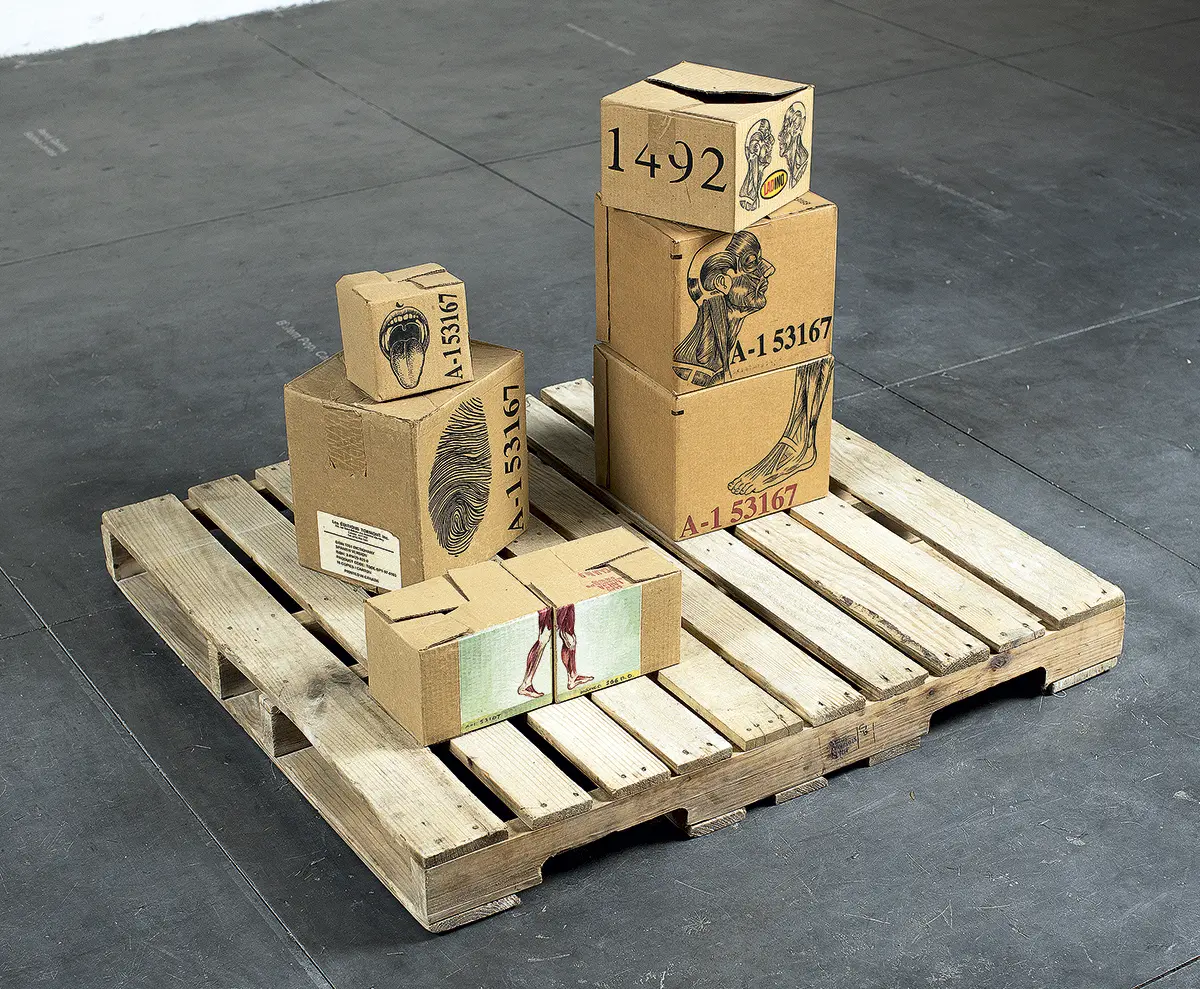
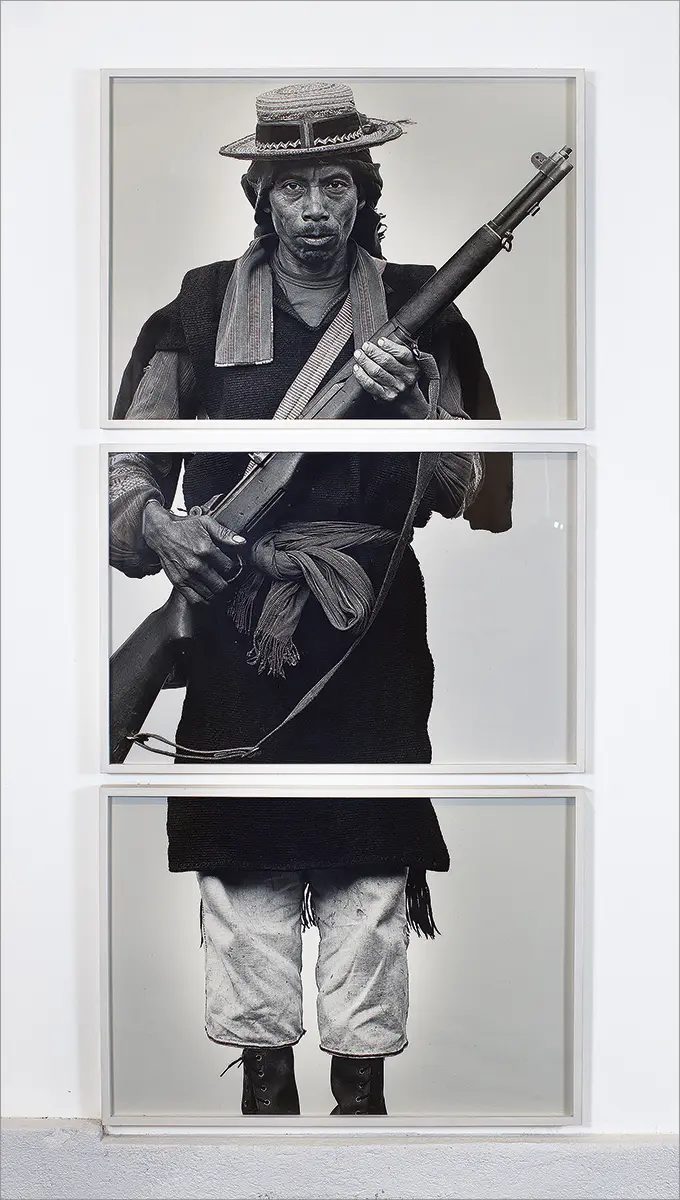
On the other side of the room—and juxtaposed with Cabrera’s sculpture—arms, legs, and faces painted on boxes are part of the late Aníbal López’s Import Export series. Written on one of these boxes, between two heads, is the word ladino, and on another one, 1492—the year America’s colonization began—and in almost all of them, A-153167: the artist’s pseudonym, which was also his ID number, assigned by the Guatemalan state. These anatomical drawings showing only muscles and bones without facial features or skin color, appear to be inscribed with both the colonial and the nation-state’s branding. They are concepts and cuts of meat, packed, imported, and ready to be exported. They are not, however, the only mutilations displayed in the urban section of the exhibition. Right above them stands an officer of those civil self-defense patrols that played a decisive role in the massacres during the war against indigenous communities. The triptych is by Daniel Chauche, who photographed a young Indian in the 1980s and divided him into three parts. He carries his rifle and over his body hang clothes woven with indigenous techniques, probably belonging to one of the affected communities.
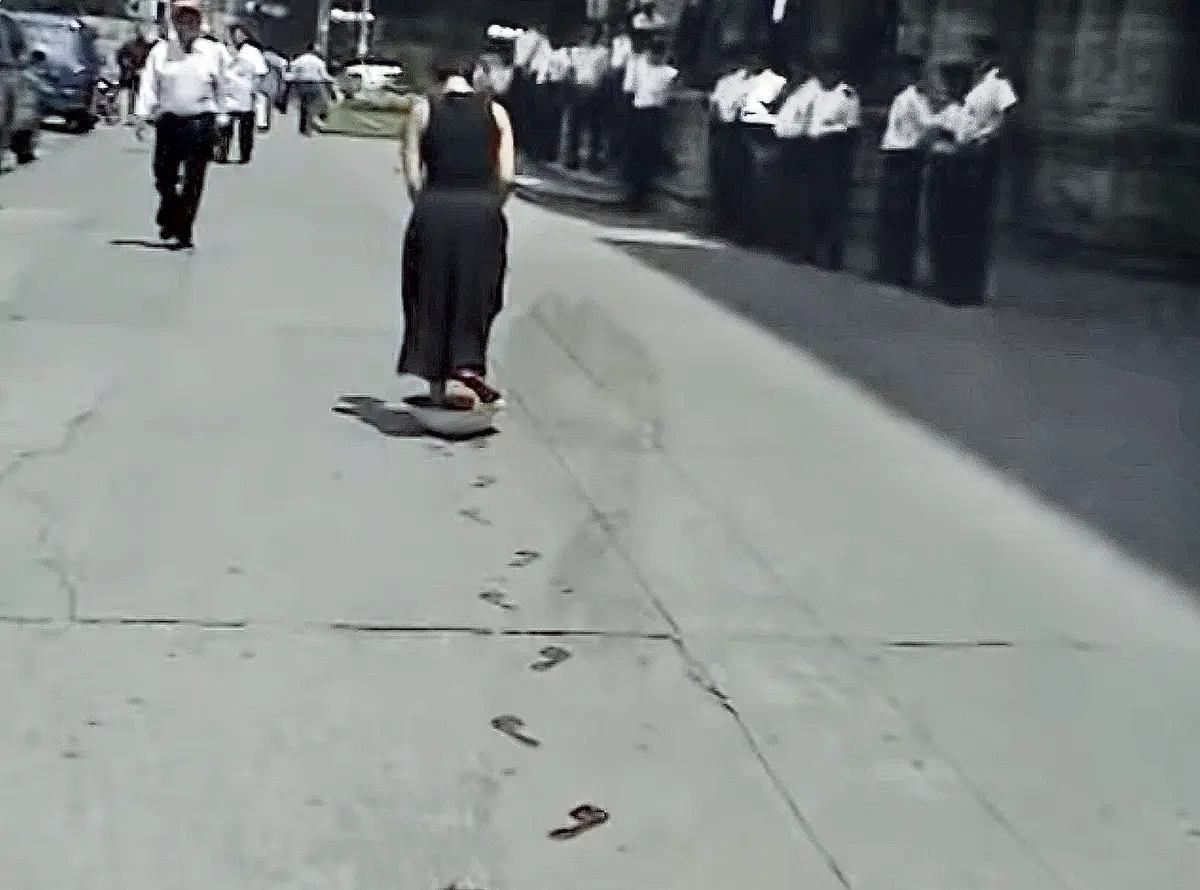
The documents in Change of Name Edict, displayed nearby, register another type of mutilation: the legal process of changing the surnames of artist Marilyn Boror Bor for those of two of the most powerful Guatemalan families, both historically and today: Castillo and Novella. Her project is the result of an investigation into hundreds of name altering transactions, from indigenous to non-indigenous surnames, in Guatemala, which are also printed on the entire exhibition floor. Awareness of the historical weight of one’s own actions is reminiscent of ¿Quién puede borrar las huellas? (Who Can Erase the Traces?), Regina Galindo’s 2003 performance. In reaction to the launching of the presidential candidacy of Efraín Ríos Montt, who was the dictator during the genocide, Galindo walked barefoot in downtown Guatemala, leaving traces of blood. The video-documentation is shown at the end of this same section.
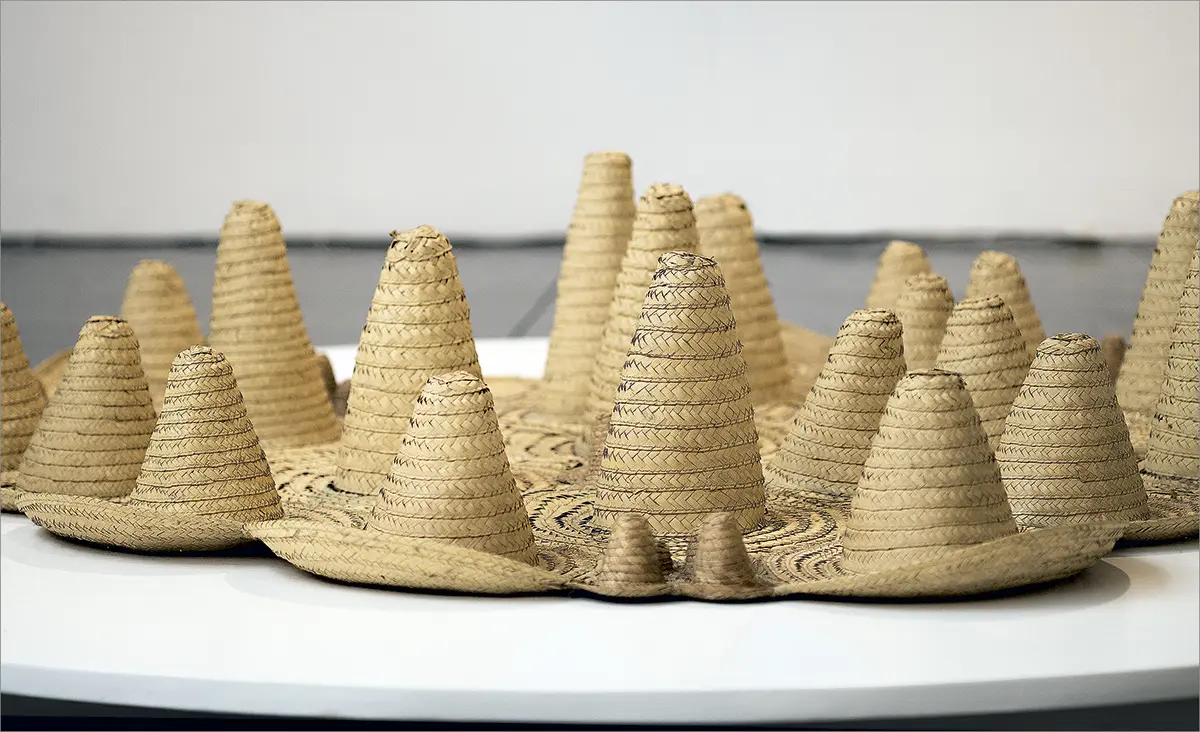
Approaching the other side of the urban/rural dichotomy, one enters a small room that seems to be a kind of open conclusion. Although no longer severed, the bodies here are not entirely visible either. We are in the realm of individual, but above all, collective potential subjectivities. I am referring, for example, to the work of Pedro Reyes, a huge Collective Hat with many tops installed on the floor in the middle of the room, suggesting that it should be carried not by one, but by many heads. In tune with this potentiality, Guan Shi’s Road 2 is a photograph of a group of people standing around an unfinished highway. Hugo Quinto wonders: Will we, as a society, be able to build a path together? I am left pondering if this path should be a highway, which is an unequivocal symbol of mobility and connectivity, but also a symbol of the exploitation of nature and labor; in other words, of modernity.
In what language will we narrate this new community, if not in the language of the modern nation-state inherited from colonial times? The question goes beyond the translation of the exhibition’s wall texts into the Kaqchikel regional language instead of English, admittedly a wise move. This makes me think of the story that accompanies Leer la tierra (To read the Land) in the last room of this show. Fernando Poyón tells us that his father had to decide between inheriting land in order to cultivate it and receiving a formal education, and he chose the former. What would education mean if it were based not on an imposing West, but on indigenous knowledge anchored in the land and the defense of communal territory? I sense that the answer to these questions can be found outside, in the streets, where proposals such as those advocating reforms towards a plurinational state resound louder and louder through the voices of social movements.