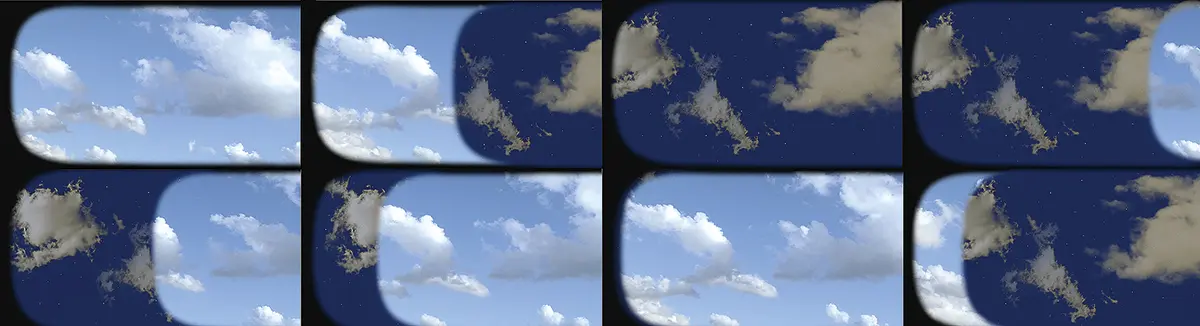
Flowing between many languages and never bound to any specific one: this has been the wide-ranging path chosen by artist Regina Silveira to seal her permanent search for the freedom to say what she thinks while diving into poetics that take her to the critical and ironic universe of illusionism and visual phantasmagorias. This intense shifting among techniques and mediums has opened her to a constant questioning of representation and perceptions of what is real, transforming her into a giant of the arts, as can be evidenced in the retrospective titled “Regina Silveira: Other Paradoxes,” which gathers around 180 of the artist’s works at the Museo de Arte Contemporáneo de la Universidad de São Paulo (USP). Regina is also participating in the main exhibition of the 34th Biennial with her work Paisaje (Landscape, 2021), a great penetrable labyrinth composed of glass walls riddled with bullets.
Curated by Ana Magalhães and Helouise Costa, the show—part of the 34th São Paulo Biennial’s expansion network and a collaboration between MAC USP and the Biennial Foundation of São Paulo—reopens the museum’s exhibition annex, remodeled in 2018-2019. The new space, very well suited for site-specific projects, installations, and large works, is ideal for displaying Silveira’s works. The exhibition also includes sketches, studies, models, documents, and informational videos. Among the least seen works are the installations Auditorium II (1990) and Símil (Office 2), as well as the preparatory drawings presented alongside most installations, in order to portray their creation process in detail.
The show was triggered by a donation of 42 artworks to the MAC USP in 2019, in collaboration with Luciana Brito Gallery, which complemented the museum’s already significant collection of the artist’s work. According to the curators, the title of the show refers to Paradoja del Santo (The Saint’s Paradox), an iconic work that belongs to the museum since 1994. The term “paradox” also refers to “the characteristic unease of the artist’s inquisitive attitude towards life and art,” according to the curators. The works also include prints made in 1960, experiments with appropriations, images and video art from the 1970s, urban intervention proposals, and some of her most recent installations.
The frontier between art and communication is in the crux of Regina Silveria’s work, often composed of photographs, prints, reproducible processes, and architectural spaces. The artist also worked as an illustrator; for example, making xylographs and illustrations in India ink for the newspaper Correio do Povo to accompany texts by Otto Maria Carpeaux, Mário Quintana, Lya Luft, and Vinicius de Moraes (copies of Correio pages from 1963-1964 are shown in vitrines).
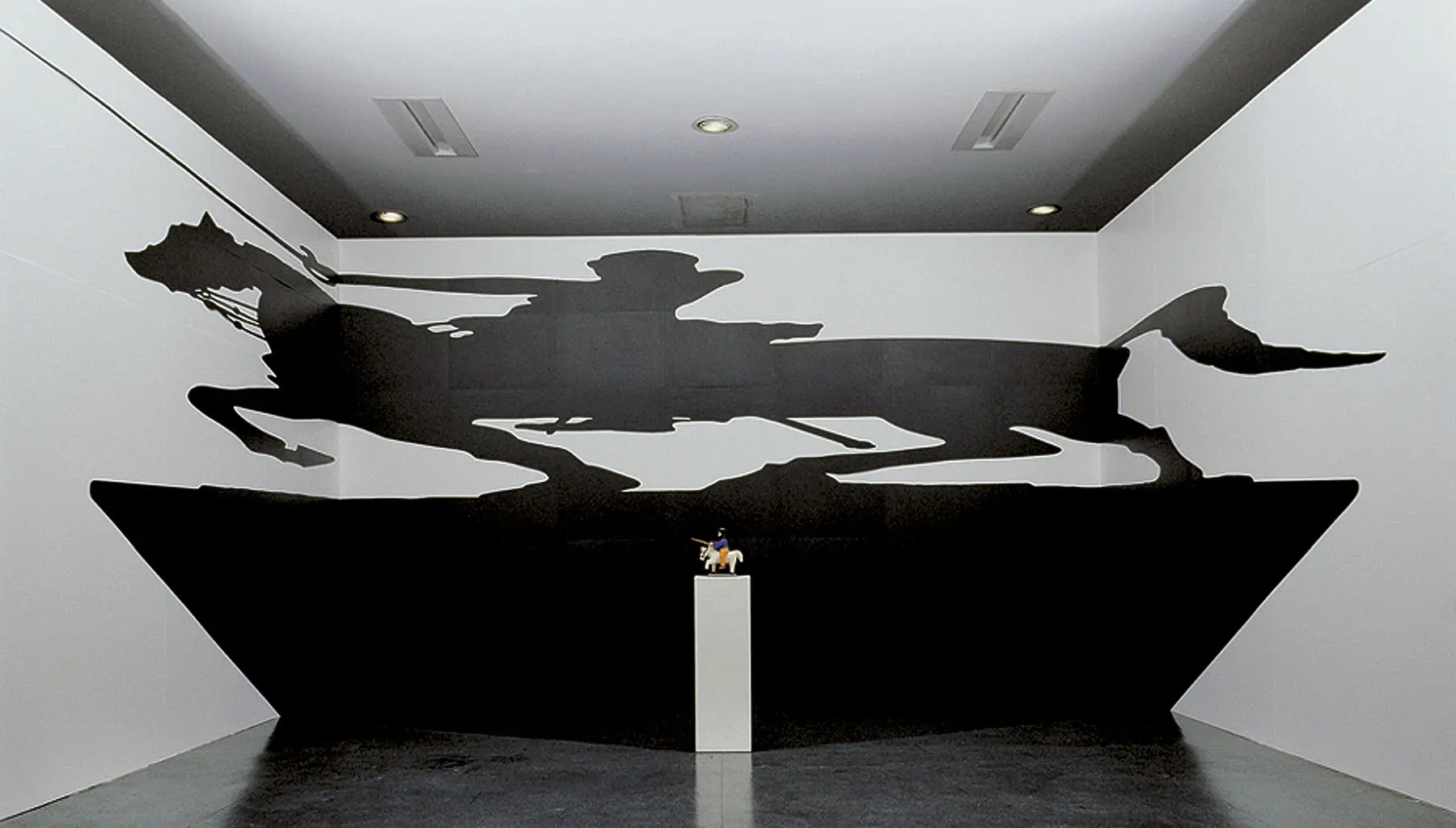
In her vocabulary, recurrent sets of signs—such as stairways, labyrinths, and shadows—are easily recognizable yet distorted, thus questioning the limits of representation and visual perception. The artist studies how the optical apparatus processes images and how drawing can manipulate those processes by altering them to the point of absurdity. In the Dilatables series, for example, which she developed for her doctorate degree at ECA USP, the artist appropriated photographs from mass circulation and reproduced them in high contrast using heliography in the now-lost original version. The Inflections series from the 1980s is also notable in that sense, gathering cut-outs of domestic objects and rendered in distorted perspectives. Nevertheless, instead of black or gray—the most recurrent tones in her production—these works command attention for their chromatic treatment.
The use of projections altered by exaggerated perspectival techniques became one of Silveira’s most recurrent experimentation strategies. She built off of figures with disproportionate shadows charged with symbolic connotations, especially those related to the political repression in the country. The political dimension in Regina Silveira’s work covers a great part of the exhibition. As the curators underline, the artist’s way of operating in relation to her surrounding reality is not propagandist: “she works between the lines, in ways that are seemingly banal but that reveal social tensions and contradictions.” The curators also emphasize this retrospective crucial role in generating gender discussions around Silveira’s work: “In making large-scale works destined for the public space, she makes the feminine presence in art visible through her ability to project and mobilize the artistic circuit, in Brazil and abroad, for the execution of her proposals.”
Regina Silveira’s formative years took place in Porto Alegre, where she was born in 1939, and Madrid. In the late 1980s, when she lived in Puerto Rico, the artist was already developing the first exercises that would delineate the essence of her work. Invited to establish an experimental model of academic learning, Silveira used intensely technical graphic reproduction techniques and participated in debates and studies about the circulation of images, discourses, and ideological systems of representation. Back in Brazil, in 1973, the artist engaged with contemporary creative methodologies in São Paulo, as can be seen in this retrospective, which includes works in new media of the 1970s, spanning all the way to recent digital processes. She also participated in the cultural management of various institutions, serving on the board of the MAC itself from 1977 into the 1990s.
Regina Silveira is one of the most emblematic Brazilian artists of her generation. Known internationally for her artistic, investigative, and pedagogical trajectory, she participated actively in the institutional history of the MAC USP at different times. Moreover, she was a key figure in the debates about art as a form of knowledge, which led the University of São Paulo to open, in 1974, the first visual arts graduate program in the country. A retrospective of such breadth does justice to the great magnitude of this artist’s work.
ALESSANDRA SIMÕES