The news, skeptical as we may be about them, keep announcing and giving voice to hundreds of scientists that venture to predict the end of the world. So, has “savage capitalism,” as we have been calling it for some decades, been foundational to this critical historical moment? So, has the imposition of humans upon nature, which has been regarded as an eternal and inexhaustibly giving mother, handing us the bill? So, has the ignorance and misunderstanding of ways to relate with the world that differ from “Western” ones help build a long dead-end road? All these questions and more are sneaking in at the current announcement of the Apocalypse. For some, it may sound strange that the end of the world is being heralded. It’s as if we were surrounded by a fatalistic scientific community that seeks at all costs to sour the moment one is currently living. Until then, time passes.
And yes! Temperatures rise during unpredictable seasons; storms, hurricanes, cyclones multiply; volcanoes awaken; the planet screams here, there, and everywhere.
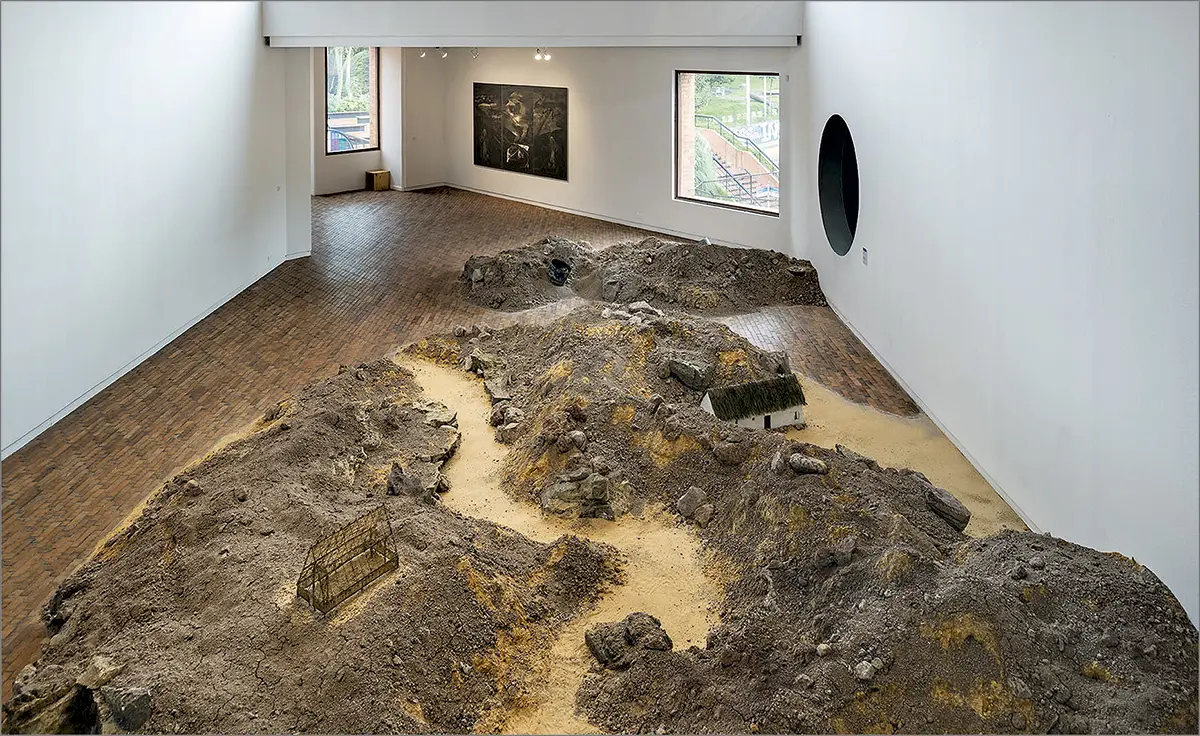
“Regreso a la maloca” (Returning to the Maloca), in principle, hinges on all this. We rethink the option of going back to the start and take some time to breathe and consider that the fatality that has been announced for a good number of years is really happening. Our “normalities” are similar to our “realities”: there are so many and so varied that we get used to living alongside them. It’s “normal” that in rainy season there is a sudden month of extreme drought; it’s “normal” that forest fires surge and devastate thousands of hectares a year; it’s “normal” that rivers overflow and flood entire towns. And from “normality” to “normality,” Miguel Angel Rojas alerts us, in an irate complaint, that we created an idea of progress that is killing us all. “Returning to the Maloca” is the name of an exhibition that delves into other ways of knowing and investigates possibilities that were never heard of, or that quite simply were abolished by force. There, in that maloca, lies the power of wisdom and of understanding the relation between human beings and nature as a single body.
Michel Onfray already said that the landscape today is what human beings have built. Landscape is the result of thousands of hands that have intruded over a long period of time. That way he abolishes the romantic notion of landscape and turns it into the object we keep depleting and modifying at our whim. Landscape is, for Rojas, contemptible as long as it continues to be a resource: for legal or illegal mining, drug trafficking, cattle raising, fishing, extensive agriculture, etc. The Amazon jungle is shrinking and with it, the choice of returning to the maloca.
This is a powerful exhibition, a poetically devastating denunciation. Experiencing it saddens the soul. When did we get on this track of consumption, progress, and greed? Although the exhibition focuses on national issues, its premise can be applied to the entire world: a frenetic race to be the first one to reach a place we don’t even know exists, yet we keep running desperately, as if fleeing from the major evil determined ages ago: poverty. Poverty as the absence of material goods, access, consumption, money. Understood in this way, living in the jungle is synonymous with poverty, and so to destroy it means progress. Miguel Angel Rojas gives us back the maloca, he gives us back the jungle, he flips the coin and reveals that there are “truths” and “normalities” that are neither truthful nor normal; that the race has been healthy for no one; and that human beings and nature are one and the same.
In tune with all of that, Rojas has been making some reflections on the coca leaf for some time now. Suffice it to say what community statespersons, experts in political economy, indigenous ethnicities, ecologists, and others have expressed about the problem of connecting the coca leaf with worldwide drug trafficking. A leaf that has been part of a fountain of wisdom, with recognized healing and medicinal properties, and influential to the shamanic processes of ancestral cultures, was demonized due to consumption; and so, we return to excessive consumption induced by a subproduct derived from the leaf. Wade Davis clearly explains this phenomenon in his book about the Magdalena River, and in his exhibition the artist highlights it by constructing the duality between coca leaves and dollar bills. Ancestral wisdoms did submit, finally, to a scrutiny based on the political, economic, and religious desire to capitalize on power. “Returning to the Maloca” means to return where wisdoms based on the ecosystem, and on the clear and friendly interaction with nature are respected. If it’s not too late for that.
ANDRÉS GAITÁN T.