The solo show “Contemplations and Memories,” featuring works by Mercedes Pardo (Caracas, 1921-2005) at the Galería Acaso, with support from the Otero Pardo Foundation and curated by Bélgica Rodríguez, was launched as the main celebration of the 100th anniversary of the birth of an artist who was essential to the development of abstract art in Venezuela. The show, which gathered pieces from private collections and the Otero Pardo Foundation, covers an anthology of thirty-two paintings, two collages, fourteen prints, and a model for a stained-glass window, spanning from the 1960s to her last days. The exhibition space revealed an oeuvre that until now had not been recognized in its rightful tenor, with its corresponding contributions to the formulation of an unusual language within the country’s dominant currents. This event places her as one of the great artists to offer innovative and advanced approaches to abstract art. Pardo developed a language that integrates sources prone to geometric abstraction and stands out for her extraordinary mastery of color, which combines an emotional arena with the structural strength of her chromatic fields. Her contribution to abstraction extends into clear, calm, and infinite planes of color, whose combinations and chords, intervals and tones, penetrate the musical spectrum from harmonic perspectives. On the other hand, this exhibition can be seen as part of the current recognition of a significant group of Venezuelan women’s contributions to contemporary art, at the margins of the dominant patriarchal system and its inflexible geometry.
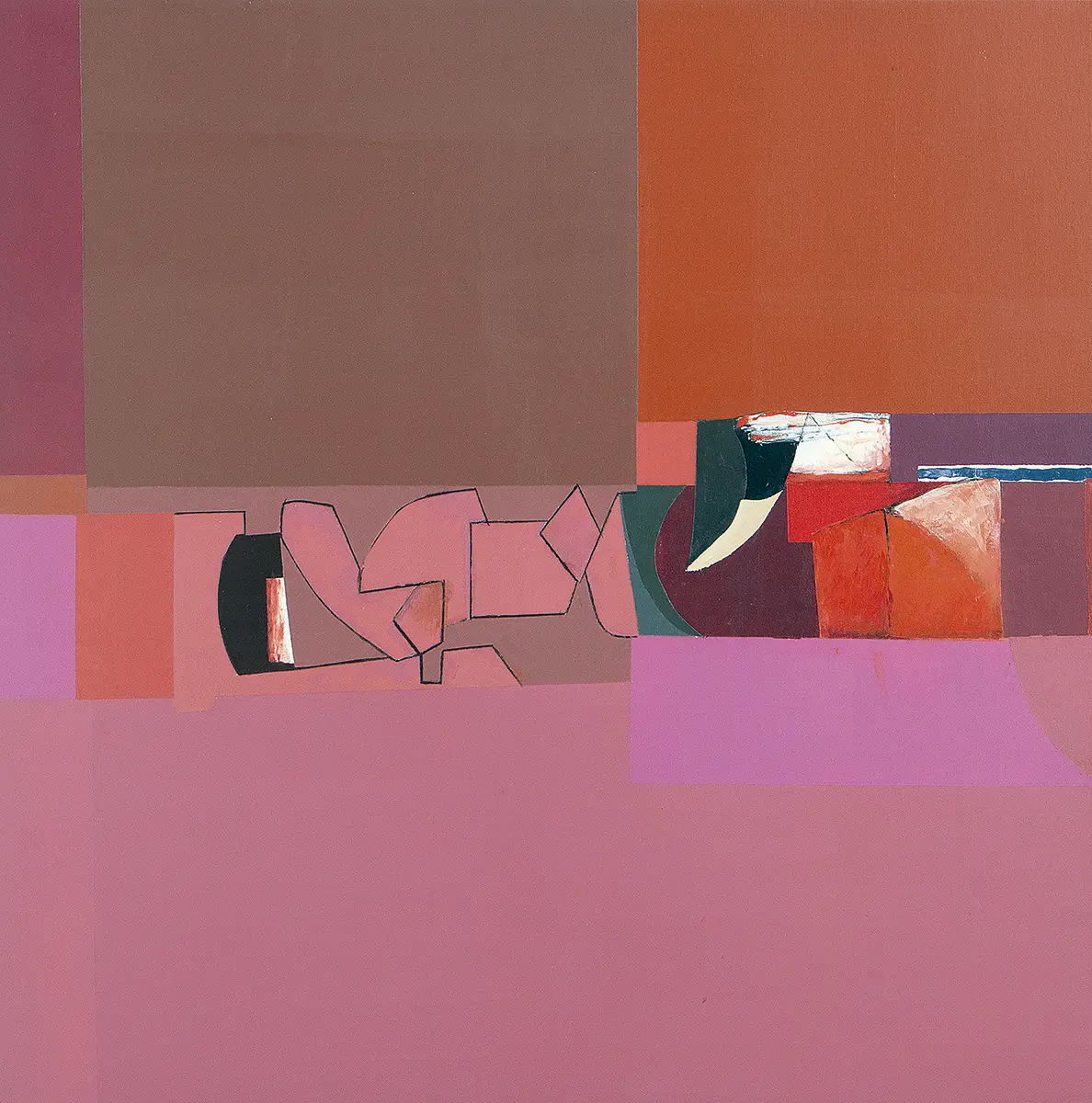
The curator took as a starting point two early collages that announce the problems that would occupy Pardo’s throughout her career: color-space dynamics, tensions and movements of the pictorial plane, spatiality, and vibrations on the canvas. This curatorial decision capitalizes on the unfolding of the connections with her later works. El Jardín de las Delicias (Garden of Delights), from 1965, and En este mirífico mundo (In this Magnificent World), from 1966, define the theme of space in its first stage, where the fragments with variegated shapes dynamize the composition to the point of suggesting imprecise geometries that later took another direction in the extensive planes of color. Collage was always a trigger for creation, a vital passion, a process underlying the realization of her pieces, where she maintained basic structural principles. The collages open the way to a journey through the fundamental works of her production, originating from its structural scaffolding in the carefully constructed square. The square is fragmented into freer forms, expanding the registers and dimensions of the works, to arrive at a possible emotional geometry. Pardo maintained two lines of work: the structure around the square, which builds the composition, organizes the geometry, and is kept as the painting’s main frame; and the projection of an emotion that is latent in its structure, and also seems to surpass the limits of the frame. Her greatest contribution was to include—with an elegance both exquisite and daring—all the problems of abstract art within the frame, without resorting to three dimensions or monumental scales.
The ordering of color is another of her major contributions, and the exhibition proves it. Color is never used in her work with a decorative or ornamental function, but rather organizes the planes and unfolds the composition. Each painting confirms her enormous mastery in the application of superimposed layers that produce different planes. Each work is in itself a revelation, but so is the collective ensemble of works laid out in the exhibition space. Parca vibración (Frugal Vibration), from 1971, solves with simplicity, and without leaving the canvas, the problem of movement in kinetic art. Displays of vibration are subtly concentrated at the edges, casting a disquieting feeling of instability and a quivering of the color bars. With this, Pardo truly became an original. In Cálido encuentro (Warm Encounter), from 1977, we can appreciate a dialogue between a warm vision of abstraction and Mondrian’s strict neoplasticism. In Rendijas (Crevices), from 1978, the planes of color give structure to a composition where thin white cracks provide the spatial dynamism. Untitled, from 1988, establishes a relationship that goes beyond abstraction and builds a conceptual narrative where the painted frame is part of the color planes. In Untitled, from 1983, 1988, and 1997, the irregular shapes alternate with the planes at the background, generating the sensation of a fragmented space where irregularity never becomes chaos. Untitled, from 2005, an unfinished painting, constitutes a poetic closure to the exhibition since it was the last piece Pardo was working on the day before she died, and which expresses a cartography of the pictorial problems that always occupied her. Her work, indefinite and tentative, but with an exemplary discipline, never yielded to the parameters of international abstraction measured from geometric regularities. She focused on the square to create a subversive space, simultaneously agitated and serene; of infinite dimensions.
MARÍA LUZ CÁRDENAS