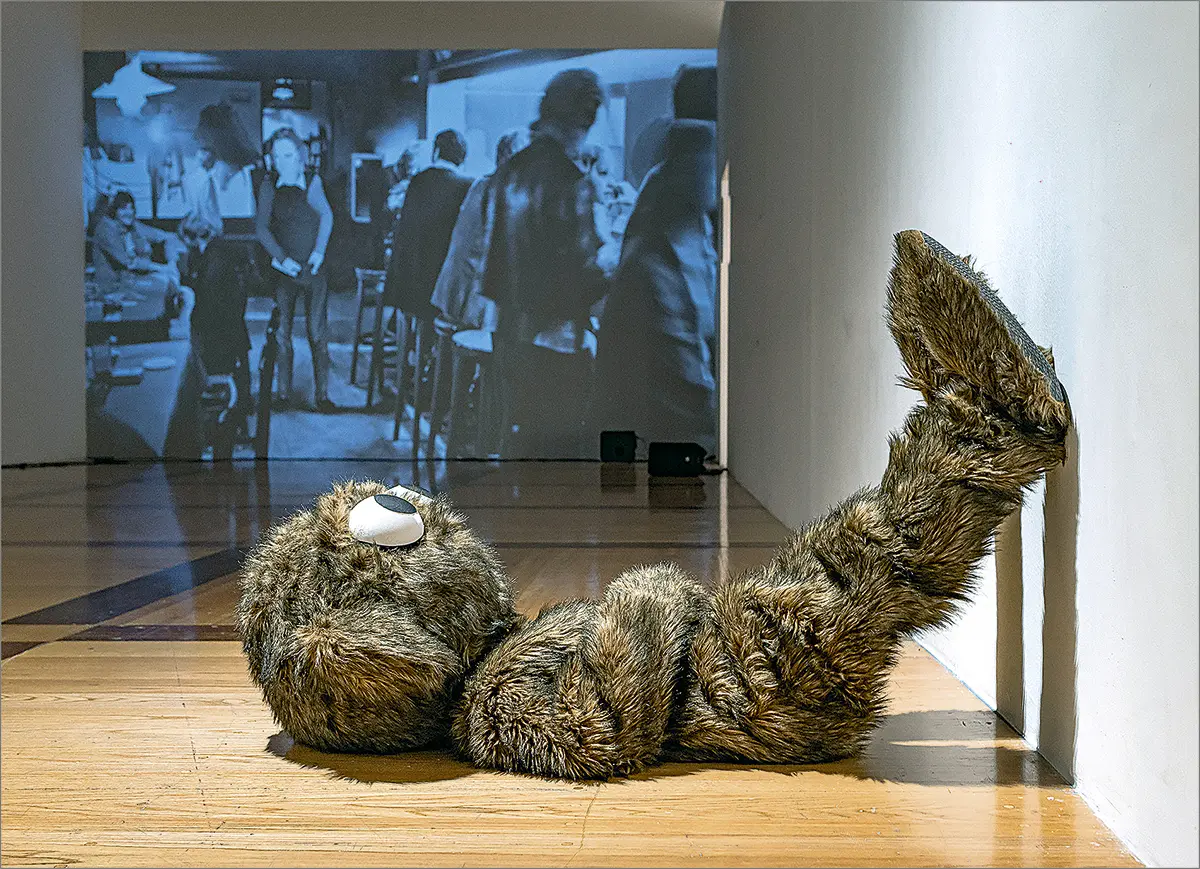
The Museo de Arte Contemporáneo presented La poética del regreso (The Poetics of Return), the first solo exhibition in Monterrey by Mexican artist Mario García Torres. The non-chronological retrospective was curated by Taiyana Pimentel, the museum’s Director. The main focus of the selection is an analysis of García Torres’ artistic practice, based on institutional critique and conceptual art.
García Torres was born in Monclova (Coahuila, 1975) and moved to Monterrey (Nuevo León) to study Art (UDEM, 1998). During 2005 he continued his studies in California, creating there his first conceptual work: What happens in Halifax stays in Halifax (2004-2006), a diorama with 36 photographs reinterpreting Robert Barry’s work from 1969, an exercise about shared secret and ideas. Thanks to a large extent to this work and to Open Letter to Dr. Atl (2005), a subtitled super-8 film, in 2007 García Torres was invited to participate in the Venice Biennale.
The show at MARCO is a powerful curatorial exercise on García Torres’ work, with Taiyana Pimentel’s three-part selection based on the following axes:
Dialoguing with the past: rethinking (art) history: Mario García Torres has demonstrated throughout his career a persistent interest in engaging with the past and with creations by other artists. Specific questions about the trajectories, actions, and biographies of standout figures of the modern and contemporary periods have driven him to reinterpret their works, directly interrogating aspects such as value, the historical moment, and the repercussions that probing those processes can have in the present. The dialogs in some of the items included in this exhibition reinterpret works by Alighiero Boetti, Bas Jan Ader, Dr. Atl, Mario Merz, and Robert Smithson, among others.
Returning (to) and retaking spaces: Included in this framework we can situate The Schlieren Plot, a video work where Mario García Torres reimagines projects that Robert Smithson planned in Texas but was never able to bring to completion. García Torres explores these spaces from the point of view of a gardener represented by his father, who also plays the role of a kind of substitute Smithson, initiating in this way a game that goes beyond Smithson’s works. The presence of this man brings into view Texas’ close relationship with Mexico, and it also situates itself in spaces that are not normally among those where gardening takes place. The arguments presented by the artist in the video are intended to show the ways in which Smithson’s incomplete projects were feasible and can be perceived in these spaces.
Exploring community realities: In his reflections, García Torres also takes into account the role that humanity has played as the cause of several negative scenarios. His project The Day Mankind Faded Away (undated) considers a fictional moment: the end of human existence. Set in a dense forest, a light-filled and enchanting location seemingly devoid of human contact, a series of recordings with archival images of the endangered monarch butterfly imagine the collapse of civilization. Questioning ideas of existence based on the presence of human beings is also important for assessing the past, and, even more significantly, the present we are living through. In another undated project, Falling Together in Time, the artist focuses his attention on simultaneous events that may not have been connected, yet feature several coincidences. With Van Halen’s son “Jump” as a soundtrack, it reflects about time and the parallel possibilities of perception in everyday life.
The importance of art history in everyday life, as well as the fragmentation of reality by loss, failure, unfinished projects, and above all, a powerful nostalgia for the past, are recursive topics in this exhibition. García Torres continuously connects possible media, depending on the artist’s resources based on different political and social situations, which are an important part of the divergent plots that can be appreciated in La poética del regreso.
ROCÍO CÁRDENAS PACHECO