As a co-organizer alongside the UNAM’s Museo Universitario de Arte Contemporáneo and the Instituto Zacatecano de Cultura, Museo Amparo had the poignant honor of hosting in Puebla the exhibition Trayectorias (Pathways), the last tribute made in his lifetime to the recently deceased Manuel Felguérez (Valparaíso, Zacatecas, 1928–Ciudad de México, 2020). First presented at the MUAC in Mexico City between December, 2019 and October, 2020, the meaning of the exhibition, originally conceived to celebrate Felguérez’s 90th birthday, was suddenly altered by the artist’s sudden passing. Felguérez was one of the few remaining representatives of his generation and retained a prolific vocation, imbued as he still was with intense vitality. Several videos included in the show attested to this and other well-known characteristics of his personality, such as his good humor, his great kindness, and his outstanding memory. We must remember that Felguérez figures among the most constant practitioners of the abstract arts that evolved in Mexico in the third quarter of the Twentieth Century as part of the Ruptura movement. Francisco Toledo and Gilberto Aceves Navarro had passed away the year before, and a year later came the turn of Vicente Rojo, all major losses for the Mexican art scene, not only because they were such towering figures, but also because they were all still producing both artworks and altruism. It is important to situate their departures in the context of the generational landmark they represented: Felguérez’s exhibition inevitably acquired new significance as perhaps the last show devoted to a Ruptura figure made with the artist still alive and present.
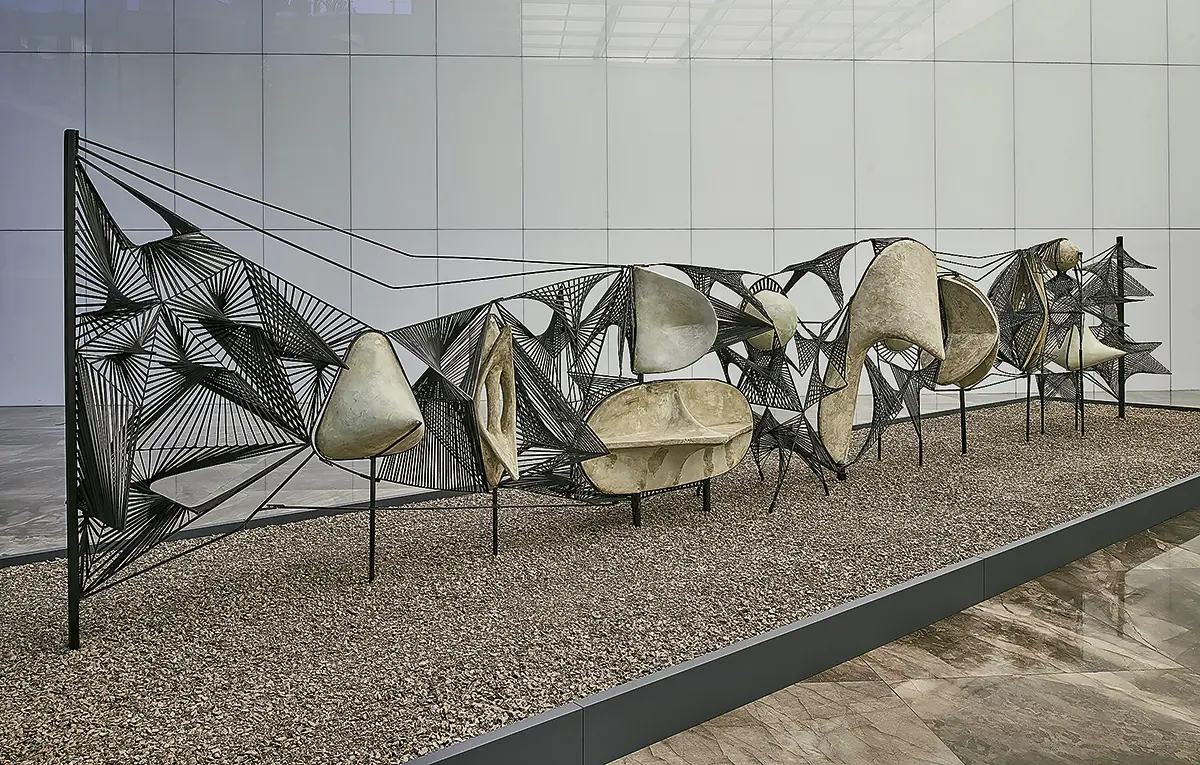
The 88 works of art in the exhibition at Museo Amparo’s galleries 1 and 2, which actually started in the lobby with two monumental sculptures from two distinct periods (a “fountain” from 1963 and a futurist suspended work from 2019), encompassed an evolving range of disciplines and techniques: small- and large-format painting, from the palette knife creations of the 1950s to the outsize gestural paintings in mixed technique of the most recent period; murals made in the 1960s using scrap materials, based on transporting a glass stained window and the recovery of a marine fragment restored by UNAM; documentation about collaborations for experimental theater and film; geometric graphics developed in the mid-1970s, first using mathematical patterns and later, computer art transferred in automotive lacquer onto canvas and onto three-dimensional versions; and, derived from the latter, models for public sculpture projects, some dating from the 1980s, that came to be realized already in the Twenty-First Century.
With the succinct curatorship of Pilar García—who directs the MUAC’s collection and who had recently organized an impressive recreation of the different editions of the Independent Salon, centered around figures of Felguérez’s generation—this solo show focuses explicitly on “three creative moments that signaled decisive turns in his artistic production.” These moments were Felguérez’s early pictorial and mural works, including the oft-exhibited En busca de la gaviota (Quest for the Seagull); his world-pioneering computer art projects, based on the systematization of drawing patterns explored in the series La máquina estética (The Aesthetic Machine); and late-period monumental works (to which excessive importance is perhaps granted, being reiterative pieces of lesser interest). The exhibition recovers additional projects, some of great significance, such as the performative-kinetic sculptures La fábrica de arte (The Art factory) and—but not only—La máquina del deseo (The Desire Machine), created for Jodorowsky’s 1973 film La montaña sagrada (The Holy Mountain), or La danza de los rojos (Dance of the Reds), one of Felguérez’s last canvases, immense and presented here alongside other large-format paintings from his late period. Although the show does cover a large swath of Felguérez’s career, it is erroneously presented as a retrospective: it is organized around key series, but omits other projects. His sublime murals in Venetian mosaic and gemstones, even earlier and less well-known, go unmentioned. The focus is exclusively on abstract works, which were certainly Felguérez’s main aesthetic interest, and this leaves out his incursions in the semi-figurative (which are, nevertheless, included in the co-published catalog, with testimonies in the artist’s own voice.) Equally missing is Felguérez’s most mechanical work, the Crisálida (Chrysalis), made in 2014 from a Volkswagen car. The exhibition does not engage either with Felguérez’s crucial philanthropic legacy as a founder of the Museo de Arte Abstracto, established in 1998. All this aside, however, this show does include a large portion of Felguérez’s oeuvre, thus providing a well-rounded account of his procedures, his motivations, and his style.
It is fortunate that the exhibition and its itinerant project were able to continue during the pandemic, a doubly admirable effort given the sanitary restrictions that came on top of a preexisting crisis of public museums at both the federal and the state levels, paralyzed by disappointing cultural policies that neglect their budgets and disdain the arts. In Mexico’s current museum landscape, the MUAC and Museo Amparo prove that this type of project may only be viable in University museums, private spaces, or mixed trusts. The UNAM, to which Felguérez donated his archives, and Museo Amparo were in that way able to put together a solemn retrospective.
IÑAKI HERRANZ