“Open Archive: Luis Villamizar” is a very special exhibition in the framework of the Abra-Caracas Gallery’s “Archivo Abierto” (Open Archive), a project that aims to advance the knowledge and dissemination of pioneering conceptualism in Venezuela, as well as the historical roots of trends that privileged artistic thought processes over their completion. Prior to this show, the gallery presented editions of “Open Archives” dedicated to Carlos Zerpa, Pedro Terán, and Maruja Rolando. The central goal of the project is to accentuate reflections on the complex interaction between exhibition discourses, archives, documents, and the public, in order to reveal a form of knowledge that has been relegated to almost invisible, empty spaces. This compels visitors to change the focus of their gaze within an exhibition and to dwell on the works of art for longer than normally foreseen. The exhibition works as a self-critical artifact for understanding contemporary processes, their history, and memory. The archive acquires a poetic and transgressive force that surpasses its documentary function and all conventional models of approach to the work of art. The exhibition becomes a space for research and production of knowledge; a living place for ideas, revealing the inner workings of the artist’s thoughts and abandoning the neutral character of the traditional exhibition room. The curatorship this time was in charge of the Silva-Zarins team.
Luis Villamizar (Maracay, 1947) developed a discreet and little-known, but very interesting and experimental body of work that includes ephemeral installations, actions, photographs, Super-8 films, videos, and installations. He belongs to the meaningful generation of Claudio Perna, Pedro Terán, Carlos Zerpa, Héctor Fuenmayor, Yeni & Nan, Diego Rísquez, Antonieta Sosa, and Eugenio Espinoza. At the beginning of the 1980s, in New York, he had a show with Marta Minujín, Ana Mendieta, and Liliana Porter. The present exhibition functions as an articulating axis for this artist’s language, deployed to explore critical perspectives on social problems, scientific theories, and the relationship with nature and landscape, but also as a narrative that reproposes the value of the archive as a methodology for the recovery of memory in a country that cares little for its value. He de-fetishizes objects by permanently juxtaposing documentary materials, photocopies, and reconstructions. The show is assembled in fourteen sets of intervened photographs and photocopies dating from 1974, which reveal the artist’s concerns with understanding the body, nature, and ecological and urban processes during a historical moment when Caracas was being transformed by the construction of the subway and other buildings.
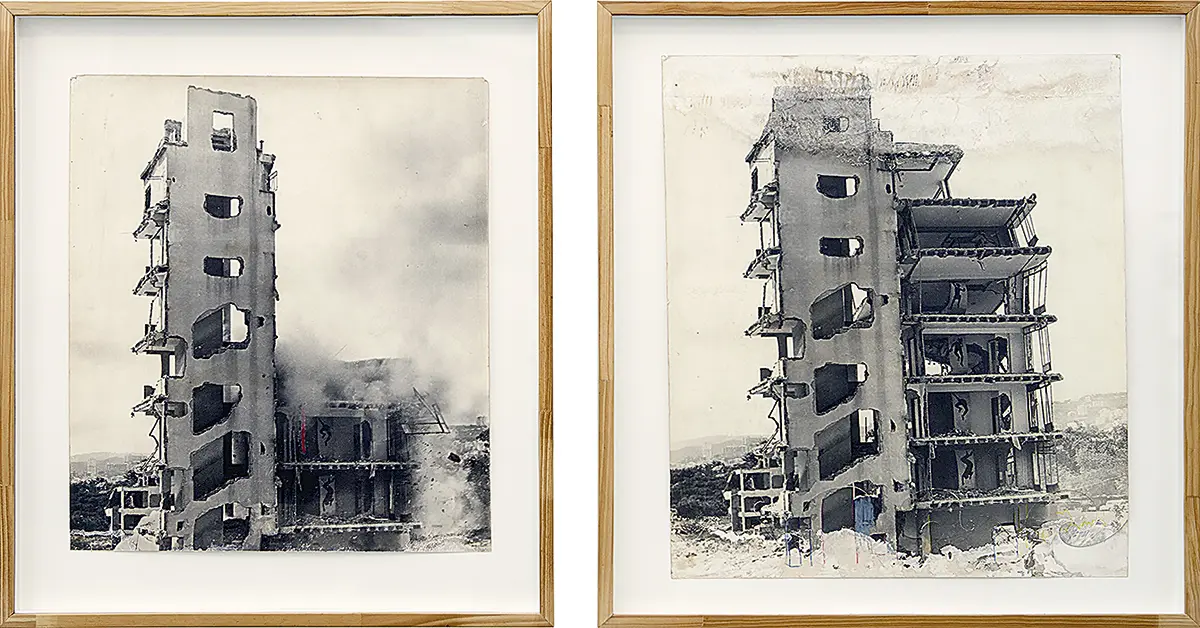
With Guías perdidas en los Médanos de Coro (Lost Guides in the Médanos de Coro), from 1976, Villamizar addresses the fragility of existence and the force of nature that devastates and buries. Suicide registers a leap into the void and a pictorial action at a building in demolition in Caracas, where he reconceptualizes the theme of death and reveals an underlying sense of humor. The Faces series are photocopies in motion that introduce the use of ephemeral materials to capture facial movements. Spiral of Leaves in Colonia Tovar follows the tradition of landscape interventions, delving into the fragility and transience of nature. The Great Leap, from 1982, records an action in New York, where he resided for some years. The videos in the room register actions and interventions in the streets of Caracas, such as the recyclable landscapes of the Cartoneros de Bello Monte, from 1976, and the sound sculpture Tal día como hoy (On a Day Like This), from 1977, for which he integrated sounds hidden between garbage bags scattered in the street. In these works, he explored the idea of how urban space conditions and is conditioned by the practices of the bodies that inhabit it. Shhh (1978), a film revolving around the urban fantasies, daydreams, and hallucinations of a peasant affected by chewing tobacco, was also screened here. Additionally, three showcases displayed about fifty documents, testimonies, projects, letters, records of actions, texts, catalogues, photographs, press articles, pages of publications with critical essays, and posters, allowing the viewer to reconstruct his early period as an artist. In his works, one can establish networks of meaning between nature, science, and art. He energized space and its connections with the universe. They are intelligent and thoughtful works, without pretense of monumentality, but of enormous conceptual force. He attempted to create a multi-temporal construction of history and works that do not care for artistic disciplines, but instead opt for new exhibition narratives where photography and documents resignify their importance.
We could view this exhibition as the tip of a much more complex iceberg, which has its roots outside the exhibition space, in the molecular interactions occurring at its edges and between the gaps of the artists’ thought processes, doubts, and innovations. A type of project that allows access to the internal paths of the creative act, its contradictions and advances, and to trace approaches to the research and reflection on the origins of contemporary art.
MARÍA LUZ CÁRDENAS