“Art in America” is a solo show by Luis Salazar, an artist with a long career in the Venezuelan contemporary art scene and who has always contravened the legitimated foundations of art through an aesthetics of rude conception and expression.
The present exhibition consists of around thirty works, including paintings, drawings, photographs, objects, and installations, recently made and grouped into thematic axes. The artist proposes a reading of art’s current situation, territorial relations with Latin America, commercialism, stereotypes, criticism, and theory. His technique involves the use of waste materials and found objects, which he does not mask, but rather exposes with irreverence and provocation, breaking away from any artistic principle of neatness.
The first works we see are the painting Tucy and a digital device showing a photographic sequence of improvised installations in the street, executed with found objects to metaphorically reveal the decadence of mass culture. The triptych entitled Contemporary Art Map Party Mix, shows a mapping or “mix” of the current cultural context. Through puns, he makes ironic connections with art systems, movements, galleries, cities set up as art centers, and collectors. Much like the North American artist Steven Parrino, he removes parts of the pictorial canvas in order to accentuate its absences within his sketched panorama.
The show also alludes to Brazilian concrete art, with paintings that refer to some of its most relevant practitioners, such as Lygia Clark and Hélio Oiticica in dialogue with Gego, Cruz-Diez, and Alejandro Otero. In these paintings he writes their names, sarcastically signaling their contributions as formulas without innovations. At the center of this room, an installation of stones and objects, arranged in a row and linked with a ribbon, simulate the dependency and uniformity of a system that does not allow for dissonance.
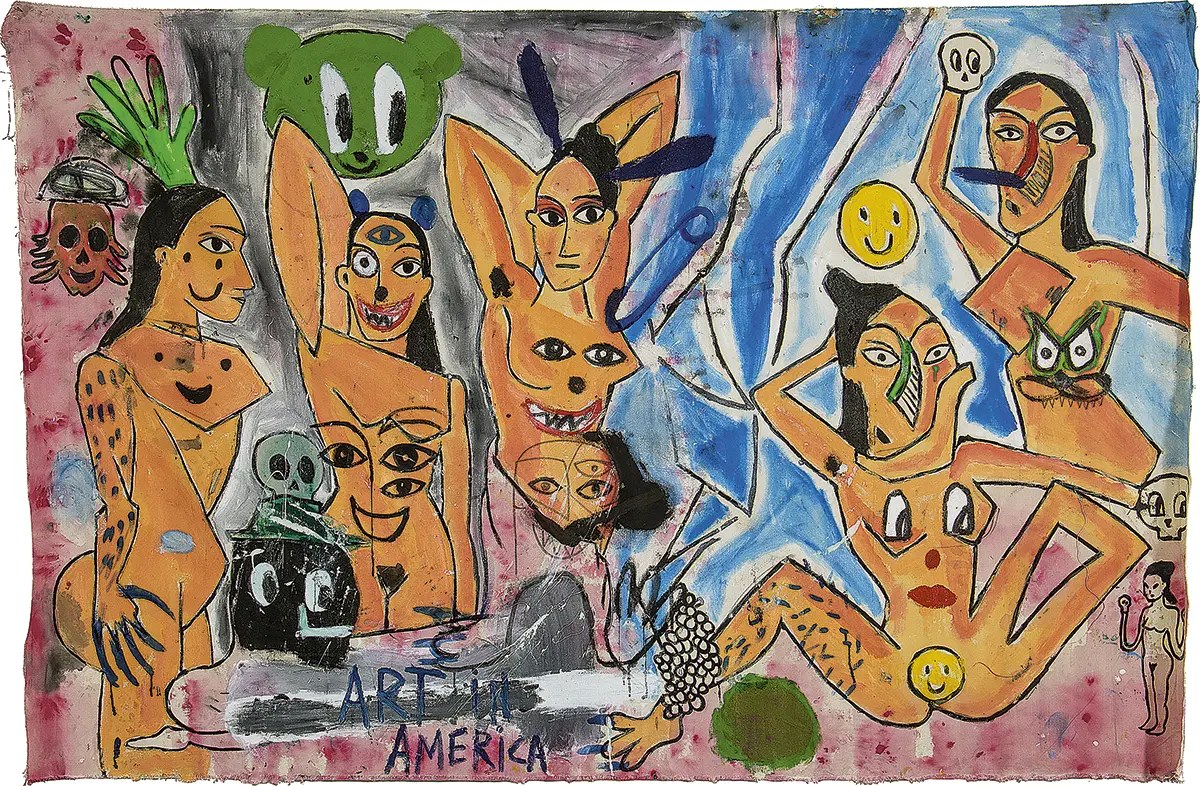
He also portrays art critics Arthur Danto and Dave Hickey in a couple of paintings, scathingly praising them as superstars. The “Modernismos” series includes Modernism 2, an acrylic on canvas that reinterprets Picasso’s Demoiselles d’Avignon by exacerbating the composition with Pop-like aesthetics and symbols with which the Americas are usually identified, such as skulls, sensuality, and joviality. Next, an installation of found objects and drippings contrasts technology with the chaos of everyday life.
In another group of paintings, he constructs an unreal situation between Sol Lewitt and Günther Förg, creating a cross between abstraction and minimalism, and replacing the usual chromaticism in the works of these artists with stains on the black and white scheme. In Eugenio Espinoza Has No Light, from the “Espinoza” series, he reinterprets the grid, a key element in the work of this Venezuelan artist, as a way to break with the established discourse around space and light.
Towards the end of the exhibition space, Salazar focuses on geometric abstract art with pieces made from scraps of boards placed on a row of concrete blocks. He thereby unravels the rigorous attention to formal structures in order to disparage the high importance given to this trend. At the same time, this piece constitutes a kind of documentary catalogue. In the last room he evokes Greek art in paintings of emblematic figures of that period. One example is Fendi, in reference to the prestigious fashion brand. Here a female figure is presented as a symbol of banality, acrobatically reduced to an image of entertainment. The last installation is made with a mattress-as-container for unloading his concerns and reflections, and everything that he questions: beauty, the function of art, the role of the artist.
With his well-recognized ability as an urban archaeologist and connoisseur of history, Salazar passionately aims to shake the fabric on which cultural and artistic thought is sustained. His findings, objects, and ideas are artifacts that carry a complex load of information and meanings. By placing them in dialogue with each other, and transposing, dispossessing, and dissociating them, he exposes their inconsistencies. He doesn’t remain on the edge, but journeys all the way to the other side with inciting cynicism. In this sense, his work returns to the canon only to destroy it. He triggers a dismantling of both image and discourse with a primitive and relational slant that highlights the decadence of what is widely considered pertinent and valid.
ANNY BELLO