The history and the present of California, like all those in the modern world, cannot be thought without considering the colonial massacre and its sequels. A vast land of rivers, deserts and mountains on the Pacific coast, the peoples that had been its earliest inhabitants were violently absorbed into the Viceroyalty of New Spain after the “invention” of the Americans in the Sixteenth Century. Many died due to the epidemics and ailments imported with the Conquest, and the free exercise of their cultures, languages, and modes of relating to the spiritual world were abruptly destroyed. With Mexico’s independence in 1810, California became part of the new nation, which secularized the misiones and turned their buildings into historical monuments. Migration processes from Asia continued, while Russia attempted to instate a new colonial moment based on the industrial sector. Later, with the US intervention in Mexico in the mid-Nineteenth Century, a large portion of the Mexican territory, including California, was annexed to the new empire of the north, which José Martí denounced using the figure of the tiger as it gave rise to a new colonial period for a land of long memory. Yes, the land, seen from the border, has a memory of its own, and the exercise opens the way for the creation of pasts and presents committed to a more just world.
The LA-based Chicana artist and muralist Judy Baca, whose work is now on exhibit in her first retrospective at The Museum of Latin American Art (MOLAA), in Long Beach, California, has reminded us of this in a career spanning more than forty years. And this is also what the Chicana writer Gloria Alzandúa had in mind in the early 1990s, when, underscoring the potential that the relationship between Chicano art, the borderlands, indigenous peoples, and people of color have to challenge and confront assimilation and US imperialism, she cited Baca to explain that “Chicano art comes from the creations of the community and represents a singular position that is always connected to the issues of its time.” It doesn’t come as a surprise, then, that the first retrospective of an artist who has so dynamically reconceptualized the notions of public art, muralism, feminism, and race, is titled Judy Baca: Memorias de Nuestra Tierra, a Retrospective.
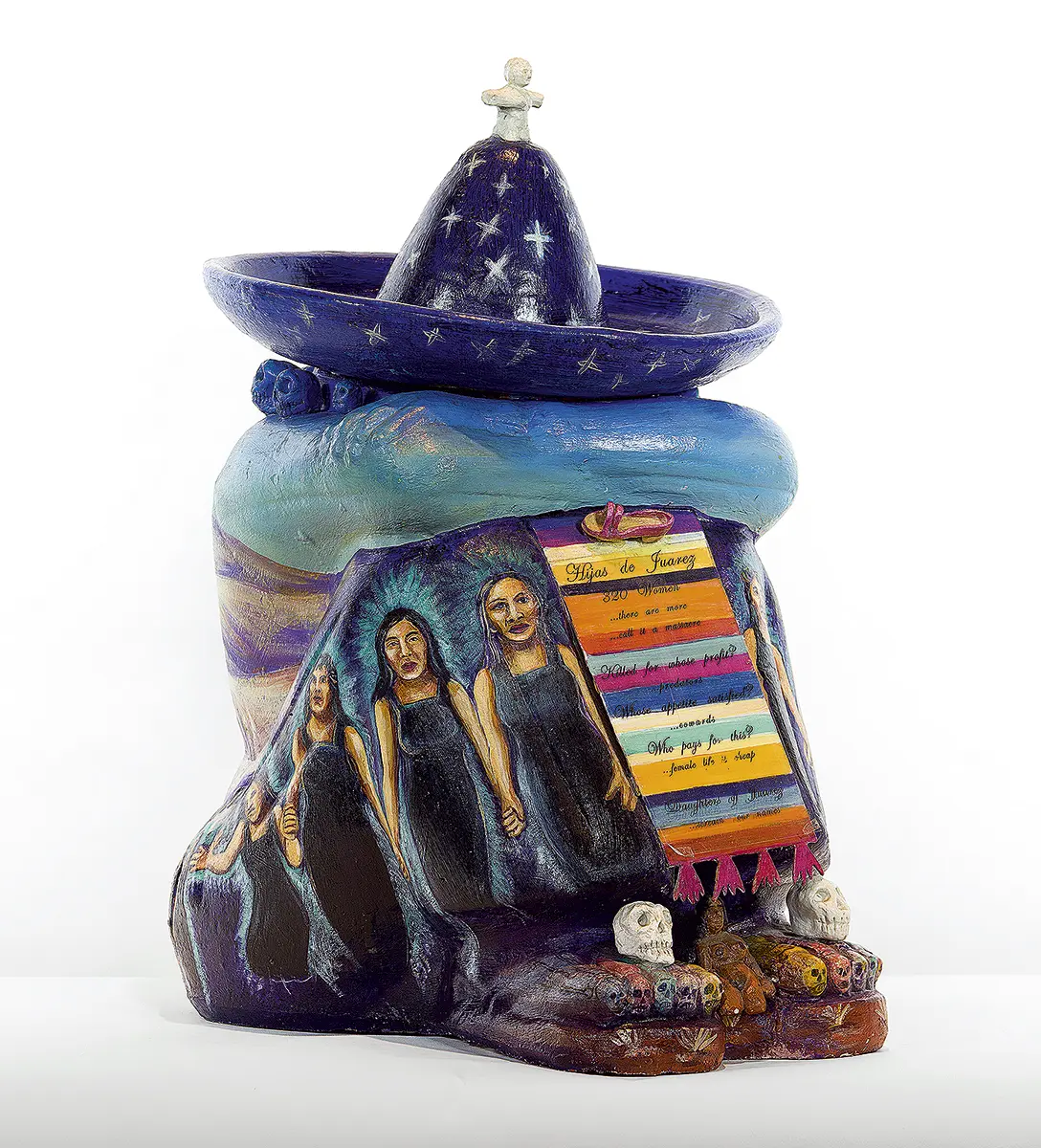
Open to the public since July 14, 2021 and organized by Gabriela Urtiaga, MOLAA Chief Curator, and Alessandra Moctezuma, who teaches Fine Arts and Museum Studies and directs the Mesa College Art Gallery, the exhibition, made possible in part by support from such institutions as California Humanities, the National Endowment for the Arts and the Pasadena Art Alliance, is divided in three thematic sections that, although interconnected, focus on different aspects of Baca’s artistic production. Gallery A features feminist works that celebrate the role of women in various anti-imperialist struggles and in the creation of decolonial cultural imaginations related to the land, bringing to the fore important aspects of the artist’s personal experience with regards to issues of gender, sexuality and power. We see, for example, the influence of Baca’s indigenous-Mexican grandmother on her way of understanding family ties, art, and life. As Urtiaga writes to explain the MOLAA’s recent acquisition of the mural When God was a Woman (1980/2021), “Baca’s abuelita, as she often recalls, was the matriarchal figure that motivated her to follow her dreams... even to dream with the impossible.”
Gallery B features public space murals created by Baca in collaboration with the Social and Public Art Resource Center (SPARC), an artistic community she established, headquartered in Venice. The works on display here underscore the presence of women and of non-hegemonic subjectivities in the creation of large-scale murals in the greater LA area, as well as the role played by collectivity and radical pedagogy in the creation of images about the present and its memory. Including the canvases for the monument to César Chávez at San José State University along with reproductions and sketches of the Guadalupe murals, this section also features a digital version of Migration of the Golden People. The latter work, created in 2003 at the Central American Resource Center (CARECEN), depicts the massive migration flows from Central American to the Pico Union district in Los Angeles, drawing attention not only to the military terror that was designed for the region during the Reagan years, but, also, the migrant’s determination to resist as a community. On the right side of the mural, for example, we see a young woman carrying her daughter as she walks. Her chin held high and her faraway gaze symbolize her will to achieve a different world, one that will not allow itself to be assimilated or defeated by capitalistic, imperialist homogeneity, represented by three soldiers from the Contra organization trailing her. The young woman’s march, like that of the other migrants, also resists the willful forgetting of those who openly condemned violence in El Salvador, like Monsignor Romero, killed in 1980 for, as Enrique Dussel put it, practicing Liberation Theology. In Migration of the Golden People, Romero’s face is represented in a placard carried by the masses in their march, bringing to light the memories of a land that is hemispheric, collective, and does not remain silent even as it marches in silence.
Lastly, Gallery C focuses on Baca’s best-known work, The Great Wall of Los Angeles, using videos, sketches and texts dynamically organized in the exhibition space to show the mural’s creation process and its layers of meaning. Located in the San Fernando Valley and started in 1974 in collaboration with more than 400 youths affiliated with SPARC, in its half-mile length (800 meters) the moral tells a story that begins with indigenous life before the invention of the Americas and includes the forced extraction of Asian labor, the deportation of Mexican-Americans, and the struggle for the right to work by women activists like Guatemalan immigrant Luisa Moreno. In this way, Baca and SPARC highlight the central role played in Los Angeles by indigenous peoples, Afro-descendant cultures, Asian, Armenian, And Latin American diasporas, and, of course, the Chicano world, all from a pluralistic feminist point of view.
The exhibition Judy Baca: Memorias de Nuestra Tierra is not only a key contribution to our understanding of the work of an artist whose art, activism, and pedagogy have for over four decades imagined alternative modes of conceiving feminism in connection with race, coloniality, and the Chicano and Latino identity. It also invites us to understand muralism beyond its historical expression, connecting it to an activist, always-ongoing practice taking place at the encounters made possible by the borderland between decoloniality, collectivity, solidarity, and, of course, liberation.
FLORENCIA SAN MARTÍN