In his diverse and extensive production, Juan Fernando Herrán maintains a central interest in the way human beings relate to each other, to their surroundings, and to their culture. His multiple projects, preceded by rigorous investigations, reveal an archeological pursuit that allows him to analyze material vestiges from his explored contexts.
One of contemporary art’s fields of research has to do with material culture, since it intervenes in unusual spaces, far beyond the artist’s daily surroundings. Interest is piqued by new places and communities that become spaces to explore, assuming that objects define the material dimension, which allows for the observation of how spaces are inhabited and how habits are built.
What are the practices and objects that mark the tangible dimension of these cultural spaces? Spaces where activities, forms of knowledge, and social customs can be detected. How can the observer occupy sites that are not part of his material culture, but do constitute alternative ways of producing it?
“Leve y emergente” (Light and Emerging), Herrán’s latest show, is located in that line of inquiry. The project began as a grant given in 2014 by the Prix Pictet, an important international photography award that organizes a yearly show and edits a book of the selected works.
Juan Fernando Herrán described his objectives: “Leve y emergente’ underlines the need to establish intimate and significant relations between the immediate context, its natural conditions, and its resources in order to conceive, engage, and build structures and objects that engage human beings with the world. A significant exchange must therefore exist between the physical milieu and the need to lean on it to solve basic necessities; at the same time, what becomes established is a culture that responds to the interaction between material and spiritual needs, so that the urgency of creating practical schemes does not point to a conquest over reality, but is rather a testimony of creativity and beauty.”
Four regions of the Colombian territory were chosen to be explored and photographed between 2015 and 2019. They are: Sibundoy Valley in Putumayo; Río Verde de los Montes and Río Verde de los Henaos, in Northeast Antioquia; Sierra Nevada de Santa Marta, and Upper and Middle Guajira. Four geographic areas with distinctive characteristics allowed him to reflect on different communities that have occupied and built their environment in diverse ways. Material cultures—the capacity of groups of inhabitants as diverse as the indigenous communities of Sierra Nevada to use the resources offered by their natural surroundings, notably wood as building material in the towns of Antioquia, as registered in La capilla (The Chapel, 2019)—testifies to the complex social fabric that populates Colombia.
In these photographs we can appreciate the conditions that constitute the focus of Herrán’s interest: how space is inhabited and with what materials. Environment and materiality reveal the beauty that can be found in ways of life which can be simple yet symbolically charged.
The photographs don’t just document the habitats; the main focus is the emblematic value of the objects used, whose meaning goes much further than whatever function they may play. The images make visible the capacity of diverse communities to know and inhabit their spaces, making the most of the materials that surround them.
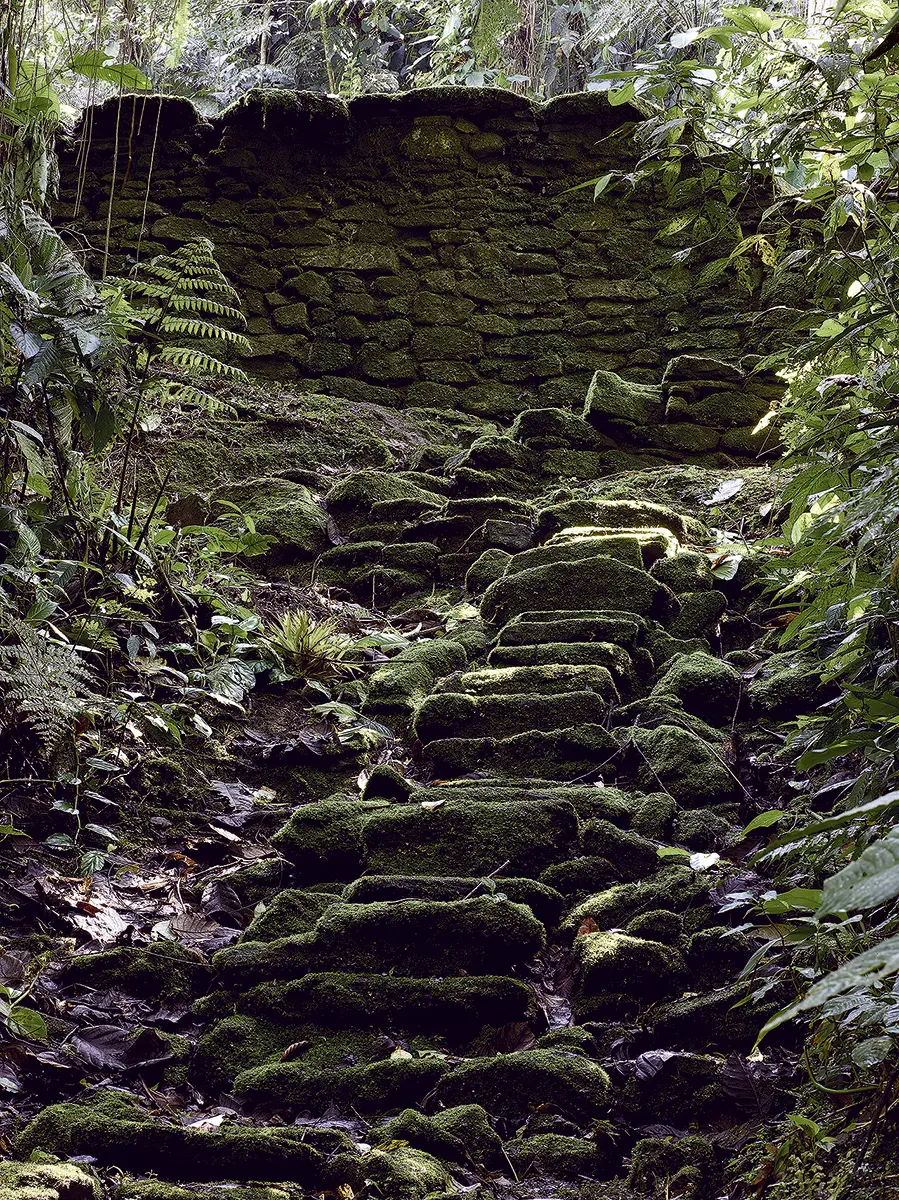
Certain images portray areas of Sierra Nevada de Santa Marta, a pyramid-shaped mountain in northern Colombia and home to four indigenous peoples with kinship ties to each other. These communities, inserted in their territoriality and with a particular relationship with nature, share the responsibility of preserving the necessary balance between nature and its occupants. Photographs such as Ascensión (Ascension, 2016) and Lajas (Slabs, 2016) record the environment and highlight the aesthetic value that Herrán gives them. The formal aspect and the materials with which the image is constructed allow us to recognize a significance that goes beyond any purpose one might initially give it, and the artist’s interest in sculpture is made visible in the emphasis placed on shapes and volumes of stairs and stones.
The concept of space from an artistic perspective can reflect other aspects of the complexity of cultural development, such as play. Futurama (2015) records the construction of a space made with various found objects that reconstruct ways of living, which in turn refer to architectural models in La Guajira. On the other hand, in Segunda piel (Second Skin, 2016) a group of children play a game of hide-and-seek.
The photographs in this exhibition constitute a small selection from the much larger series produced by Juan Fernando Herrán in his travels throughout the aforesaid regions, exploring the traditions of various communities, in order to discover the material culture and symbolic value enclosed in these spaces and in the objects that populate them.
IVONNE PINI