
Without mistrusting man, the birds looked at the intruders in amazement or confronted them without suspecting their own disadvantage, only to be immediately struck down by an unerring blow. José Luis Alonso Marchante
When discussing the condition of non-human animals as moral subjects, one criterion—says philosopher Peter Singer—is to determine whether animals feel or not; if they are capable of suffering and enjoyment. While many question these theories by rolling their eyes, Singer makes a reasonable argument when he asserts that if we feel it’s wrong to inflict pain on a human infant for no compelling reason, then it has to be just as bad to inflict pain to a horse for no reason.
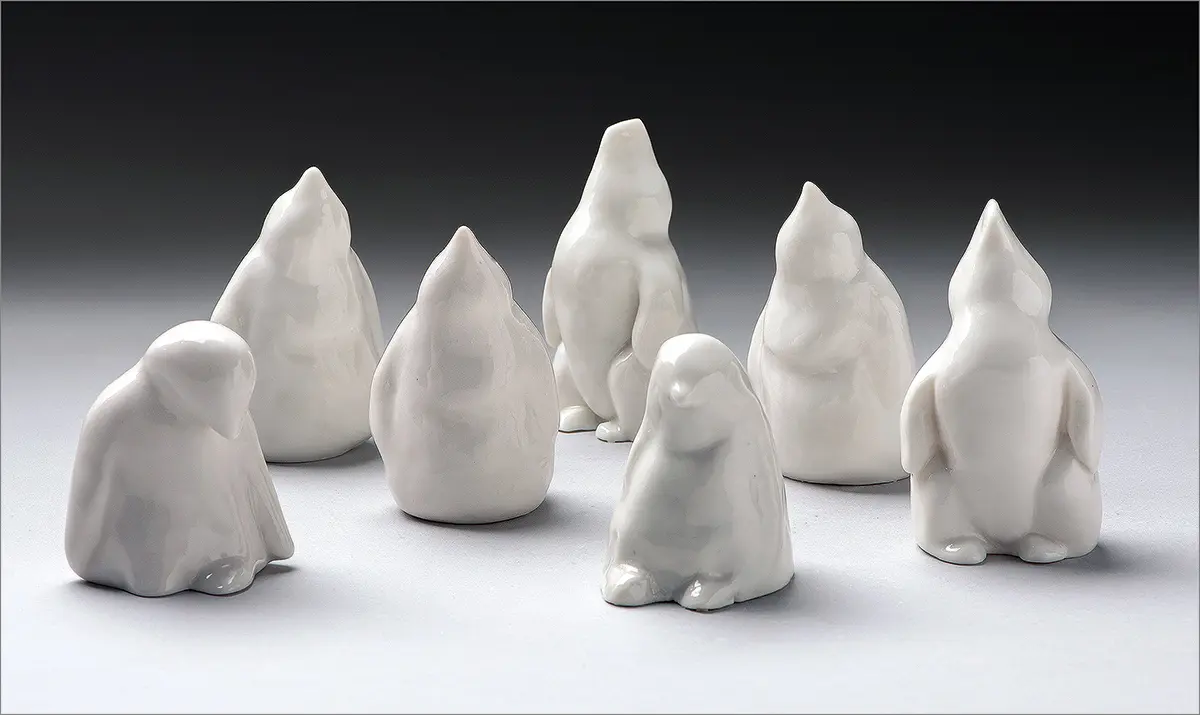
Today, in the so-called Anthropocene, when environmental philosophies have made us more aware of the insane impact of human societies on the planet, a slaughter as heartless and predatory as the one that took place at the end of the 16th century in Chilean Patagonia takes on a much more tragic meaning, if that is possible. Anchored in Port Desire, the English captain John Davis and the crew of his ship Desire killed 20,000 penguins and seals, a number that obviously far exceeds the goal of consuming them for sustenance. This fact is narrated by Alonso Marchante in his book Menéndez, rey de la Patagonia (Menéndez, King of Patagonia), where he discusses the “civilizing” actions of Europeans in America and focuses on the behavior of José Menéndez at the southernmost tip of Chile.
Josefina Guilisasti’s exhibition “El mar se viste de pluma y el hielo se pinta de rojo” (The sea is covered with feathers and the ice is painted red) alludes to this brutality. Its title personifies nature: the sea is dressed with the feathers of slaughtered penguins, and the expansions of ice, like a blank canvas, are painted with the blood of this tale.
During her career, the artist has developed an extensive series of paintings, and only in recent years has she tried to distance herself from the pictorial act. She has succeeded without ceasing to be a painter. For example, in the video Free Fall (2018), Diaguita ceramic vases are broken into a thousand pieces, staining in slow motion all the surrounding space with the colors of their powdered clay. In her current exhibition at the Lucía Mendoza gallery in Madrid, painting is still important, albeit in a more conceptual way (although the artist also includes several of her previous still lifes), similarly to what happened to the Brazilian artist Hélio Oiticica, who, despite having ceased to paint in order to experience his Tropicalia phase or subsequent projects such as the Bolidés, the Parangolés, and the Penetrables, painting guided his work in every stage.
Likewise, Guilisasti creates three scenes with small porcelain figures in this exhibition—The Arrival, The Massacre and The Revenge—where the color-space-time triad is very present. The fact that the figurines are white is a pictorial decision that the artist has been exploring at the core of her works and which she associates with various historical issues related to economic and symbolic themes. At the same time, each static scene tells us about a territorial and temporal space where movement has occurred; one could speak of an imaginary cinematic notion, which appears to be silent, but screams deafeningly.
Presenting antagonistic moments in the story it narrates, from nature in its splendor in The Arrival to death’s putrefaction in The Revenge, each scene deals with decolonial discourses that take us from the past to the environmental crisis of our times, when power makes decisions as cruel and crude as those made by John Davis. It is enough to see the Amazonian reality under the government of Jair Bolsonaro, or, without going farther than Chile, the refusal to legally declare a territory in the Third Region as a natural sanctuary in order to personally benefit the family of the President of the Republic through the sale of a project, in a “tax haven”, which will exploit this land for mining purposes.
The curator of “El mar se viste de pluma y el hielo se pinta de rojo,” Christian Viveros-Fauné, points out that the exhibition clearly addresses the need to raise awareness about “the evolving ecological emergency caused by humanity’s incessant devastation of nature.” This crisis we are experiencing, which has no return, is modifying livelihoods, changing economic priorities, and fostering our inability to foresee any future. The overuse of the planet and industry’s desire for economic success have led us to a cinematic place, like Guilisasti’s scenes, where the time to turn back has now elapsed.
Incidentally, dead penguins transported on the Desire gave birth to maggots that killed almost the entire crew.
ALEXIA TALA