Jose Dávila‘s work to date can be partially characterized as a poetic and cerebral exploration of materiality. Stone, concrete, wood, glass, and metal are just some of the media he transforms into intriguing and elegant sculptures and installations that engage the phenomenology of space and the viewer’s relationship to it. Even when Dávila works two-dimensionally, his imagery and mark-making is as much about the world beyond his art’s formal parameters as it is an interrogation of its internal dynamics. But adding to Dávila’s deft métier is a plethora of engaging subject matter too, which all exquisitely manifest together in his solo exhibition titled The Circularity of Desire.
The exhibition is oriented around the iconography of the circle and, according to the artist, how it’s been art historically explored in the last hundred years. Consisting of paintings, sculptures, prints, and cardboard silkscreens, the circularity thematic is further complicated by the qualifier of desire. Spread over three galleries, the first impression of the exhibition is that it is a group show. This observation is not a perception of it as lacking artistic coherence but rather exemplifies the ease by which Dávila can work in diverse formal registers. In fact, Dávila also operated somewhat as curator, for the installation design was authored by the artist himself.
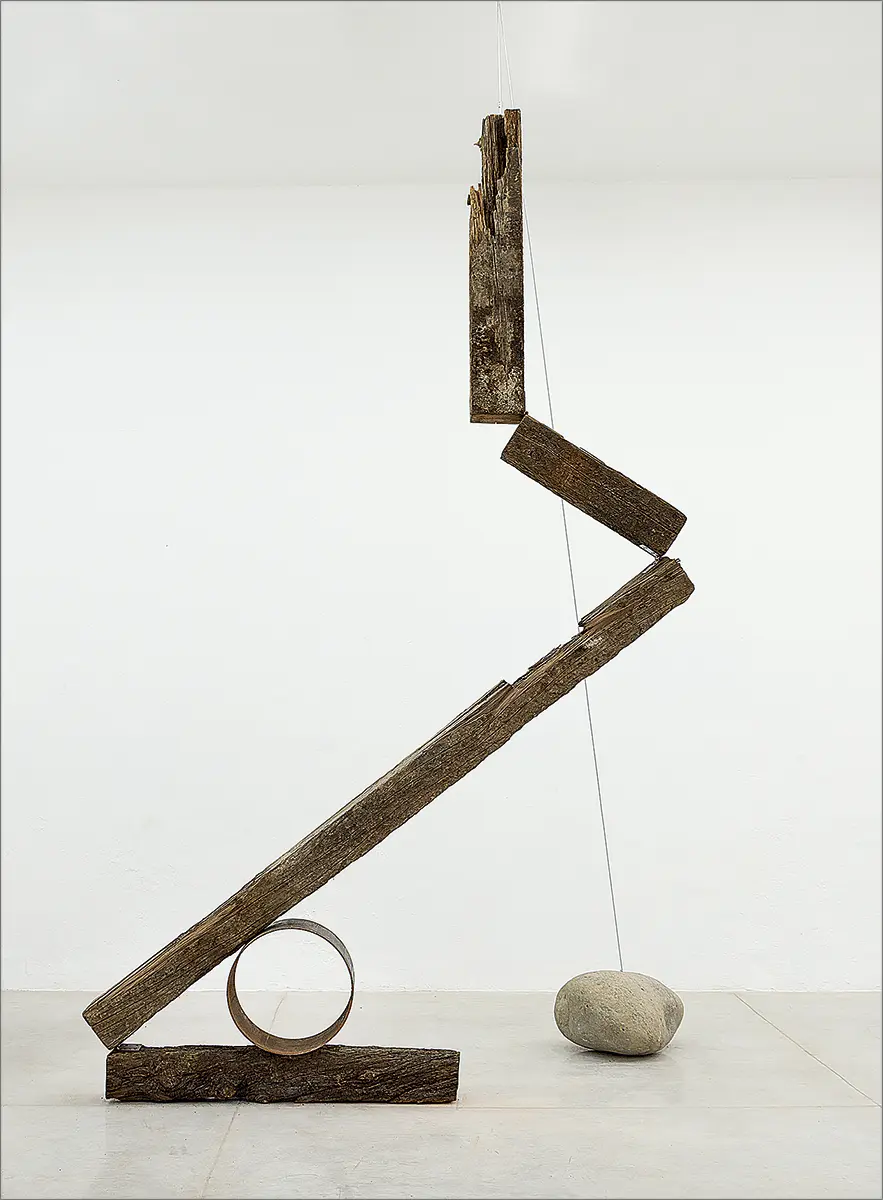
Upon first entering The Circularity of Desire, one encounters Untitled (the fable of the apple or an explanation waiting to happen) (all works 2021). This sculptural installation consisting of a rock placed on the floor that connects to a cast-bronze apple via wire suspending the latter from the ceiling, is more than reference to the Surrealist René Magritte or Isaac Newton’s famous apple that triggered his study of gravity. For one can see these as also respectively symbolizing dichotomies of irrational/rational and the subconscious/conscious mind. The broad purview of meaning inherent in this work paradoxically resides in a reductive aesthetic. Because as is often the case with Dávila’s three-dimensional work, by paring it down almost as if it was a post-Minimalist strategy, he achieves maximum narrative possibilities. This is also evinced in other sculptures and installations in the main gallery as well. As one enters the larger, main exhibition space artworks tend to dialogue with each other in ways that would make any curator envious. To the immediate left is the totemic The old tree is worth keeping after all. Using wood, metal, wire, and a boulder, the title alludes to a phrase in an Aesop fable titled The Peasant and the Apple Tree in which the tree is saved from being axed by the peasant because it’s revealed to contain bees and copious amounts of honey. Like the fable, Dávila’s wood is imbued with abundance albeit of a social variant rather than from nature; for it originally functioned as part of an old train track which brings to the sculpture its previous context making it more nuanced and polyvalent. Although the other sculptures in the exhibition share an aesthetic affinity that is stylistically Dávila, they have a formal and conceptual logic unto themselves. Ditto with Dávila’s two-dimensional work.
In the larger gallery are also richly polychromatic large-scale paintings consisting of recognizable motifs from Sonia Delaunay, Frank Stella and other iconic modernist artists that are intermixed with passages from books regarding the perception of light. These lush and monumental canvases of imagery and texts are strong contrast to the sculptures’ physicality and material presence. Citation of art history is also intrinsic to another gallery exhibiting a series of prints that reference Roy Lichtenstein’s corpus of paintings that he made in 1965 titled Brushstrokes. But like the paintings and to a lesser degree the sculptures, Dávila’s thematic associations to art history are less appropriation as they are re-contextualization of the past into a wholly different narrative dynamic. There is no doubt that Dávila’s works are not visually dissimilar to Lichtenstein’s; however, the former are prints, while the latter are paintings. Thus, there is an aspect of Walter Benjamin’s mechanical reproduction thesis to the prints, but the laser-cuts are also not far off from Dávila’s Mexican heritage and its highly recognizable folk tradition of papel picado or perforated paper. While the show in one sense is rife with cultural signifiers, that aspect of Davila’s identity does make its way into the cardboard silkscreens. Here, the works are intimate in size but exponentially loom large in their formal and conceptual complexity. Consisting of torn cardboard from a myriad of packaging from Mexico and U.S.A., transnational politics are atomized in silkscreens of precise spherical designs in diverse colors articulating too the gist of the show: that the circle is the sine qua non of modernist art but also that it is endemic to human history when circularity is synonymously expanded to symbiosis and reciprocity.
RAÚL ZAMUDIO