
The year 2022 will mark the 100th anniversary of the Semana da Arte Moderna, the Modern Art Week that so stirred the cultural scene in São Paulo, which up to that point had remained rather subdued as all effervescence concentrated in Rio de Janeiro, Brazil’s federal capital. Many museums are already paving the way for the commemorations with shows by representatives of Brazilian Modernismo. Last July, the Pinacoteca do Estado de São Paulo inaugurated a retrospective of the Swiss-born, Brazil-based artist John Graz. After studying architecture, drawing, and decoration in Geneva and Design and Advertising in Munich, Graz moved to Brazil in 1920 and married Regina Gomide, also an artist. They are considered the importers of Art Decó in the country, alongside Regina’s brother, he painter Antonio Gomide. Participating in a milieu that included intellectuals and artists like the critic Sergio Milliet and the writer Oswald de Andrade, Graz joined the modernist group and took part in the 1922 Semana events at the São Paulo Municipal Theater, with seven canvases.
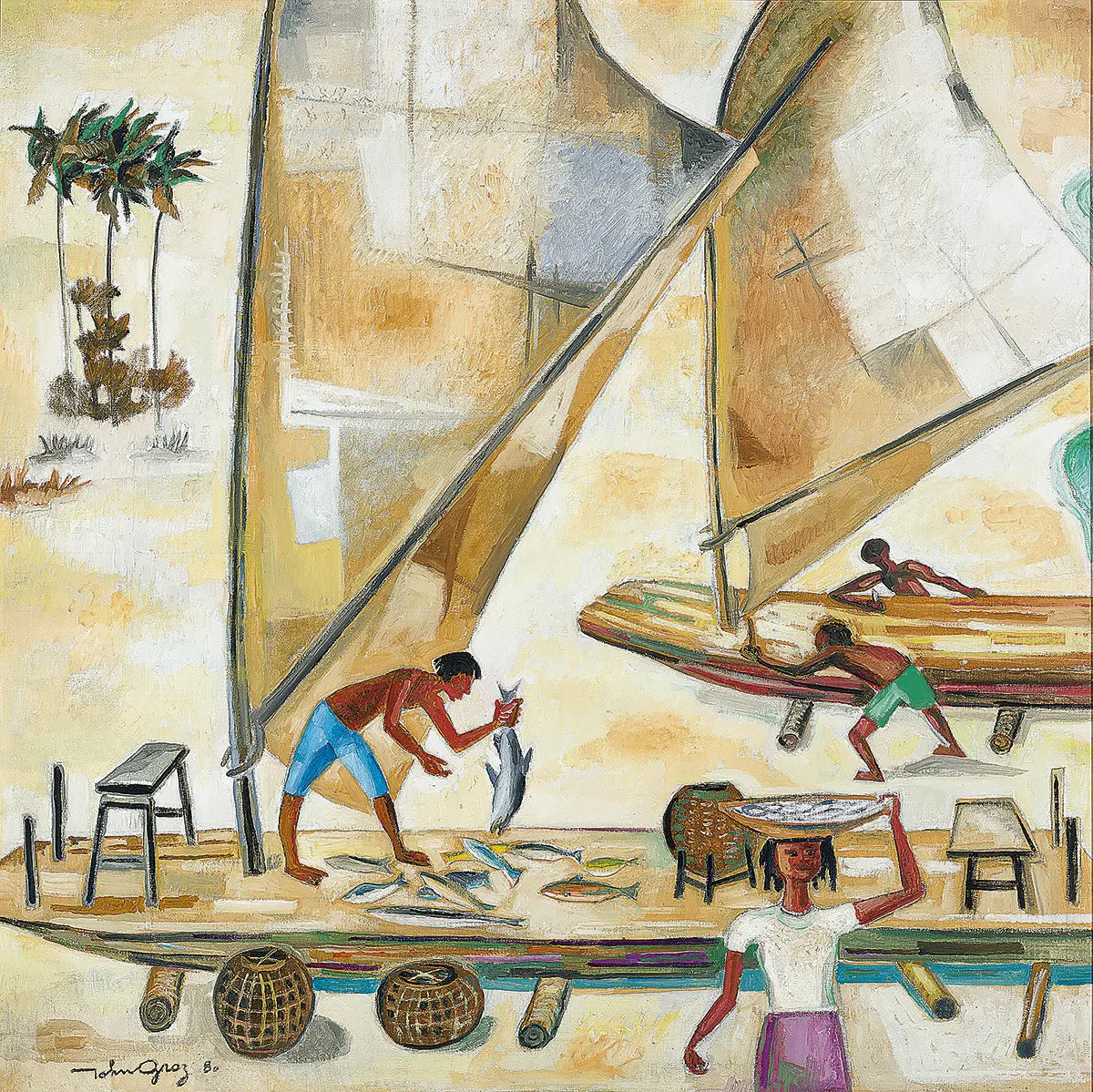
In Brazil, Graz developed an intense interest in local history and culture, popular traditions, and indigenous peoples, the representation of whom is one of the nodes in his retrospective. The show was organized in six sections: Arcadia; Indigenous Themes; Nature in Brazil; History and Popular Culture; Indigenismo; and Abstraction and Design. The selection includes nearly 155 works of art, among them paintings, drawings, and studies, along with architectural and decoration projects, furniture, decorative objects, and utilitarian items. Graz’s contact with Europe’s Avant-Garde movements, such as fauvism, cubism, and futurism, translated into a disciplined aesthetic investigation and resulted in a practice of carefully planned composition marked by chromatic and formal balance. A compositional concept similar to muralism is often in evidence, with different scenes arranged simultaneously on a surface. One example of this is an untitled 1935 gouache depicting groups of bandeirantes and indigenous individuals. In the lower third we see a canoe driven by two naked indigenous men, who hold the oars in their hands while a clothed, hat-wearing figure arranges some coffers on the vessel. In the central section, another bandeirante appears to be giving orders to a shirtless man, and the upper portion presents figures on horseback. The composition is framed, on both sides, by handfuls of plants.
As is often the case in Graz’s work, the human figures are not individualized. Their faces feature no particular details; they are types to be identified only by their clothing (or its absence), or by the things they carry, like bows and arrows. Graz’s palette favors earthen tones but accepts more forceful colors when dealing with such subjects as carnival celebrations or other popular festivities. In general, his brushstrokes and lines are parsimonious, always continuous, and his compositions are free of unnecessary adornments. These characteristics can also be appreciated in the furniture he projected, distinguishable by its “clean” lines, light design, and local materials with natural finishes that value the qualities of texture and color.
John Graz’s engagement with his subject matter was based on a rationalistic approach. His studies evince the careful planning of proportions, composition, and use of color. It was not by chance that his Avant-Garde affiliations tended towards movements with an Apollonian, reason-based orientation, focused on the structural elements of pictorial language as their object of study. The subjects that attracted Graz are pretexts for a formal investigation that preserves the distance between the observer and the observed. Living in São Paulo at a time when local culture tended to value characters seen as heroic, such as the bandeirantes, and to idealize indigenous peoples as the “Good Savage,” Graz explored the potential of the such symbolic images without infusing them with an emotional charge. He gave the same treatment to other characters he portrayed, such as boatmen, washerwomen, quilters, or peddlers, and even to animals and plants. According to curator Fernanda Pitta, “we can see that his representations are characterized by a ‘romanticized’ conception of the subject and connect strongly with a concise, almost abstract idea of the ‘primitive’ form explored by Avant-Garde artists, reflected in the elongation of the figures and in the now spiky, now compact limbs of his humans, animals, and plants.”
The abstract works selected for this exhibition date from the 1960s and 70s. Abstraction is pure in three of them; in the rest, we find figures that combine human and animal elements. Here, Graz used a wider range of colors, in a treatment that differs considerably from the rest of is oeuvre, which tended to occupy the entire plane; in these flirtations with the synthesis of forms, Graz’s composition covers large areas with no other element than color, nevertheless retaining the commitment to decorative harmony that was constant throughout his career.
SYLVIA WERNECK