Chilean artist Iván Navarro presented his exhibition “Desvanecer” (“Vanishing”) in São Paulo. This is the artist’s second solo show in Luciana Brito Gallery. Navarro continues his explorations of light, color and geometry with materials like neon and mirrors to arouse changes in the viewers’ sensory states, dislodging them from the three-dimensional and towards infinity. He disrupts their natural sense of time and space towards a symbolic experience by suspending certainties of materiality and boosting the senses.
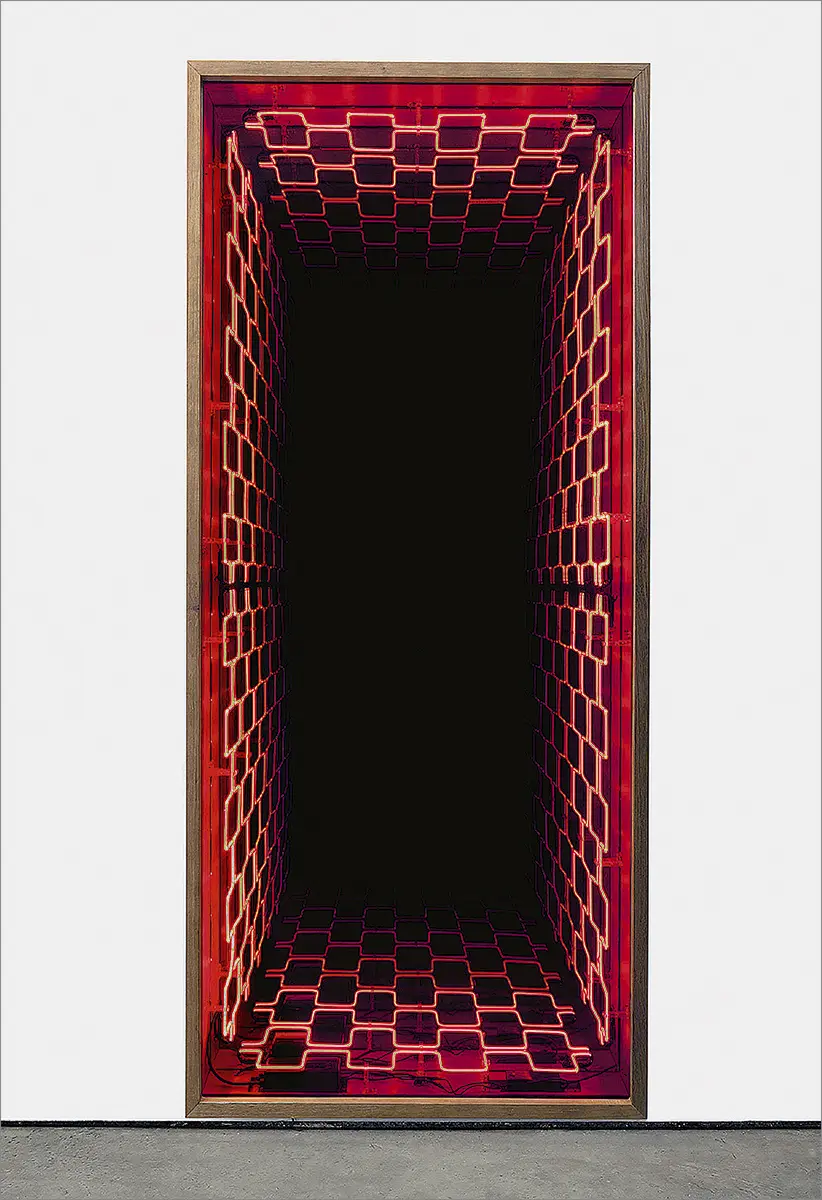
The impact of this exhibition begins at the entrance, through interaction with the neon sculpture on the main wall of the gallery. Lights and colors draw the gaze and provoke tension in viewers, sharpening their senses and taking them on a journey towards a symbolic, infinite space. The illusion of perspective happens through “vanishing points,” and visitors are taken to a sphere in which an uncertainty is imposed between the real and the imaginary. It becomes possible to feel as if outside of matter; these sensations come from neural and emotional reactions projected onto luminous bodies in a dreamlike way.
Iván Navarro uses this strategy to create a paradox where geometry makes the environment appear to amplify, while at the same time engulfing any image before it, causing it to disappear, to vanish.
Navarro has been on the artistic path for many years. In 2009, in the 53rd Venice Biennial, he experimented with this concept, creating similar effects in an installation composed of aluminum doors and lights. In “Vanishing,” Navarro advances an experience that is more sensory than material, where visual sensations impose themselves over the physical ones.
For Iván Navarro, the perceptions provoked by the different neon chromatic designs projected on luminous boxes are directly related to the effects that come from chromatic dynamics, and metaphorically refer to the space in which they are located; spatial materiality vanishes before the senses. The show establishes a dialogism based on the way the patterns and chromatic effects in the exhibition room are complementary to the installation at the external area of the gallery. This part of the show, named Water Tower, was created in 2014 as part of the series This Land Is Your Land, and displayed in front of Madison Square Garden, in New York.
The original series was composed of three urban installations: Eu e nos (Me and We), Cama (Bed) and Escada (Ladder), all in huge dimensions, about 4.67 meters in height by 2.63 meters in width and depth. Ladder is the one presented in Luciana Brito Gallery along with “Vanishing.” The image of an unending ladder placed inside a wooden container is theoretically built to store water, inviting the public to stand below the water tank and look up at a path to infinity.
Navarro also presented this work as a public intervention in May 2021, at the iconic Antonio Prado Plaza— also known as the Plaza de los Emboladores—in São Paulo’s downtown, across from the Farol Santander, where, on the 22nd floor, a show was organized to interact with Navarro’s ExFinito.
In Ladder’s initial installation as part of the trilogy called Urban Art: three cylindrical water towers, staples on the New York skyline, merged with the park’s landscape on the street level. Navarro named it This Land is Your Land after a popular 1940s folk song by Woody Guthrie, an American hymn advocating for the freedoms offered to immigrants.
By retaking one of the three urban works and incorporating it into “Vanishing,” he creates new meanings, widening the concepts of dematerialization and connection with other realities that aren’t visible in the material world, but can be reached through other senses inherent to humans.
The effect is generated by mirrors upon which the reflection of the neon perpetually repeats itself. The original piece resulted from something that lived unresolved in the artist’s memory as a child during Pinochet’s brutal regime, which led to reflections “on the liberties of the American experience” and to the creation of This Land is Your Land. Through this work, he raises discussions on the topic of social structure and how language can manifest simultaneously as liberation and oppression.
Ladder, dislocated from the original trilogy, and in dialogue with the works shown in the gallery in São Paulo, relates the political in the field of sensation with the field of the absolute.
The water towers are elevated above the visitors’ heads, allowing them to walk below and see the contents of each sculpture. Navarro’s water towers, each about 2.10 meters wide and mounted on 2.50 meter supports, serve as containers for a vocabulary that stems from the political and personal experience of immigration. The interior of one tower displays the words “me” and “we”; a second one contains the word “bed” and a third shows the image of a ladder, all three composed of neon lights. Mirrors allow the neon to multiply endlessly.
HÉLCIO MAGALHÃES