Monuments are these days at the center of academic, social and political debates across the world, as we no longer have of them the image that we had just a few years ago—in particular, that of the recognition given to a conqueror. As one enters Iván Argote’s exhibition at Perrotin Gallery, located in a typical East Village building in New York City, its façade diagonally crisscrossed by fire escape ladders, it is good to keep this maxim in mind: monuments are not what they were. They were intended as timeless, infinite in time, as Barthes had it; that is why they were built and placed in memorable spots within a city. Nevertheless, we see that monuments may have endured and resisted all kinds of affronts from nature—rain, high temperatures, snow in some cases, the implacable noonday sun—but could not withstand the assessment of history, which is now getting its due. No sooner did we begin to revise history as a living domain that can be written and rewritten, whatever the era, than we were able to connect some monuments with human barbarity—with “the ends justify the means.”
From Sebastián de Belalcázar or Christopher Columbus in Colombia to Joseph Gallieni in France, through George Washington in the United States, they all have a dark side in history that erodes their validity as heroes and places them against a wall.
Already at the entrance to the gallery we realize we are stepping into a place of discomfort: photographs of monuments with their base untouched but supporting a sculpture that has been transformed into mirrors. We move on and discover fragments of a sculpture made into flowerpots, videos of a monument being lifted, monument bases and mirrors that return our gaze and force us into a posture, and one painting, for instance, depicting the erection, using large cranes, of ancient Egyptian obelisks (?) stolen in some old raid of conquest. In sum: several artworks resolved in a variety of techniques are part of this exhibition to make a common point, at any rate the purpose highlighted at the top of this review: contemporary questions about our past, present, and future history.
Let’s begin with the monuments-mirror. The use of a number of bases in cities, and even some that have been brought into the space of the gallery, has shifted and they no longer support the “great” figures of history; they now support sculptures made with mirrors. All we see in them is our reflection and the reflection of our surroundings. Thus, their unidirectional nature as monuments fades away, and now, with the mirrors, we begin to realize that a monument is activated by the people who gaze upon it. It does not exist to be seen; it exists to reflect us. Assumed in this is an attitude of reciprocity similar to the one we expect in the case of the work of art: it is not what the artist says, but the communication that occurs between the image and the eye that perceives it. At this point, though, the issue of what happens to the figure originally atop the base once it has been replaced with mirrors. With an evidently iconoclastic spirit, Argote, “dethrones” the figure and leaves in its place geometric monoliths, obelisk, cube, vertical parallelepiped, made, as has been noted, with mirrors. We see some minimalistic figures, almost devoid of meaning, empty, that amble and occupy the place that before, and over decades or centuries, signaled and exalted an individual who unscrupulously wrote a chapter in history. There is nothing left other than revising and understanding that the history of the past is the same we are living through. The monument, whatever it is, ends up as a historical artifice that was built to tell a story no one believes in any longer.
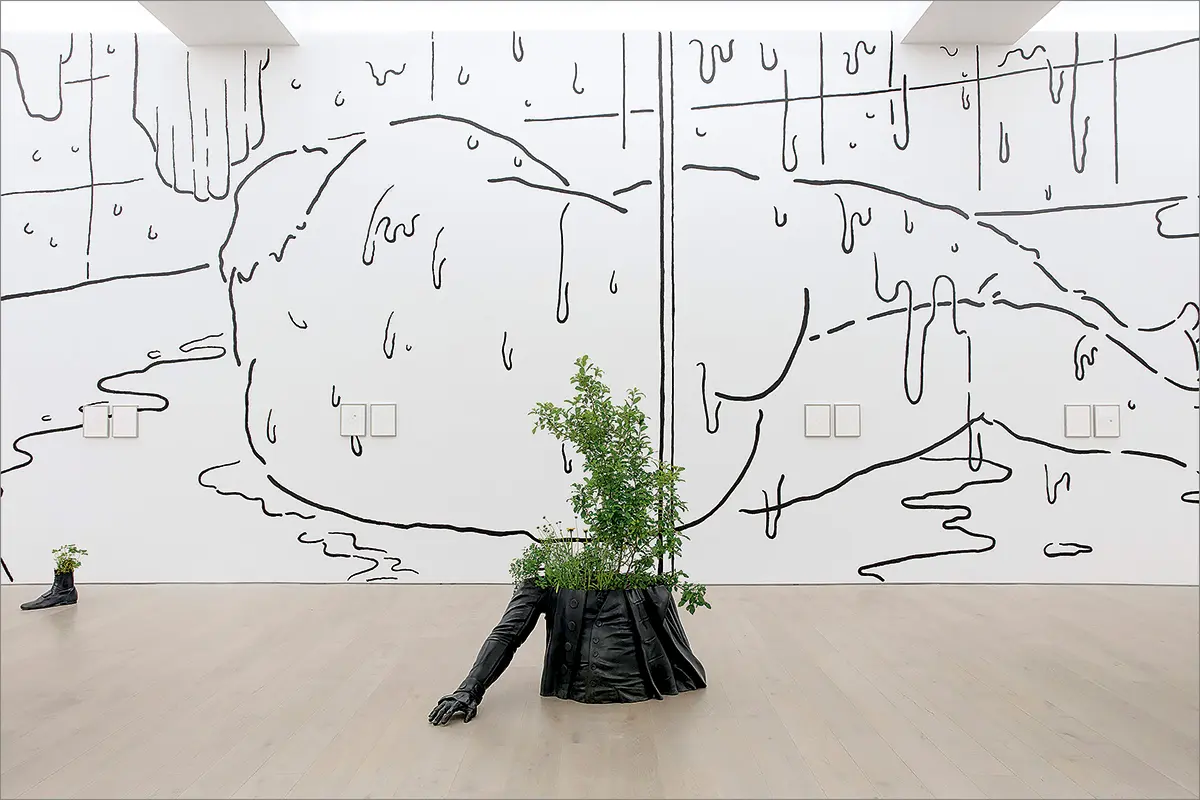
Following that, we see fragments of a sculpture depicting one of the United States great national heroes, George Washington, a 1:1 copy of the monument located in Wall Street, New York. Argote insists on “dismantling” the monument, reducing it to planters, transforming it into landscape containers. One hand there, half a torso here, one shoe, perhaps a finger made into a flowerpot and carefully anchored to the wall; little by little, we are no longer talking about Washington, but about all the monuments of the world, filled with empty air, inflated for recognition and veneration. We are living through a historical moment when what is assumed as “reality” is understood as just that: an assumption. We haven’t all lived through the same realities, nor do we all see ourselves reflected by the monuments that supposedly tell a story now obsolete in the tendentiousness of its meaning. Perhaps this is what Argote’s New York exhibition, A place for us, most insists upon. It is not by chance that the us in the title point towards all who do not feel ourselves part of those dark histories, and seek instead to unveil and critique them.
ANDRÉS GAITÁN