Iole de Freitas practiced contemporary dance for almost twenty years, a training that permeates both the form and in the content of her art. The exploration of the body in her work of the 1970s and 80s was carried out in performative self-portraits and experimental films that probed the creative possibilities of a repertoire of images aligned with the effervescent European arts scene of the era, when artists privileged the used of unconventional materials and techniques. Taking herself as the domain to investigate, she focused on observing gestures, rhythms, and fragments of actions. This methodology gradually expanded as her career moved forward, coming to encompass relationships with the immediate space and with architecture, and driving her practice towards a sculptural language. The body, sensorial perception, and motion remain present to this day as starting points. The artist chooses industrial with sufficient flexibility to trace curves and snaking movements in space, resembling those of a dancing body.
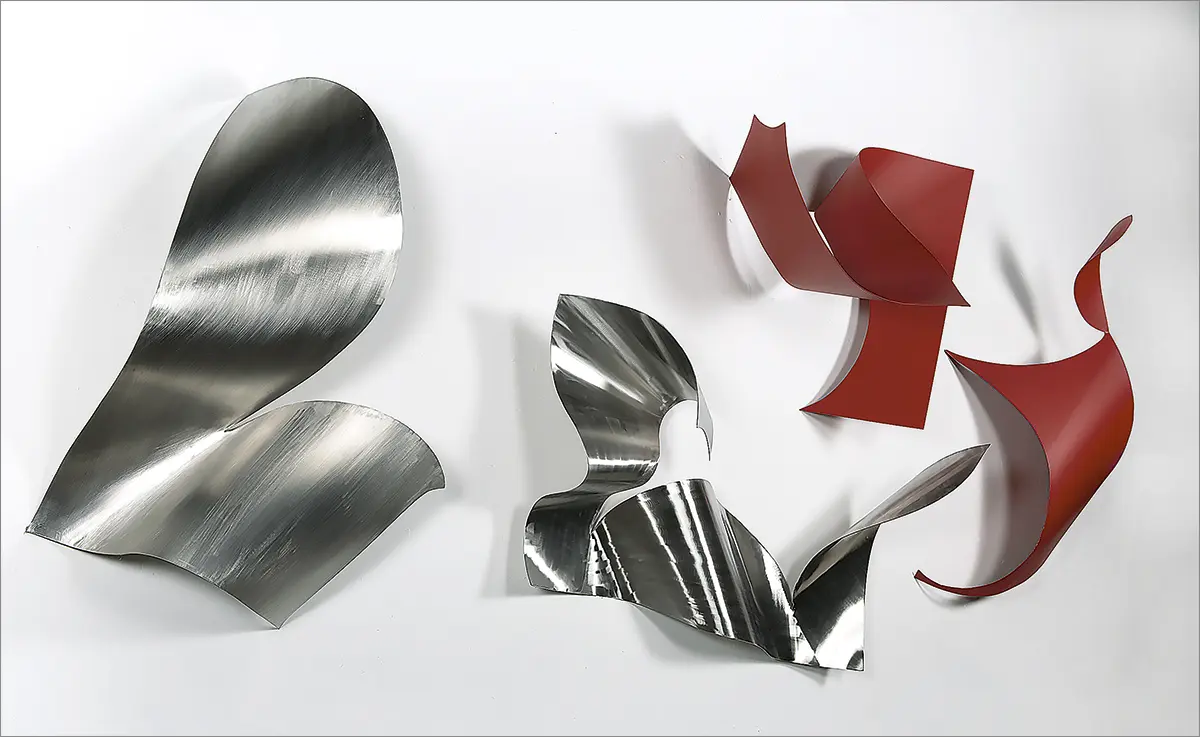
Rubro (Crimson), de Freitas’ solo exhibition at Raquel Arnaud Gallery, features groups of new artworks that, while stand-alone, sustain with one another harmonious dialogs of form and color. While each element can be appreciated as an autonomous item, the whole can be read as a large installation. A formal coherence unites the individual works, expressed in the sinuosity of the lines, the subtle variations of texture, and the economy of color, already characteristic of de Freitas’ productions. In previous site-specific works, she regularly “sewed” the inside and the outside by breaking the boundaries of walls and windows in a giant scale; here, the tone is more intimate. This is because Rubro was entirely conceived during the pandemic, with its imposition of a confinement that is not only physical, but mental as well. It was necessary to adapt the work, to think in smaller scales, and to direct attention to everyday stuff, as everything one learned about the outside world became a source of fear. De Freitas has said that she sees artistic creation in such atypical conditions as a mode of resistance, a need to enkindle the life drive.
All the sculptures on exhibit are made in stainless steel. Many are painted white, beige, or the intense red hue of the show’s tile, but some retain their metallic color. Their size is small relative to de Freitas’ earlier installations, and are based on studies with a few cuts on paper, later reproduced on metal plates, resulting in various folded and curved shapes that probe concavities and convexities. On display in the first gallery are the Rubros (Crimson), Pálidos (Pale) and Lívidos (Livid). The first two groups are arranged on the wall, while the Lívidos remain on the floor and seem about to take flight, or perhaps just graciously landed. Derretida (Melted), the show’s largest work, is firmly ensconced in the area that panoptically connects the two galleries. It signals a transition from a space with colorful artworks to a space with white ones, which are in a way quieter and direct the viewer’s gaze to their interior, while the previous section called for a view of the environment as a whole. Adaga de papel (Paper Dagger) is the only item installed by itself in one of the walls. The title plays with the paradox between the weapon’s potential violence and the fragility of the word paper; its sinuous yet sharply pointed shape is painted white, concealing the steel it is made of. Finally, the last group, Sem título, is comprised of three sculptures with a more volumetric and closed appearance, differentiated from the others by a composition that turns toward their own center, like fragments of spirals.
As we follow the pathway suggested for this exhibition, on a first moment we come across a dynamic environment of shapes that open towards space. Our gaze is attracted to the Pálidos and the Rubros on the walls. On the floor, the Lívidos, with an equally expansive motion, reinforce the sense of restlessness and dialog with the sculptures flanking them. Although Derretida can be seen from the start, it is only when we reach its location that we see all the works and perceive the difference in rhythm between the two spaces—the first one is colorful and frantic, while after Derretida we encounter a chromatic and formal deceleration. Adaga de papel projects sharp shadows onto the back wall, but, in its whiteness and isolation, also invites introspection, which is reinforced by the untitled works towards the back, each seeming to close on itself as it curves onto its own center, almost into a fetal position.
SYLVIA WERNECK