The exhibition “Civilización Atalaya” by the artist Fernando “Huanchaco” Gutiérrez at the Museum of Contemporary Art in Lima, and under the curatorship of Giuliana Vidarte, is based on the true story of an archaeological-ethnographic fiction. The story begins with the journey of Mario Poggi—controversial psychologist, sculptor, convicted murderer (of a serial killer), and then eccentric “celebrity” of Peruvian television—to the Amazon in the early 1990s, where he had supposedly discovered a cave in a forest of the Atalayan province of Ucayali, in eastern Peru. The entrance to the cave was shaped like a vulva, which Poggi christened (with gynecological rigor and a lewd sense of humor) “the Lost Chucha of the Incas.1”
About ten years later, Huanchaco became friends with Poggi, who told him about his trip and his discovery, which no one had taken seriously given his well-known penchant for extravagance; not in vain he called himself “Crazy Poggi.” He gave Huanchaco the maps he had made and directions to the place. Some three decades after that voyage of discovery, the artist decided to retrace Poggi’s steps and search for the underground cave. Huanchaco took the 19th century scientific expeditions that would have inspired Poggi as a conceptual and aesthetic guideline, documenting his journey through the Peruvian jungle, and confirming the existence of the enigmatic cave.
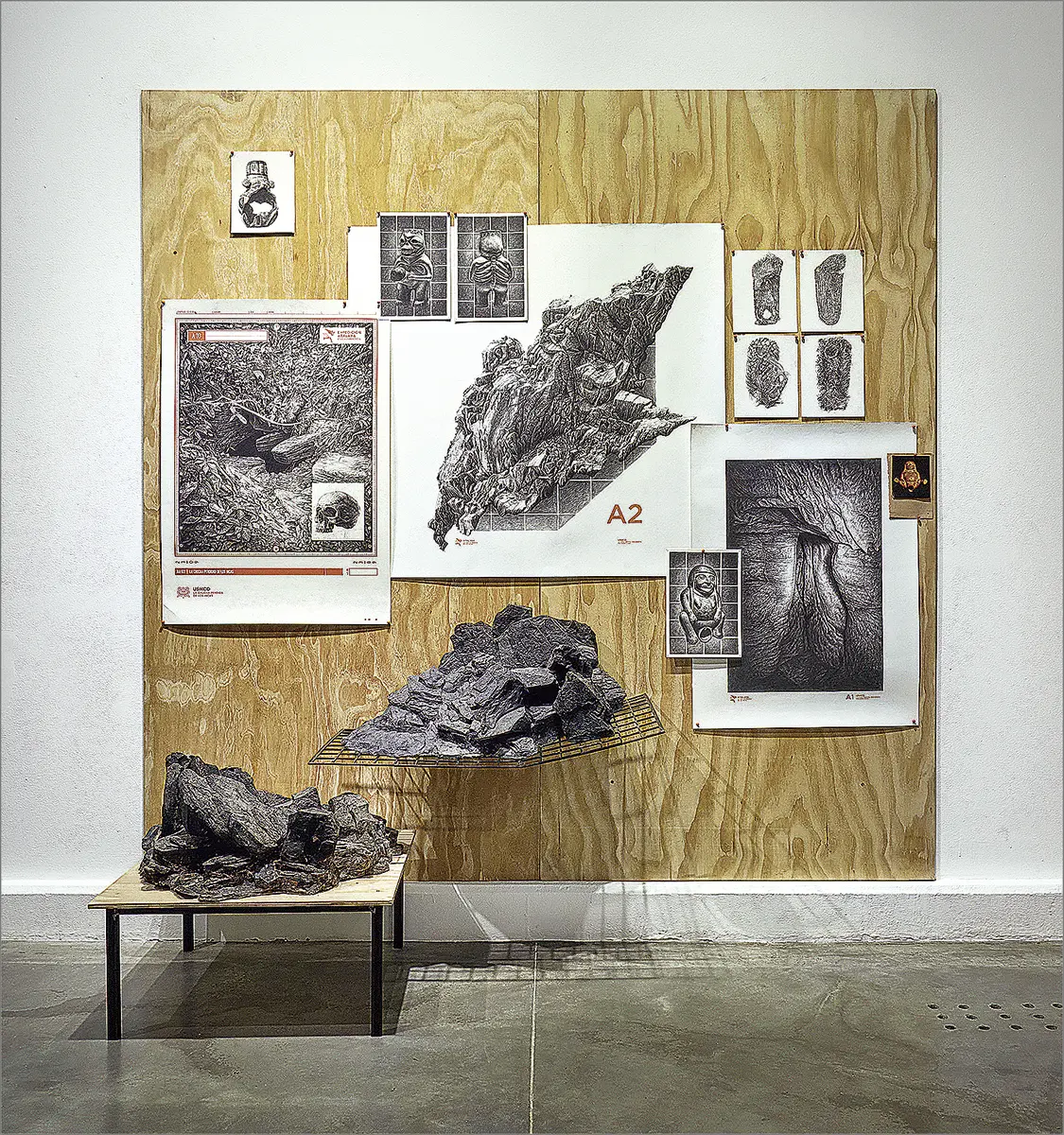
In “Civilización Atalaya” Huanchaco gives an account of this trip by organizing a constellation of documents, recordings, photos, drawings, objects, archeology books, videos, pre-Columbian relics, replicas of archaeological objects, and paintings, among others materials, and offers them as a visual narrative that informs us about the archaeological search itself and about the discovery and its interpretation based on an ethnographic conjecture about the hypothetical pre-Columbian civilization of Atalaya, with the “Chucha de los Incas” as one of its sacred places.
The exhibition is organized around a central structure made up of wooden panels and tables that bring together various images and objects. Around this structure, paintings, drawings, diagrams, and objects have been placed on the walls, other panels and more tables. Two monitors with videos complete the ensemble.
The project is a critique with a parodic nod to the disciplines of the Enlightenment, like archeology and ethnography. The photographs of the trip bring to mind archaeological expeditions such as those of Howard Carter in Egypt, in the 1920s, and of Hiram Bingham III in Machu Picchu, in 1911. Formally, these images evoke straight photography by underlining the speeches of scientific rationality at stake. But the photos and videos also reveal the problematic foundations of scientific expeditions of the 19th and early 20th centuries in search of ancient civilizations. The expedition members appear dressed in costumes reminiscent of colonial times (the use of the helmet and khaki clothes echo British India), while the native characters are presented as exotic specimens.
The quotes from pre-Columbian civilizations of the Peruvian coastline, mountain range, and jungle, and the images of settlers from different regions of the country, refer us to ethnographic discourses. This also occurs with the inclusion of the San Pedro cactus, represented in multiple ways and addressing the ritual consumption for its hallucinatory effects. This reading is reinforced by a video where the cactus’ fantastic qualities suggest a psychotropic journey.
The pictures are especially interesting. Painted with diligence and extreme detail, these canvases represent the artist’s imagined version of the settlers of the Atalaya Civilization and their cult, allegedly centered on fertility and sexuality, which would account for their mystical relationship with the “Chucha of the Incas.”
There is a key aspect that organizes the entire exhibition and is concerned with the discourses of art history that underlie its spatial configuration. The wooden panels on which pre-Columbian pottery drawings, geological sketches, representations of ancient settlers, vegetation figures, models, and texts have been arranged, among others, are reminiscent of German art historian Aby Warburg’s Atlas Mnemosyne, begun in 1924 and with which he sought to map recurring aesthetic themes and forms from Antiquity and the Renaissance to his times.
With its spatially organized sets of images and objects, Huanchaco establishes aesthetic, thematic, and conceptual associations, which can be based on formal or iconographic criteria as well as subjective, random, and even whimsical ones. In this sense, “Civilización Atalaya” seems to suggest that any interpretation that confronts unknown worlds ends up linking collective pasts with individual presents, and using the aesthetics of pre-Columbian civilizations as a support to project the ideologies and desires of those who have tried to understand them.
NOTA
1. Chucha is slang for ‘vagina’ in Peru and other South American countries.
MAX HERNÁNDEZ CALVO