A recipient of the FEMSA Residence Award in 2015, the Polish-French artist has resided in Mexico ever since. She has exhibited in galleries in Europe, Asia, Latin America, and Mexico. In June of this year, she opened Pasta o barrotes (Paste or Bars) at Enrique Guerrero Gallery in Mexico City.
The show brought together eight sculpture works and an installation with video. The work that titles the exhibition is comprised of rods and wires that create a sense of balance, forming triangles and a kind of clothing line from which hang clay letters spelling: “P A S T A O B A R R O T E S.”
There is in the phrase and in the materials a suggestion of “paste” as a material, mixed in some letters made of clay and a measure of plaster paste, and the colloquial term pasta used in Spain to designate money, as well as the clay itself, out of which the hanging letters are made—yet, because of the way they are arranged in the rods, the word is broken into BARRO and TES; barro being one Spanish word for molding clay, so that the material is also evoked along with the bars (barrotes in Spanish, as in a window or a jail cell.)
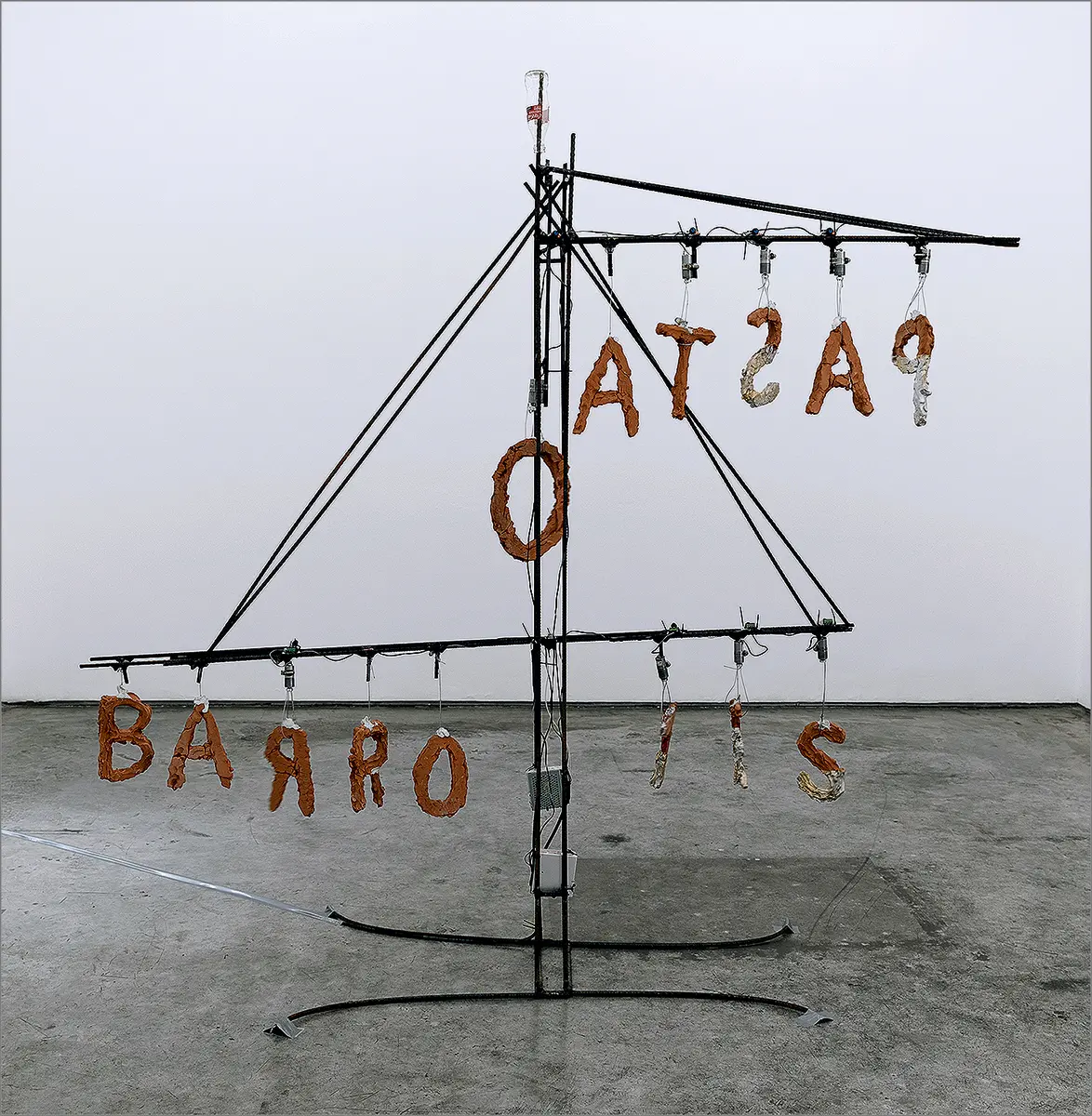
In construction projects, rods are usually placed as part of the foundation, as a base for the structure, which sets them counter to the fragility of clay.
Another important element, in the upper section, is a glass Coke bottle covering the highest rod, as is commonly seen in dwelling constructions in working-class areas of the city, with spaces that their own occupants oftentimes design and expand by themselves as their needs and the passage of time necessitate.
A different section holds two works also created using metal rods, pipes, and mud. It appears to be the early stages of a construction project, but on this occasion, the clay, as an organic element, transforms the materials into something plant-like, perhaps moss or a fungus that comes alive on the inert metal surface and generates a harmonious, unexpected mode of coexistence.
A different set of seemingly simple and even minimalistic sculptures, all made in stone but treated in a variety of ways, shares a persistent common element: despite their volume, they all feature graphic gestures, as though the goal were to generate a three-dimensional drawing rather than a mere texture on the surface of the works.
Traditionally, marble sculpture evokes Renaissance works of art created with intensely realistic attention to the human form; here, however, the material resembles a cutout, since the slab is flat and includes small irregular geometric elements, with additions of smaller slabs or with incisions that mark its surface. Here, the stone is abstract, but, to the viewers surprise, it is not solemn—rather, it can become a stone covered by color tracings.
The final section features three sculptures in primary colors, made with rods and clay as a game of balance, with the thinness of the rods—which resemble legs—contrasting with the heaviness of the top part, made in clay; not a support as such, but rather something that punctures and mixes in it, creating tension between the lines and the irregular shapes, between the metal and the clay that displays the traces left by the fingers that shaped it in organic and whimsical forms.
Alonzo’s sculpture recovers traditional elements such as stone, metal, and wax, but transforms them and makes them appear as something more accessible and commonplace, through a juxtaposition of elements that may at first seem haphazard but is the result of a careful combination of details and gestures introduced into the materials, as well as the artist’s personal experiences and interest reflected in each element and in her intervention of space. Each object suggests a story and the dedication to her work with which the artist challenges classical techniques and changes space in the personal field in which matter is her language.
ISAURA RUIZ