Artist Elian de Almeida presented his first solo exhibition, titled “Antes - Agora – O que Há de Vir” (Before – Now – What Is Yet to Come) in Rio de Janeiro’s Nara Roesler Gallery. The show brings to the public the developments of the artist’s investigations starting with his Vogue series. Some of these works can also be seen in São Paulo’s Pinacoteca. The exhibition was inaugurated on September 1st and closed on October 23.
The show, organized by curator Luis Péres-Oramas, was structured around the main axis of the Vogue series and lays out the artist’s concerns about his affective memory, his artistic practice, and his responsibility not only towards contemporary art, but also towards social issues. The dialogue that the images generate with the viewer is mainly about the erasure of the history and memory of Afro-Brazilian cultural traditions. Elian Almeida’s creative power is an emergency call for the rights of memories that have been omitted, veiled, and for revealing the presence of slavery in Brazil, an enormous scar that has yet to heal.
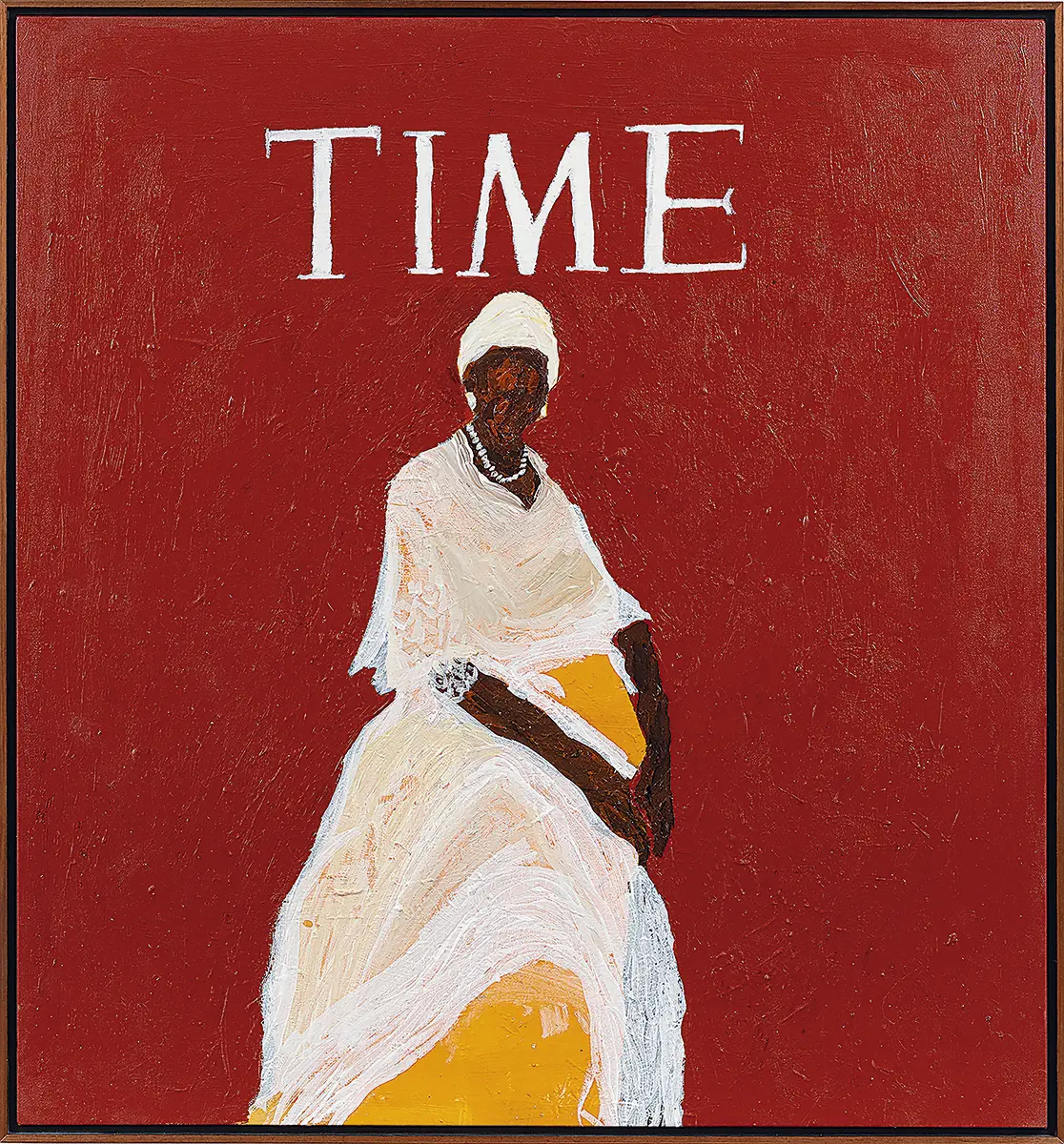
Almeida’s work focuses on rescuing memory, removing veils, reconnecting with the past, converging with the present in a look into the future. This operation amalgamates time as it connects dots and repositions history, reconfiguring the nature of the omission of memory rooted in Africa. He does this with the mastery of his brushstrokes, the textures he evokes, the mythical symbolism of the characters he rescues, and the reconfiguration of the scene that he offers to these characters.
The show presents sixteen portraits of black women, mythical figures that the artist illuminates with a sort of Benjaminian aura. In his artistic work, Elian de Almeida undoes the historical omission that has not ceased to violently kill memory. Almeida leans on the concept of necromemory, developed by Cameroonian philosopher Achille Mbembe, known for questioning the limits of contemporary states’ sovereignty when it comes to deciding who lives and who dies. Necromemory refers to the hegemonic decision about what will be eliminated, silenced, muzzled, dead, annihilated in Eurocentric memory.
In the act of collapsing the temporality between past, present, and what is yet to come, the artist invalidates the notion of time and space by gathering Esperança García, a black slave from the 17th century known as the first lawyer of Piauí; Luisa Mahin, an exslave from the 19th century who played an important role in the Malê Revolt in Bahia; Tia Maria do Jondo, Mercedes Bautista, the first black dancer of the Municipal Theatre of Rio de Janeiro; and actress Ruth de Souza on the same sacred altar of his creation, along with aunts, mothers, and other black women who symbolize the resistance of culture, of memory, of history.
In the necroportraits of these divas, Elian de Almeida reconfigures and denounces the violent erasure from history of virtuous black women. The artist places these women on stage with expressionless faces, weakened and invisible glances, somber images that seem to retake the space, while still carrying with them the violence they suffered through obliteration, through a kind of amputation of history and memory.
Elian de Almeida uses multiple forms of language, such as painting, photography, audiovisual and installation to weave a narrative that strives to revindicate the marginalized as protagonists and allow blacks agency in contemporary society. He takes on the responsibility of an activist engaging in the rewriting of the pages that were ripped out of Brazilian history.
His project, born as the Vogue series, was sparked when he confessed to his professor that he didn’t have the money to buy materials. The teacher’s answer was: “Work with the resources you have access to.” One of his sisters, who studied fashion design, gave him a few of her Vogue magazines. Almeida began to work and draw on their covers and noticed that there were no black women in the magazine.
The search for his origins through photography and history led him to ask profound questions: Who am I? Where do I come from? Where am I going? Such inquiries flow into the lack of history, of narratives, of memory. Elian de Almeida is devoted to pursuing these answers and seeks to fill the empty spaces of life stories like his own, which reflect upon the descendants of Brazil’s violent slave culture. As an artist, he finds resources to strengthen and find a place for another history, another narrative that must be told, included, and deeply explored within Afro-Brazilian historiography.
HÉLCIO MAGALHÃES