Although the line that separates art from science has become increasingly blurrier, or, if you prefer, more invisible, due to actions on each one of these two distinct ways of understanding the world, the fact is that their reasons and processes followed separate yet absolutely concordant paths from the start. Indeed, the earliest myths were created in order to explain that which seemed unmotivated, by means of coherent, highly imaginative stories that could bridge differences and thus produce a common-union, this is to say, a communion—or, in more complex terms, a community.
While art in its earliest manifestations took on the task of connoting the world, infusing the appearance and the motion or stillness of things with meaning in the coded system that we today call the symbolic world, science progressively unveiled mysteries and denoted their components, using observation and empirical verification to outline the potentialities of natural phenomena, including all living species—among them, sapiens, those who possess thought, i.e., us: the only “beings” with the power of processing cognition through both the aesthetic poetics of art and the logical encoding of science.
Both instruments—which turn out to be two basic branches of human knowledge, along with the speculative discipline of philosophy—are without a doubt the most complex expressions of civility and understanding based on the very essence of what has made us into beings responsible for the fortune or misfortune of our animal condition: the condition that drives us to call ourselves human.
Nowadays, the cross-pollination between cognitive disciplines is increasingly more vibrant, to the point that many processes of invention don’t necessarily involve a clearly distinguishable mode of art, science, or philosophy. On the contrary, their elusive manifestation is part of a totality that presupposes the immanent timelessness of the world. From that perspective, the arts, as much as the sciences (including the so-called mother of them all, philosophy), have consolidated ways not only of poeticizing existence, but also of making possible the world that each of us conceives and that each community or human collective has been able to experience. It is thus not unusual to find art processes that deliberately visit the methodologies of science in order to gain nimbler access to the mysteries of life. And this is not only a phenomenon of the present era; the indelible bond between art and science in Leonardo’s Vitruvian Man is well known, as are the fascinating harmonies of the Notre Dame rose windows. Rather than one destroying the other, the edge of each discipline becomes more and more diffuse when beauty or the sublime, as embodied in such examples from the past, overwhelms understanding and institutes the emotions that the power of art can mediate.
In clear awareness of all of the above, Edwin Monsalve has consolidated a discursive platform that incorporates phenomenological processes delicately ambling at the edge of the relationship between art and science. For this Colombian artist, “art is a discipline that, in a dynamic game that physics does not permit, allows its own logics to be repeatedly shifted, and it has access to a communicational dimension pointing beyond the rational, direct into the emotional, through experience as a way of learning and building.” In that vein, Monsalve speaks of the possibility of creating parallel realities with the power to confound what we understand as reality, a construction that goes beyond the sum of time and space.
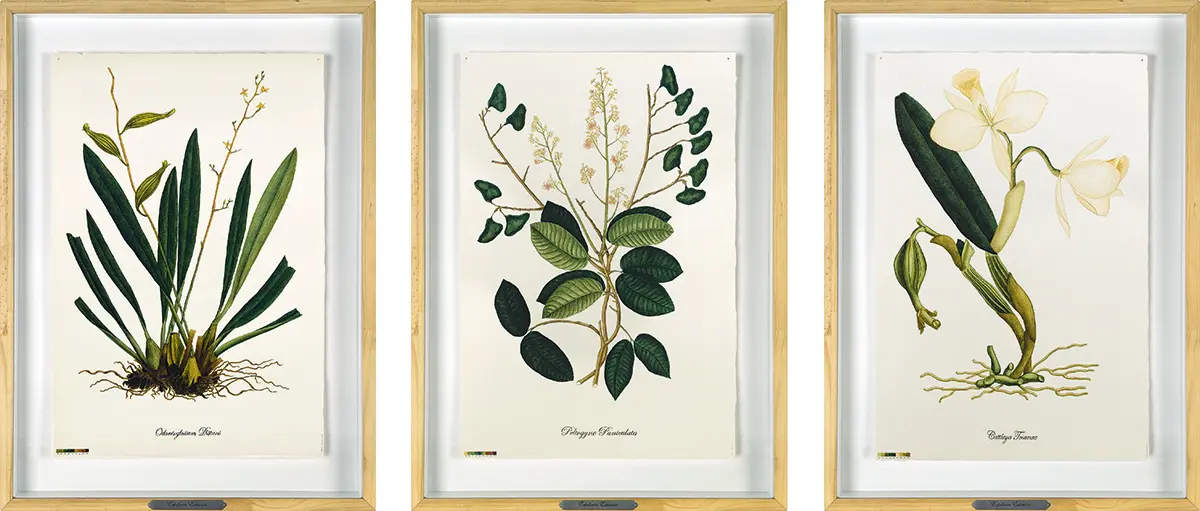
Following an exhaustive process for the extraction of pigments from plant specimens with the accoutrements of an organic chemistry lab at a modern pharmaceutical concern, or, perhaps, a medieval alchemist’s workshop, early in his artistic career (2008-2011) and under the premise of understanding the phenomenon of time, Edwin Monsalve took on the task of obtaining the essence of plant life, as embodied in something as ethereal as color. The technique he patiently distilled and mastered through trial and error made it possible to accumulate a relatively large range of colors, derived from different plant families, genera, and species. The artist, with the mysterious drive of the truly curious, put together a color card broad and content-rich enough as to recreate some of the prints made by the Rosario School that accompanied José Celestino Mutis1 in the Royal Botanical Expedition to the Kingdom of New Granada. Painstakingly, Monsalve searched through thousands of botanical transcripts of that epic feat of scientific exploration and selected images depicting extinct or grievously endangered species. The result: a vast selection of watercolors, delicately executed on pH-neutral cotton paper, that retain the logical, ethical, and aesthetic parameters of the Colonial-era commission, intended to decipher the magnificent, exuberant vitality of the equinoctial region of the Americas, clearly with an extractive intent but, for others, filled with the same anxiety that results from an inscrutable curiosity simply intent on knowing nature and its boundaries.
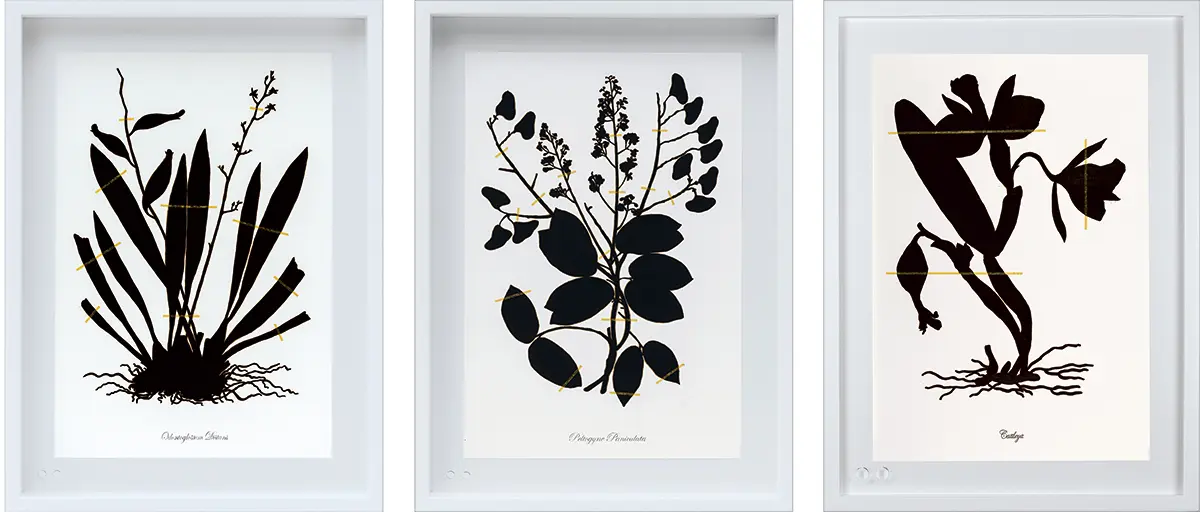
Each one of the new prints, which retain the measurements of the originals they evoke, carefully preserved at the Royal Botanical Gardens in Madrid, leaves its structure in view in the background, carefully drawn in pencil. Monsalve’s case is not that of a naturalist who acquired expertise in scientific illustration along the way, but that of an artist who brings to the realm of botanical research questions about the ghosts of the vanished, seeking to engage the enigmatic dance of time and its ineffable, voracious, never fully understood ability to transform everything it embraces.
The painter and historian Beatriz González, speaking recently about the group of artists trained at the Nuestra Señora del Rosario school in Bogotá2 during the colonial era, described the exercise we are commenting as a creative possibility, saying that anyone who dared using a plant to draw that same plant would be evoking the being of being, which is to say, proposing an uncreated thing, an ontology that travels to the very center of the concept of reality, and would ultimately suppress the origin of the gesture. This is what a young Monsalve had already abundantly accomplished when he collected 45 species over three years in a process craftily titled Expedición extinción (Extinction Expedition). The standouts in that collection are the Orchidaceae and Araceae families; after the coming and going of several other projects, these reappear now not in sap-ink extracted from the plant itself (chlorophyll), but in the raw sap of the land as such: petroleum, or gold and silver leaf.
Those who have acquired one of these cards are undoubtedly familiar with the delicate plot that lies behind the virtues of the watercolorist. Not an iota has been denied of this story, the sole promise of which is the disappearance of the work as representation and the emergence of the work as presentation. Sooner or later, every single one of them will once again dissolve in the immensity of everything, disappearing forever. The first time those plants vanished, they vanished from the face of the Earth as a consequence of the natural evolution of species; the second time, they will vanish as representations. To put it briefly, only a schematic of the skeleton of the “thing”, its delicate, accomplished structure as subject matter for drawing, will serve as a support for its specter that, which could be experienced with a modicum of imagination. A white leaf of a certain weight and texture, carefully observed if one is to capture the thing that obviously remains there, only this time imperceptibly—at least for our limited sensorial endowment. Monsalve reckons that 15 years will be required for what he painted to become something different than what he studied without direct knowledge, only through the mechanical reproductions that the Royal Botanical Gardens, keeper of scientific testimonies from two centuries ago, has been able to edit and put in circulation.
While the artist’s trajectory and his striking idea of art as a mode of knowledge, which I have been attempting to sketch here, harkens back to other logics, such as mimesis or verisimilitude in an artistic formulation, specifically in attempting to unsettle, and indeed unsettling, his perception and ours with the use of trompe l’oeil (for example, by replicating one butterfly wing while preserving the original in a kind of entomological box and its aesthetic representation right next to it), his exploration has come to discover a complex system of artistic creation founded on the scientific method and its many applications. Nevertheless, his own method consists in exhausting the intrinsic qualities of empirical mechanics and confronting them with poetic rhetoric as he subjects matter to formal and conceptual stress tests, appealing to its extensive and symbolic qualities. We have noted this with regards to the essence, the extract of a plant or of the land, which in subsequent instances became basic elements for the artist to experiment with as he gradually, in an altogether coherent evolution, brought into his work minerals and natural resources constitutive of reality. Sociocultural progress, and much especially the economic development that today presents us with peremptory claims about the rationality of being and existing, has been the pathway and the quarry wherein Monsalve experiments and creates.
Asked about how he understand his own research process, what parameters or norms he follows to determine the terrain of his actions, almost immediately Monsalve mentions “nature” as the container and content of all that exists and is; the idea of “method” as a specialized procedure that helps understand or access the reasons behind a thing or a phenomenon; and, finally, “time” as a natural occurrence of space and the experiences that take place for us to be and exist. The triad formed by the notions of nature, method, and time has become the Colombian artist’s modus operandi and the constitutive grammar of his poetic framework. At the same time, Monsalve keeps his creative activities in step with his teaching responsibilities, which has imbued his operations with a high degree of ethical responsibility. All of this is part of a logical concatenation of meanings whose foundation lies on a dynamic of action and reaction, as a methodology that moves in the direction of the quasi-scientific formalizations Monsalve has been able to impose and that, as a premise, brings forth the notion of entropy3, with its sine qua non capacity of perennially transforming matter in order to again and again make something from what is unmade, until the scoria on its face gives us back our own in its reflection.
At this stage, drifting appears as the agglutinant of the artist’s method. The finitude of matter, in terms of its formal and structural possibilities, has been in recent years the most difficult challenge facing humanity as it confronts an abyss without return. Monsalve takes advantage of this, stretching and trying to understand the intrinsic properties of nature and its infinite diversity. A paradox that contrasts the scarcity of resources with their perpetual mutability. Knowing matter is, thus, both a methodological and an aesthetic command as he processes each object or symbol.
Many people live in worlds proposed by others, a rather normal state of affairs for a type of existence that favors example and the rule of emulation in the transmission chain of knowledge. This, however, is not the case for artists. Whatever creative terrain an artist may choose for his or her intervention, in every instance—particularly given the direction taken by contemporary visual and performance art—each life-artwork is unique, and encoded behind it is a singular methodology that makes it possible to decode ways of creating worlds, as Nelson Goodman describes the potency of art in his thesis connecting it with the sciences. While the idea of the artist as “genius” was debunked and buried a long time ago, the idea of originality has given way to that of a commitment to reality, equated with art’s most delicate labor, its power to make different worlds possible.
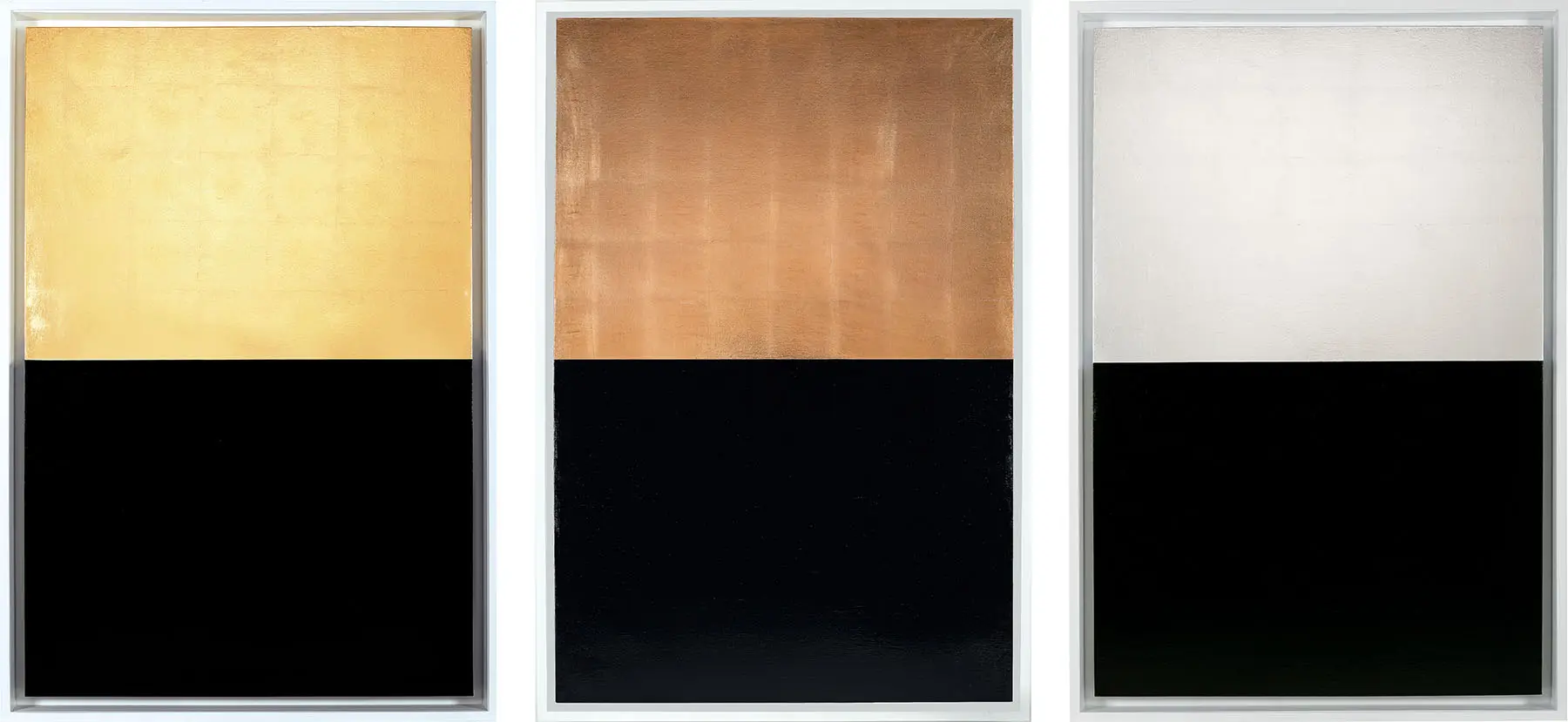
In one of the central processes in his arduous formal excavation, Monsalve has placed on his workshop table, in a delicate balance, utility on one side and on the other the symbolic power of basic, common elements such as metals considered precious (be it for their condition of intrinsic value, as in the case of gold, silver, and platinum, or for their functional performance, as with copper or mercury). Along those lines, petroleum has been capturing the space as at same point did chlorophyll, this time with an accurate, indelible stroke.
Extracted all over the planet, each time with different chemical and physical properties, crude oil serves as a vehicle of representation, but also of presentation when it captures the scene as a raw material (now for art, not industry) and appears as a thin film on the paper, with no greater interest than its mere presence.
Theories help in our attempts to elucidate mysteries, just as art did in its earliest emergence, with Homeric poetry or with the fascinating figures in the cave walls or hillsides that protected our forebears. There are legendary narratives of Armageddon4, for example, and their striking appearance in the world attempts to explain the fact that today we have hydrocarbons. In the Mesozoic era, large egg-laying animals evolved, giant beasts, and also outsize ferns and plant species, which were buried under tons of ash after the meteorite catastrophe. Today, thanks to that destruction and without having witnessed it, we are more or less certain that those bodies and living structures have transformed their nature and become an opposite entity, one that in less than two hundred years has helped drive human development into terrains Leonardo himself could not have anticipated.
In contrast with the above, many original communities around the world use mystical, highly poetic theories to help them situate oil or tar in a transcendent plane, as the blood of Mother Earth. A profoundly beautiful metaphor that gives shape to a mystery and proposes its understanding, imbuing its dark dimension with signifying power.
In Monsalve’s case, after many operations with the landscape—operations that have included tests and projections of organic materials, such as wood or medium-size or large conifer trees, subjected to therapeutic processes with prostheses for a possible regeneration after trauma and drastic morphological change (Naturaleza y artificio [Nature and Artifice], 2012-2013 and Prototipos para una naturaleza rehabilitada [Prototypes for a Rehabilitated Nature], 2013-2014)—crude oil has established a dialog with the profuse beauty of gold or silver, effectively calling attention to the very condition of the materials and the role they play in power and knowledge dynamics.
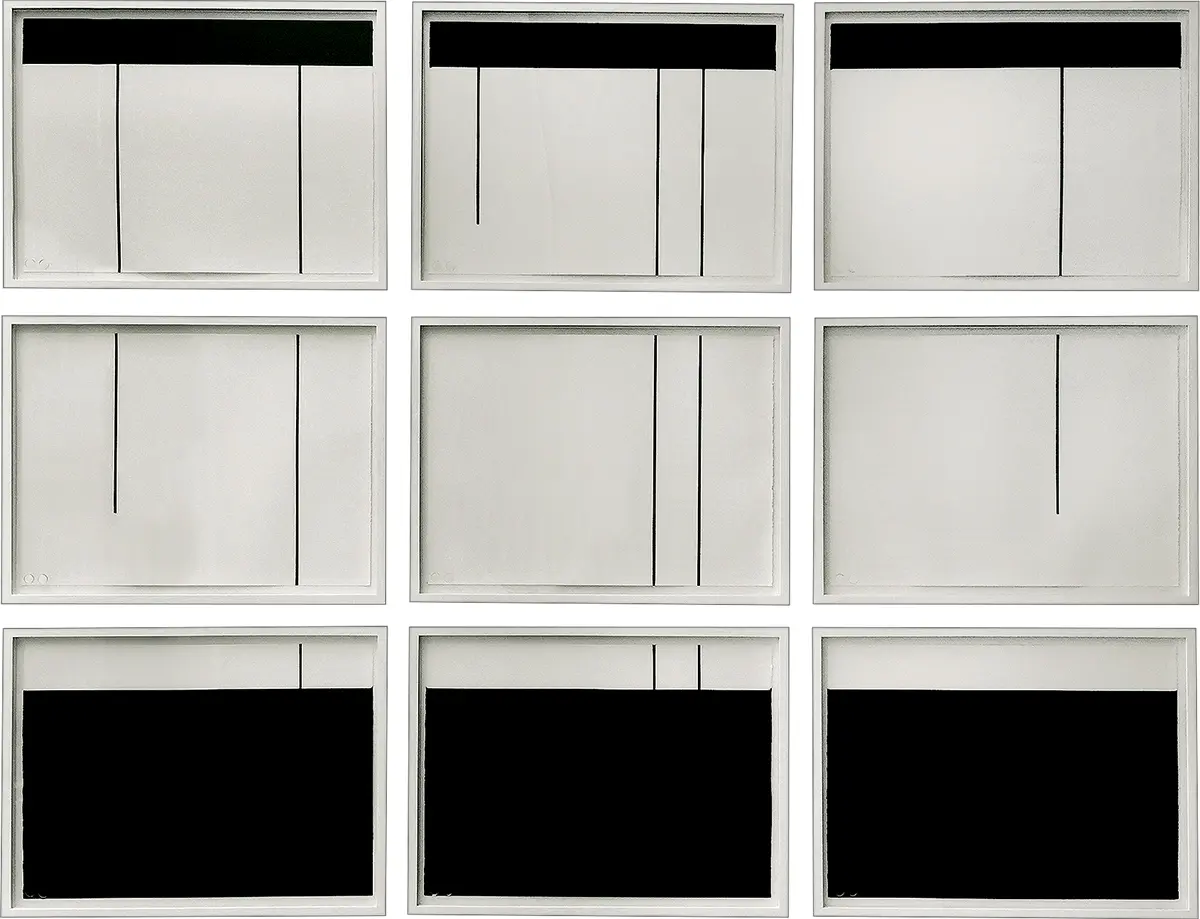
Monsalve decision to draw in crude oil was something that the work itself dictated; with that gesture, he deliberately started to challenge the chain of production itself. He went to the origin, to the starting point of the built landscape. Petroleum, even though it constitutes the base for the most refined oil paints used in the most sublime artworks, will in the end unmake the bonds that keep paper together. As was the case with Expedición extensión, whoever risks acquiring one of these drawings will only be guaranteed the company of a time machine, an image that will mark from the inside its uncertain drift. The represented forms used by Monsalve, especially in his most recent projects, for example Geodesia (2018-2021), allude to the representation of the Earth’s globe itself, in concordance with the scientific precept that codifies all possible segmentations in which models of the planet can be represented. Operatively, this form of science is deployed as an attempt to understand the productivity of a given fragment of surface and to determine its consequent use. It is in this way that simple geometric shapes such as circles, triangles, and squares play out three surfaces with well-defined boundaries, always connecting petroleum with metals of high symbolic power.
As well as a project comprised of several exhibitions at different locations, La imposibilidad del paisaje (The Impossibility of the Landscape, 2016) is also a conclusion, an unquestionable sentence for humanity due to the wrong direction it took along the way, with the aggravating factor of having done this at great speed, in contrast with the time it took the dinosaurs to become oil on the ground. As happens with turpentine, the environment in the spaces inhabited by these works, which also incorporate coal as an agglutinant, is transformed by the hydrocarbon’s penetrating smell. The land is thus the protagonist of the mise-en-scène; its tacit presence is forceful, overwhelming.
A creative process based on subtraction, a praxis that allows thermodynamics to act and also lets the elements be autonomous and true to life, devoid of artifice, without forcing them to say what they can’t. Thanks to the testimony that makes it possible to glimpse the scientific advances of archaeology and the many other sciences that study the Earth and what happens in it, Monsalve deploys reasons and arguments to dialog with materiality, allowing them at the same time to shine through with their mirage of ambiguous beauty.
Along these lines, we can highlight the presence of hyperrealist representations in Monsalve’s work, this time of blocks of ice (Glacial. 2015); waters as ancient as they are pure, cooling down the oceans after their meridian migrations. Icebergs portrayed in black pencil on a faraway horizon. The perspective brings to mind the overlook points of the island of Terranova, a frequent route in this migration of minerals. This project, then, uses a metaphor of opposites. Water and oil come together not for the purpose of mixing, but intent on reminding us that they can’t and shouldn’t.
Oil rigs are taken by assault by the landscape: giant masses of water that froze just as the great meteorite changed the planet leave the Pole and set out hunting for monumental constructions, which become like paper structures on their path. Irreconcilable eras encounter one another in these catastrophic collisions. A thin black layer, this time made from the sap of the land, the same substance that those beings from eons ago, longstanding masters of the planet, were made of, spills over the deep blue of the ocean. The scene brings to mind the tragic accident that took place in the Gulf of Mexico in 2010, when the British Petroleum Company opened a forbidden spigot in the ocean floor and prompted one of the direst ecological disasters of the industrial age. This occurred, paradoxically, in the same region where modern Darwinian thinking locates the strike of the cretaceous Armageddon. There is a contradiction in the fact that what pushes life to the edge is a longed-for development; this stark reality that confronts us with the impossibility of the landscape in all its force.
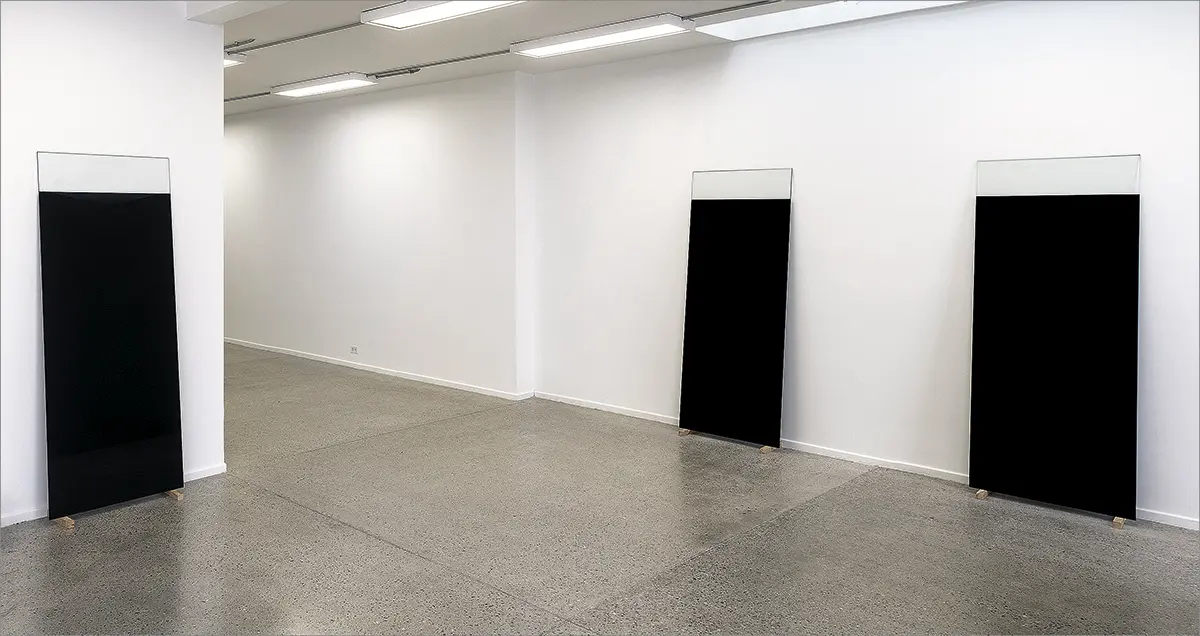
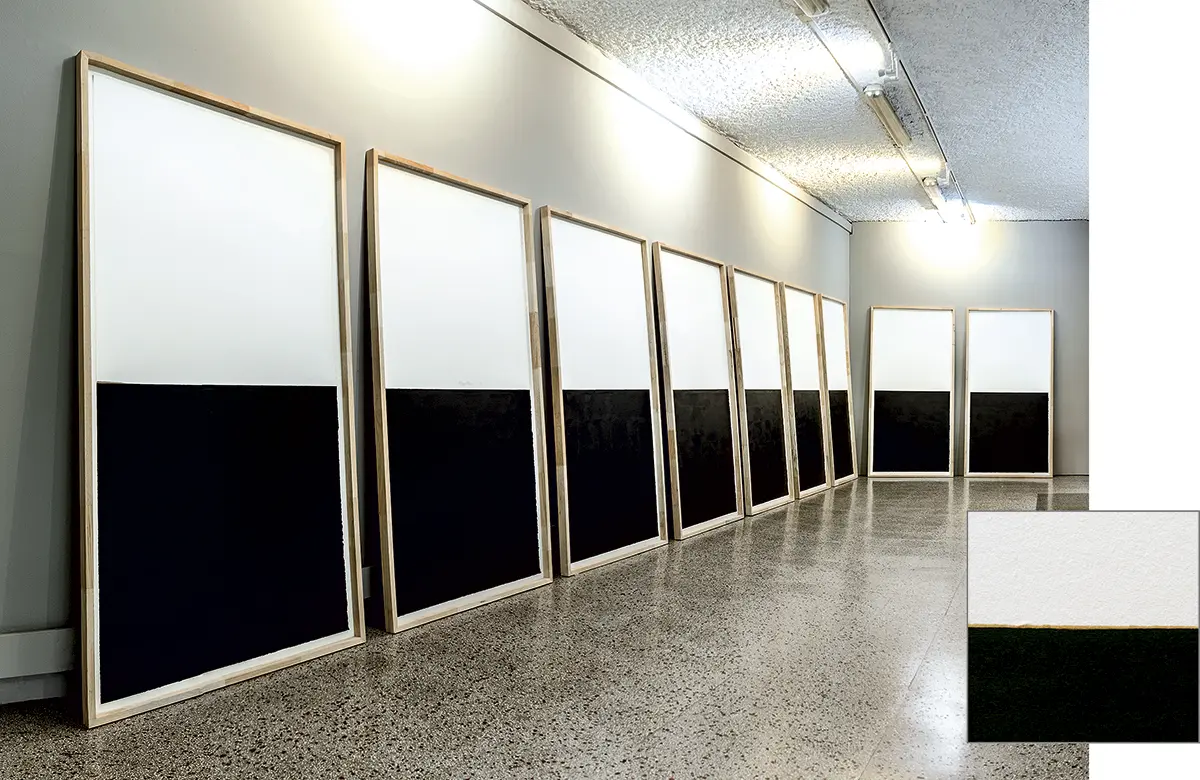
Today, in one of the galleries of the Museo Universitario of the University of Antioquia, a plane folded accidentally, made on heavy cotton paper and suggestive of a scale geography of the mountain systems in Colombia’s Andean region, presents us with mirror-like lakes of unmeasurable beauty in between its valleys and bends. The vertical planes arranged of the wall in the same gallery trace a continuous line that breaks the horizon between an impeccably white background and a black overlay made simply in crude oil and stabilized coal. As we come closer to the art, we are surprised, more than by their difficult sobriety, by the agony of a landscape supported only by its mirage, a black line that has slowly began to climb in a haphazard but homogeneous manner, revealing in the distance mountain shapes like those seen by the Conquistador in his time.
The immaculate sumptuousness of the corrugated support that brings the topographic plane to life allows each lake to speak. No moralizing postures whatsoever lie behind this universal truth. Monsalve not only poses his gaze on the drift that makes macro-history possible for us; he also allows himself, by virtue of his ethical responsibility, to underscore the human nature encoded in those lakes, ensnaring us behind their mirage with a truth as blood-soaked as time itself. Each drop of that liquid is, paradoxically, metal, a treasured and useful element ensconced well inside the planet, where it has been forever preserved in harmony, which once outside becomes—with few exceptions already validated by science—a guarantee of destruction, given the greed that swells up all vanities.
Mercury, the name of an Olympian god and a planet in the solar system, is the bearer of nature’s enigmatic beauty, and in Edwin Monsalve’s works it is also a powerful symbol that interacts with us by positing open-ended concerns that each must solve in his or her own way. In sum, delving deep in an aesthetic poetics means reaching for the possible limits of knowledge, especially when whoever prompts us does so in an honest and methodical way, clear on the fact that what is sought will never be found.
NOTES
1. Cádiz, Spain, April 6, 1732 – Santa Fe de Bogotá, Viceroyalty of New Granada, September 11, 1808.
2. González Aranda, Beatriz. Escuelas precursoras oficiales de arte en Colombia. Cátedra Mutisiana, Medellin Chapter. Available in: https://www.youtube.com/watch?v=E1olh-8ZY-4
3. Rudolf Clausius, 1865, introduced a new physical magnitude, entropy, which characterized the system alongside energy. In this way, the second principle of thermodynamics tells us that, in a closed system, entropy can never decrease. In other words: energy cannot be destroyed, only transformed, but with each transformation, it loses quality, until it becomes dross.
4. A term used in the biblical Book of Revelation to describe a destructive celestial body. Chapter 16, verse 16.
OSCAR ROLDÁN-ALZATE