Two moments have marked decisively—and traumatically—the world’s political, economic, and socio-cultural stage in the first two decades of the Twenty-First Century. The first one, the terrorist attack on the Twin Towers in New York City, on September 11, 2001, and the post-national, no quarters war than ensued. The second one, the pandemic declared in early 2020, which continues to ravage the planet. It has been a particularly virulent pandemic, and not only because we remain in the midst of it, but also because the entire world has been scarred.
The two most important solo exhibitions so far by Dagoberto Rodríguez have reflected upon the echoes of both events and their impact on contemporary society and culture: Guerra interior (Inner War), curated by Andrea Pacheco (CAAM, Las Palmas de Gran Canarias, 2020) and Planeta de cristal (Crystal Planet, at Piero Atchugarry Gallery, Miami, 2021), curated by the Aluna Curatorial Collective (Adriana Herrera and Willy Castellanos). Indeed, war and inner conflict were very much present in Guerra interior. That show reminded us of something we already knew, thanks to Von Klausewitz: “War is the continuation of politics by different means.” This is why, perhaps, the world seems to go through periods of truce rather than any enduring peace. Several of the most significant works in Guerra interior spoke of this, among them the installation Ánforas (Amphorae, 2020) and Casa tow (2019), which confronted viewer with the unending sequels of work both in the social and the individual plane. The installation’s object-based poetics metaphorically reproduced, in clay, explosive devices made from gas cylinders like those used by Syria’s rebel militias against Bashar al-Assad’s army. An internal conflict that over the course of more than 10 years has caused over 400,000 dead and millions of displacements, and which invites reflection about the nature of all war, “that unhinged belligerence that has lost all sense of life and destroys everything in its wake.” (1) But also included in this exhibition was a set of works that pointed towards a reflection about the act of dwelling, as in the monumental Puente invertido doble (Double Inverted Bridge, 2019) or the diptych Corredor 14 (Hallway 14), from the series Túneles (Tunnels, 2020).
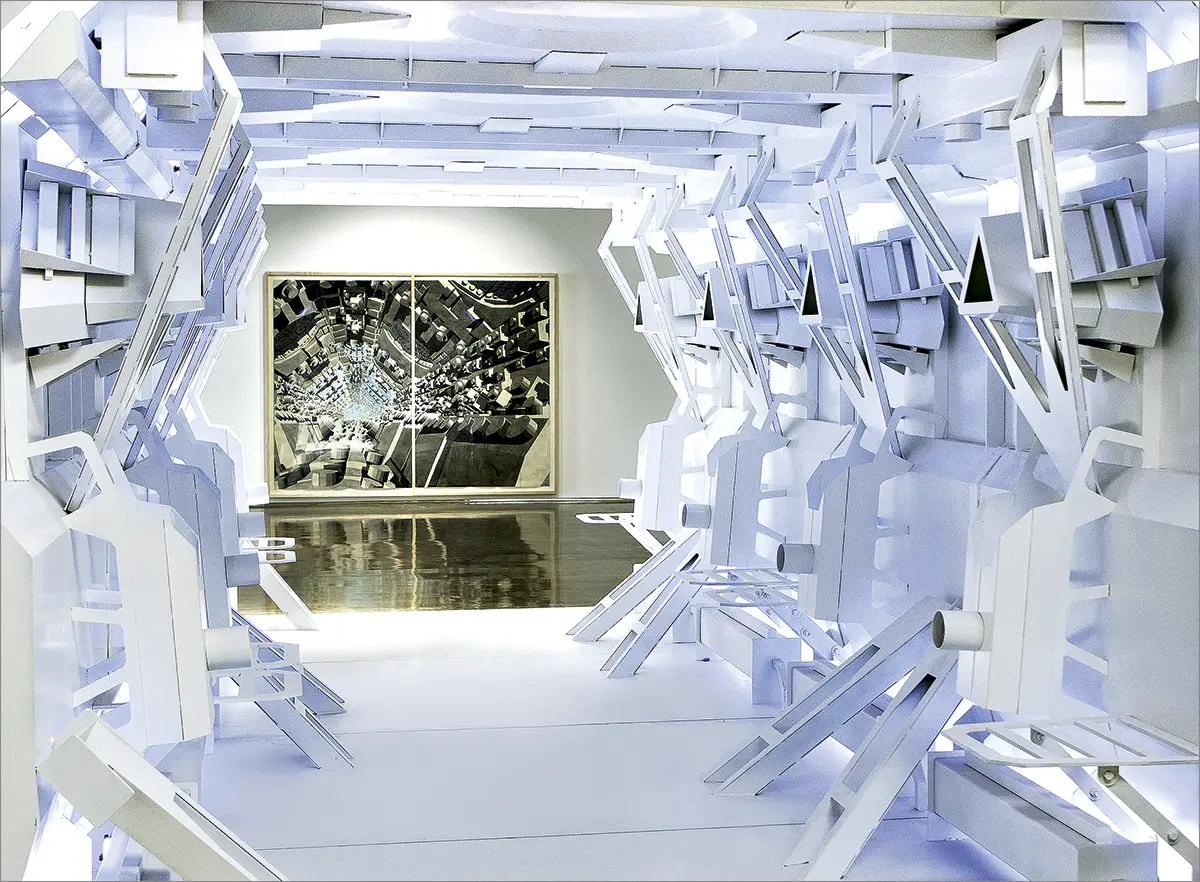
Whereas in Guerra interior the gaze reflected above all on permanent global war, in Planeta de cristal (2021) Rodríguez recovers an emphasis on that planet-wide dwelling, increasingly more strained by wars, the pandemic, climate change, or Wall Street, as the manifestation of the new barbarism of ultraliberal capitalism. And he recovers this emphasis to the point of making it the central axis of his show. This discourse funds its metaphorical translation in an iconographic constellation of buildings, tunnels, bunkers, cities with the appearance of natural telluric shapes, or circular structures allusive to the planet, etc. It is an iconographic repertoire, as in Iceberg de ladrillos (Brick Iceberg), Hielo 7 (Ice 7), Planeta de arcilla (Clay Planet), Planeta de cristal (Crystal Planet), or he series Colisiones (Collisions), which speak of a kind of architecture of confinement, of isolating constructions, the meaning of which seems rather that of a post-apocalyptic dwelling from which beings must seek shelter, traversing the night in these places where we can be, but which we cannot inhabit. The bunker and the tunnels, the icebergs or the mountains tattooed with reliefs that suggest the constructions of a dystopian architecture, speak of an “entrenchment” of life. They suggest the endemic fragility of existence in the current circumstances, marked by the urgency of a state of siege and by the exceptionality of the communal both in the public and the private space. Rodríguez has acknowledged that these works in Planeta de cristal are, in a way, an imaginary response to the sensations and feelings of anxiety and uncertainty he experienced during the harsh confinement of 2020.
As viewers explore the show and pass through the monumental metal sculpture Túnel blanco (White Tunnel), when they immerse themselves in the large watercolors of those tunnels and bunkers, made in a neo-figurative language not devoid of surrealist echoes, they will inevitably experience a certain unease, the saddening feeling that life is elsewhere. Because whatever the place, however sophisticated comforts we have to shelter us, one can be there, one can even reside, but these will never be spaces for a true dwelling.
NOTE
1. Dennys Matos: “Dagoberto Rodríguez. Guerra interior”. El Nuevo Herald, Miami, November 12, 2020.
DENNYS MATOS