
Bogotá’s MAC hosted Casa Hoffmann’s itinerant curatorial project CYBER ERA, which had previously been at the Chamber of Commerce and the Museo de Pereira. “CYBER ERA” is a group show that follows a narrative thread in three episodes: Extinction, Genesis, and Technotropics. This review aims to give an account of some of the exhibition’s works and artists.
“CYBER ERA” constructs an immersive environment, a strange world generating constantly enveloping soundscapes that invade its visitors even before they establish a visual dialogue with the works. Like the jungle, “CYBER ERA” is never silent, never still. Sounds get under the skin and brush against neurons, activating the body far beyond the visuals and adding a sensory layer to the experience of this exhibition. The curatorial fiction starts with the sixth mass extinction, brought to its most extreme consequences at the end of the 21st century: rising temperatures reduce oxygen levels and cause extreme atmospheric phenomena; consequently, all animals on Earth, including humans, disappear. Emancipated and conscious, Artificial Intelligence (AI) sets in motion a plan to regenerate ecosystems through insect-like devices that collect information and communicate with each other to design a single algorithm that will define the future behavior of planetary cycles and trigger a new era on Earth.
“CYBER ERA” is no run-of-the-mill curated show. Artists do not illustrate the curatorial theme. The different works are narrative pieces within a story born from their coexistence in Casa Hoffmann’s ecosystem. Works and artists define a trajectory, a gaze, an engagement with a space that has been hosting multiple kinds of curatorial investigations. The present exhibition goes one step further, adding a literary element as a narrative medium. The story and the artworks complement each other as intertwined formats that allow spectators to enter the game and sign a secret pact with the exhibition. The result is a museum staging that takes sides with one of the most relevant issues today: the future that awaits the planet if things continue as they are and global warming runs its course. The overwhelming reality of climate change as a phenomenon that already affects our daily lives permeates the imaginary of a dystopian future; science fiction used to seem far away: other galaxies and other planets to be conquered, colonizing extraterrestrials... Today, imagined scenarios in which our world will no longer be the one we knew because it will have already disappeared seem to be just around the corner. If we fast-forward a couple of generations, there it is: the total melting of the poles, the disappearance of pollinators, and unsustainable temperatures for most living beings. Taking sides is important and putting the issue on the table is urgent. As Philip Kitcher and Evelyn Fox Keller say in their book The Seasons Alter: “We need to talk.” In their essay, they also project a fiction: in 2159, human survivors commemorate Climate Day and review the pandemics, wars, and forced migrations that took place until reaching that commemorative moment. They look back feeling sorry for the human ignorance, stupidity, and greed that made us incapable of taking care of what we had. The other fictional tale in the book is the conversation between two people about climate change, opening the debate between “denialism” and awareness of what is happening and why. The book presents two groups of human beings who survive decades of calamities we don’t even want to imagine, just as it is hard for us to think that from one moment to the next there will no longer be a life outside our window because there will no longer be a window, nor an inside or an outside, and no eyes to see with. This approach is the starting point for “CYBER ERA”.
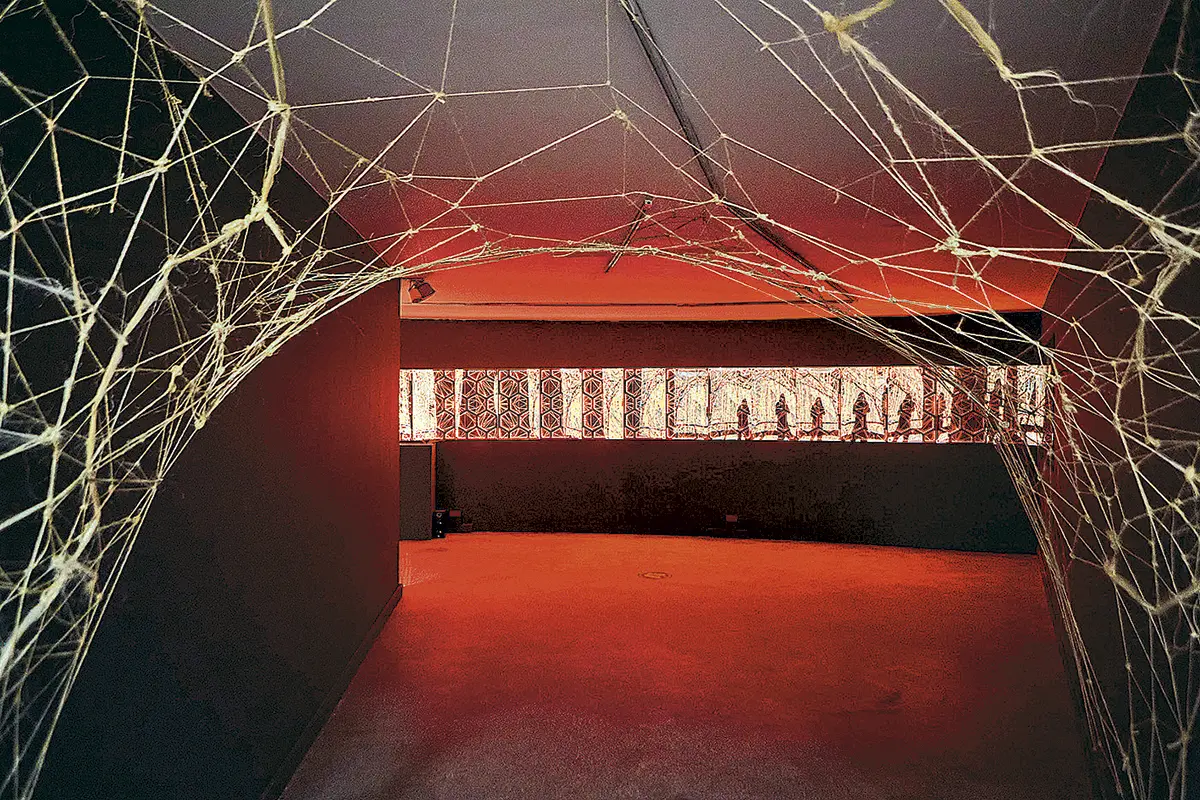
“CYBER ERA” welcomed us viewers with a range of grays to distance our experience from any reminiscence of the world as we know it. Gone are the colors of life and biodiversity. On the first floor of the museum, Extinction underscored these extreme weather events. Sandra Rengifo’s work, from her series “Limbo,” still offers a romantic look based on a landscape about to fade out. We also encounter a far-off vision projected through scientific and technological means in this introduction to disaster, as in the works of William Aparicio (Geo Bits) and Juan Cortés (Origin. Variation II), who offer us an overhead view of the Earth through the ever-vigilant satellite eye. On the other hand, in Pollen Surface María José Leaño magnifies microscopic reality to generate landscapes from another world, which are actually surfaces of different types of pollen. Here we not only experience mediatic distance, but also an invitation to empathize and place ourselves in context. In Sonia Rojas’ Devenir Tierra (Earth Becomes) wind and sand blow in an uninhabitable landscape contained inside what looks like a fish tank. Are we relieved that we’re not in there? But are we not in there already?
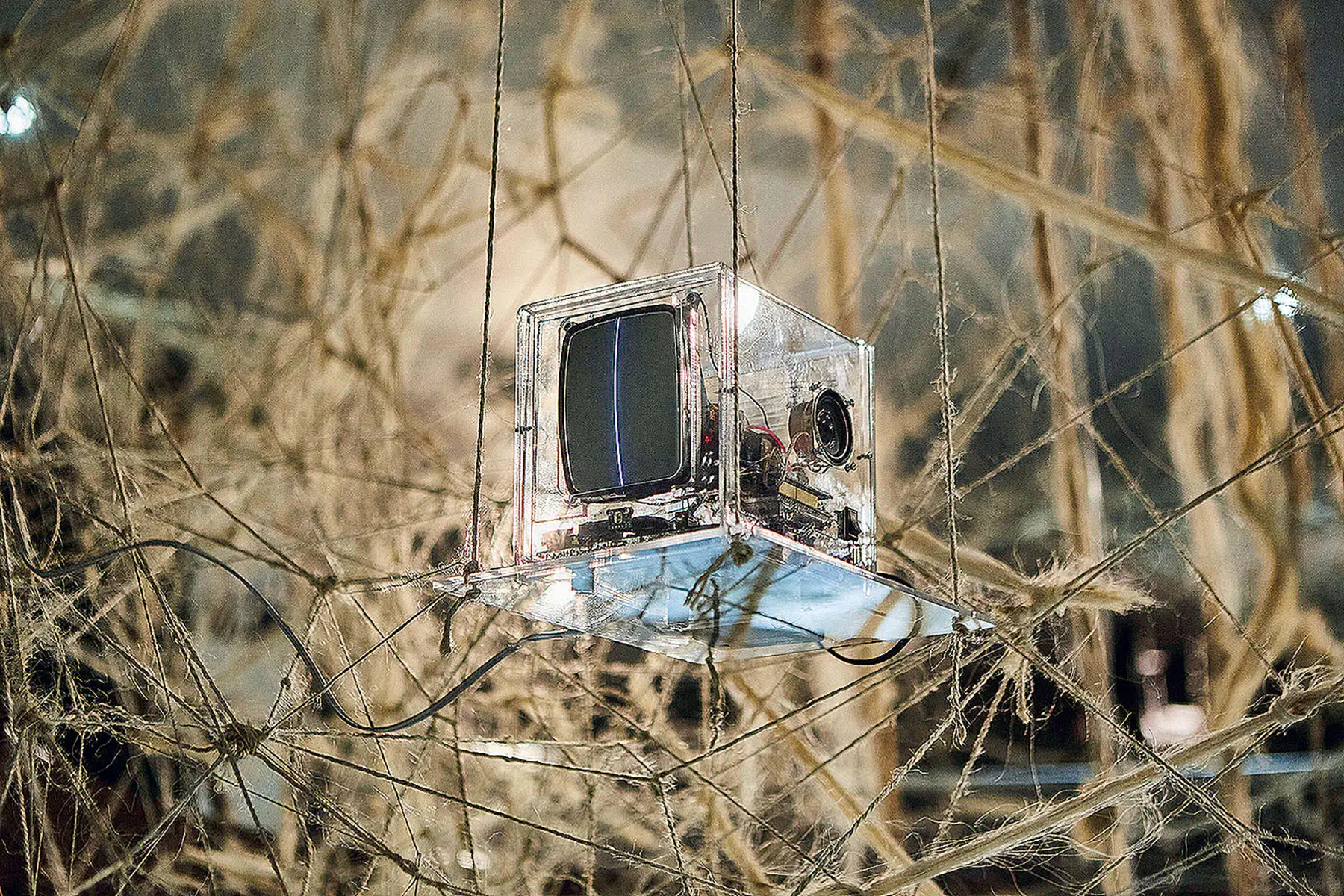
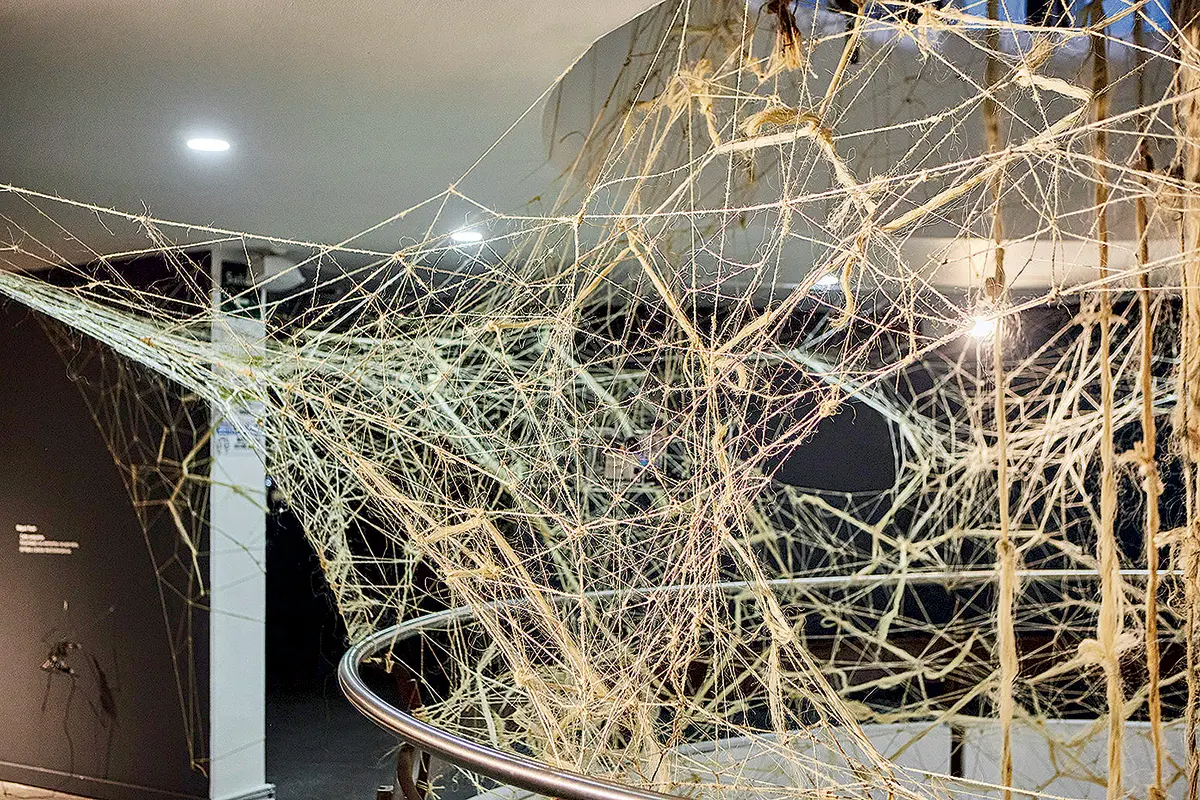
The second moment, Genesis, is ground zero after the cataclysm; the embryonic state of a new awakening, or rather of a new detonation for Artificial Intelligence (AI). Genesis played with the museum’s architecture, invading the stairwell as a place of incubation. The natural fiber structure of Silent Adaptation #3 by Ana Escobar houses the heartbeat of Rocío Pardo’s monitors (Attempts 1, 2, 3 and 4) and Alejandro Villegas’ digital eyes (Desiring Machine #1), leading to the work Untitled (Random Growth Structure IX) by Cristina Figueroa, a woven pita sculpture, possibly the last exponent of human and manual work on Earth. Four artists with different but related languages form a perfectly matched assemblage to establish the natural network in which life is reset: we have reached the end of the Anthropocene and the “CYBER ERA” begins. One of the transitional works, INFINITY V2 PLAYGROUNDS by Gabriel Pulecio, is really the only high-tech work in the exhibition, and generates an audiovisually-immersive structure. We can imagine INFINITY as the central brain that houses the algorithm, or the working and resting space of the colonizing insects. Despite being a futuristic work, it evokes the nineteenth century, perhaps because it’s slightly reminiscent of a factory that emits superhuman sounds and setting the rhythm for production, or of the film Metropolis by Fritz Lang (1927), because of its colossal and futuristic nature.
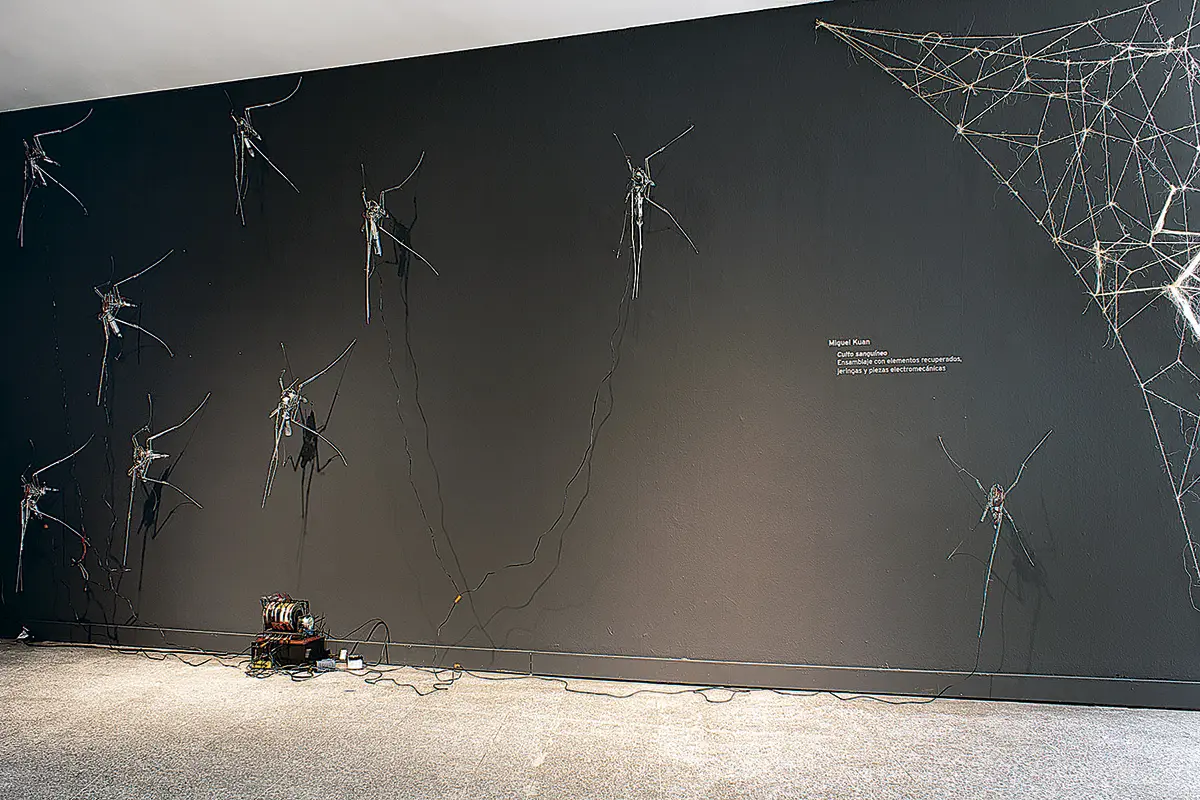
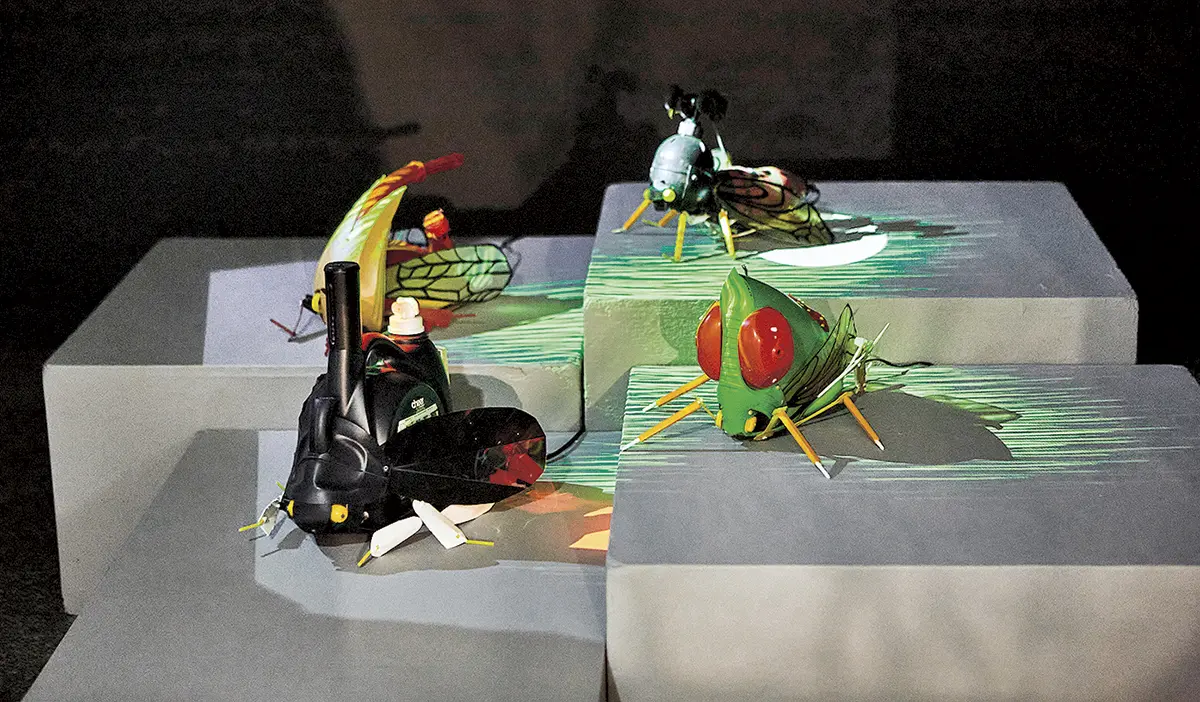
Technotropics, the third and final chapter, is an ode to low-tech. This is the common denominator of those machines and bugs inhabiting the outcome of this story. One could imagine a highly technical future, but “CYBER ERA” resolves narrative tension with a touch of realism and humor. The future will not necessarily bring highly technical solutions. The works in this chapter are, for the most part, made with recycled material, Ricardo Arias’ Sound Object or Carlos Bonil’s Membracidae insects, which are three-dimensional illustrations taken from science fiction B movies made with plastic detritus. We also came across dancing screws and pins in Andrés Felipe Ñáñez’s Pythoness Pacemaker and organic matter mixed with technology in the Chancletópodos sculptures by Juan Melo, who mixed calabash and bamboo with “mestizo robotics.” Melissa Pareja’s sound sculptures fuse design, textile, and sound art, and Miguel Kuan recycles electronic waste in the terrifying scavenger installation Perishable. His Blood Cult mosquito-like techno-monsters are ready to launch into action: syringes never looked so terrifying. The soundscape in this chapter involves two contrasts: on the one hand there’s Leonel Vásquez’s Modular boulder, and on the other, Jorge Barco’s Space Nomads. The first piece may be a nostalgic tribute to the missing and the extinct; the second one looks out into space, towards a possible future.
Perhaps “CYBER ERA” poses a somewhat unlikely future, as science fiction often does. But if we look closely, we may realize that a sober decision was made to get out of the way. This puts forth the unreliability of human beings as the dominant species responsible for giving rise to global warming. It suggests, ultimately, that after us, life—however and whatever it may be—will go on. To accept this is an exercise in humility that should help us to remain on the same level as any plant, insect, or any other animal. Despite the murkiness of these conclusions, we cannot help indulging in a game of technological humor and auditory tickles. And now, let’s face it, “we need to talk.”
*Courtesy: Casa Hoffman