The work of Cecilia Paredes, now on exhibit at the Ruiz-Healy Gallery in NYC, is a refreshing aesthetic incorporation of performance art and photography in cooperation with painting and textile manipulation. It is presently on view at the Ruiz-Healy Art Gallery, a gallery space in the upper East side that has the distinction of having hosted many years ago the famous CDS gallery form Caracas under the direction of the late Clara Sujo who was fundamental in promoting Latin American artists Soto and Matta.
The artist is featuring herself in the works, which are series of photographs that depict her investiture into a painted, and wrapped subject that covers the entire work. Her body is carefully painted with the same patterns of the textiles that cover her partially; this is the performance part as the painting of the body can take up to nine hours of excruciating detailed work, that matches the textile she has partially incorporated into her body wrapping/covering. Some of the photo performance inkjet prints, like Whisper also integrate her face into the composition, where she appears to emerge quite literally from an enchanted garden, an exotic jungle of leaves and flowers that we perceive simultaneously as forms in nature but processed as a framework of processed images derived from patterns in textiles. The eye recognizes that these forms come from human, rather than nature’s invention, but the volume of the body, indicating a sculptural presence to what we see, makes the photograph appear closer in perception to a sculptural relief.
Cecilia’s work elicits allusions and commentary on the discourse that contemporary artists have been having about the fragility of nature, our recent realization of the emerging new dangers of over production and usage by large post-industrial populations on natural resources and the well-being of nature at large.
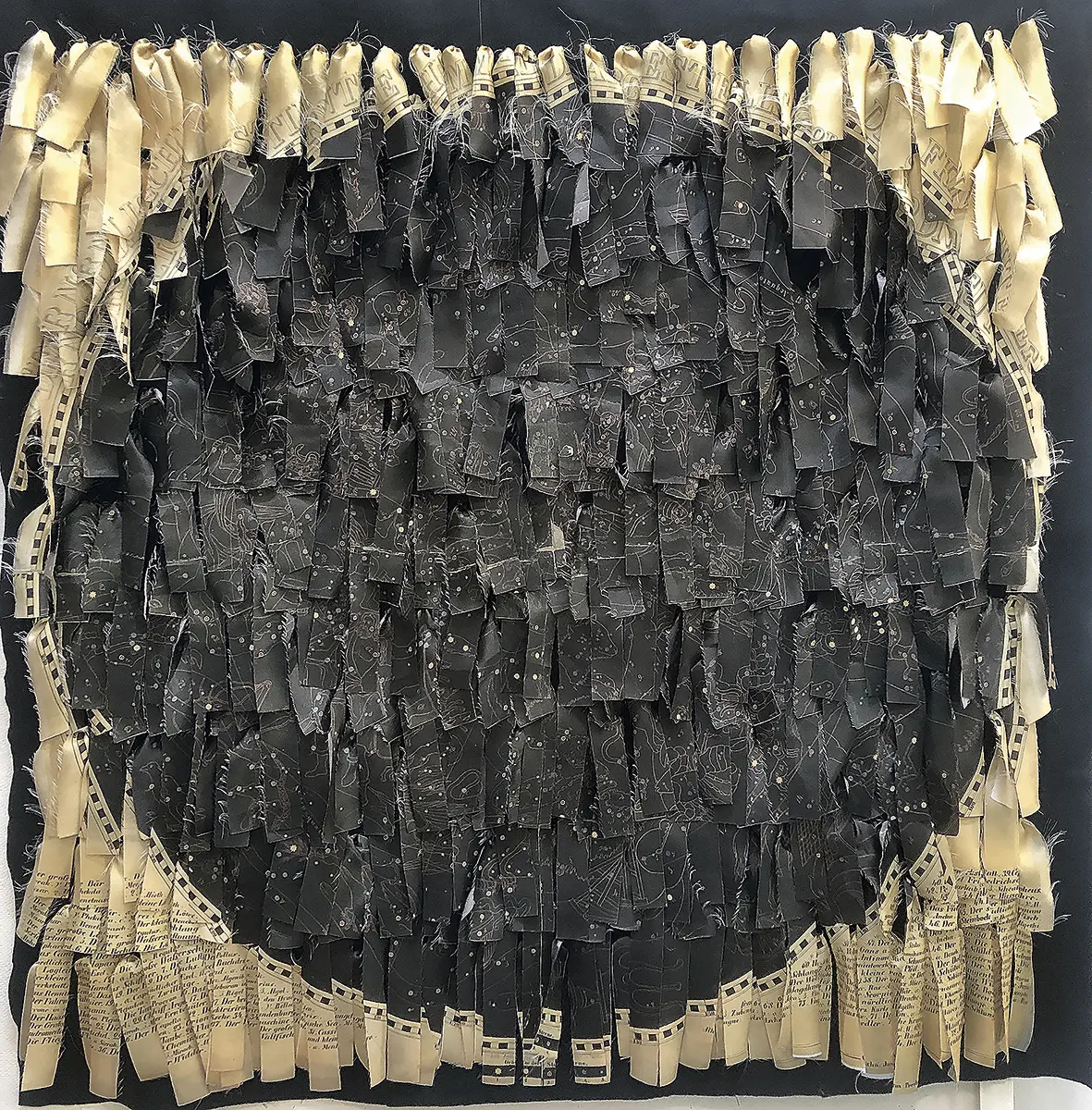
Her subtle commentary is best illustrated in her impressive work, Constellation, which is described in the gallery notes on the piece as made from discarded and intentionally aged materials. A circle inside a square composes the center of the work, which are sewn and layered fringes of intentionally aged used cloth of dark color upon which we see the constellations as they would appear in an antique globe depicting the heavens. Around the circle, in a light shade there are more fringes with what looks like writing from ancient manuscripts. The general impression is perfectly described in the gallery description of the piece in the notes where it is stated that This work is an allegory of how we humans accommodate and re-accommodate our ways to insist repeatedly on living without caring for the planet. The reconstruction of the heavenly map indirectly points out as well the tragedy of lost knowledge and culture that has been endemic to human civilizations since the very beginning of history and weaves that narrative into the contemporary challenges of conservation. As a Peruvian artist the presence of the cloth fringes is also referencing the quipus, which were the cloth knotted strands used by the Incas to keep records.
Another piece, Proud Waves, also draws inspiration from the quipus, which were also used as depositories of census information. Here Paredes aims to make us participate in a real life story that punctuates the struggle that women still have to undertake in traditional societies that keep them tied to old beliefs. The silk she used for this piece is originally from India and is collected from the rims of women’s garments that are cut off before they are allowed to enter temples because they are considered impure.
A piece that relates to the theme of endangered species is beautifully expressed in Of Wings and Thorns where only her head can be seen from behind, emerging from what looks like a conglomeration of birds. Upon close examination some have labels hanging, with the classification names written out as if these were taken from a book of species, such as the famous Audubon series on birds of America which brings to mind the idea of encyclopedic fauna and floral books that were published in the 19th century when more species started becoming extinct than at any other point in history, although that is not precisely the reason that the publications appeared, but rather because it was also a process of providing illustrations of faraway places that were quickly colonized by the European powers, eager to expand their spheres of influence in all continents. Due to the quick development of industries the natural environment was infringed on and the living spaces of animals threatened by the consequences of pollution, which came to the fore in increasing waves as the century progressed, and spreading from the industrial nations to the colonies later.
This exhibition is the first for the artist in New York and very much in good timing with the pandemic that has brought renewed attention to conservation and the reality of climate change that will carry on, beyond the new ‘normal’ time that has now become an everyday reality for all.
ALBERTO BARRAL