The city is not only the material, but also the critical reason that permeates the work of artist Carmela Gross. This definition, given by the artist herself in an interview (2017) reproduced on her website, reveals a peculiar vision of the urban and its relation to art. This can be seen in the solo exhibition “grietas, chispas” (cracks, sparks) in Vermelho Gallery in São Paulo, where besides the video Luz del Fuego II (Light of Fire II) from 2018, three new installations were shown: X, Fuente Luminosa (Luminous Fountain) and Cabezas (Heads), all from 2021.
In every piece, urban signs become materialities composing a poetics whereby the city reveals itself visually “transcoded.” In the gallery’s facade, the installation X shines brightly like a big metropolitan landscape, creating tension between the vertical and horizontal axes and making the large rigid surface of the wall connect to the ground. The idea of connecting those two axes is fundamental in Carmela’s work, especially in X, which requires the physical participation of the viewer.
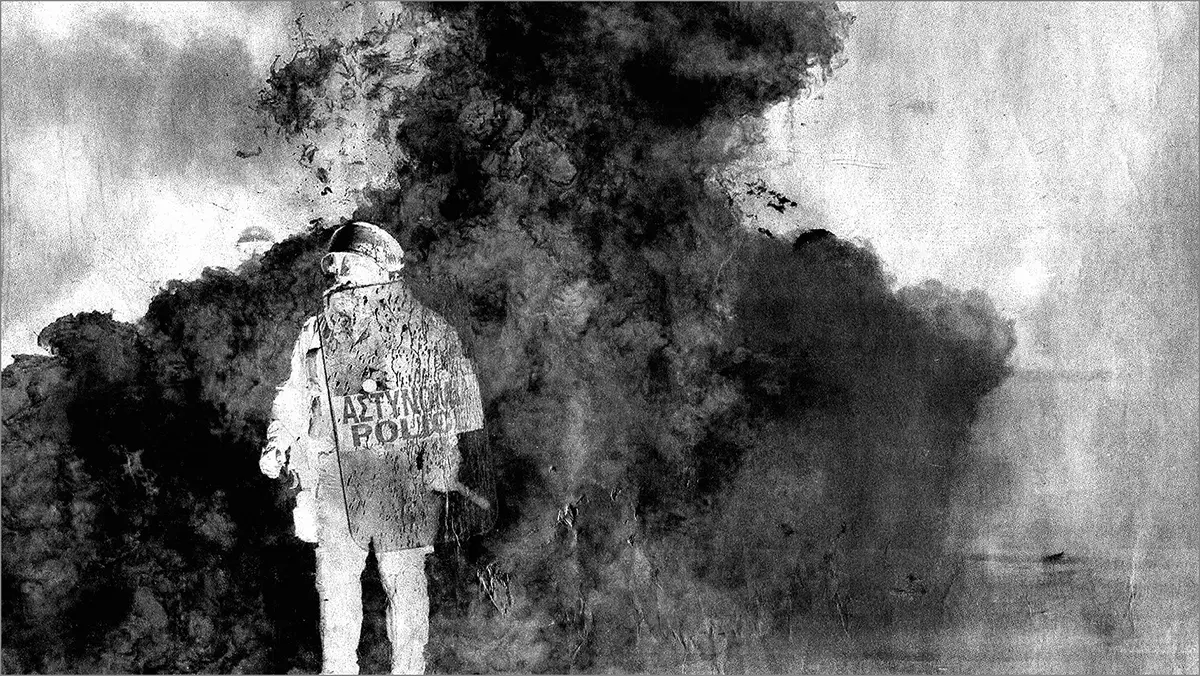
Fire is a constant element in the show. Luz de Fuego II uses images of fires that were published in daily newspapers. Fires in cars, constructions, car tires, and streets, mark these images representing conflicts and confrontations in diverse countries. Images of fires that consumed Brazilian cultural institutions in recent years are also in this video piece; a negative document, in black and white, of events that since 2008 have filled the pages of the main newspapers of the world.
Fire reappears in Fuente Luminosa in the form of volcano lava. In this installation, Carmela draws on the wall with incandescent gas contained in neon red lamps. The process results in a visual metaphor for the materiality of a volcano, with drawings of strings and lines adjusted to express their own dynamic and internal coherence, widening the impact of explosions of rock liquefied by heat and pressure.
Cabezas is composed of 226 drawings of variable dimensions and made on paper with India ink, expressing again the idea of carbonization. The drawings are made with ink stains on glass. Carmela places a fine paper on top, which absorbs the ink and, after it dries, she removes the white remains of the paper and perforates eyes and a mouth to create a human face. These formless figures are insinuated as if by chance. It’s not something sought or constructed, but a process that induces the discovery of unimagined faces. The possible multitude of a city that encompasses every diversity, like São Paulo: the “material metropolis” of Carmela’s poetics. The dimensions become gigantic with all the accumulated heads, giving the work a significant visual impact.
Born in São Paulo, where she works and lives, Carmela includes in her work an affective aspect generated in public space. Since 1969, when she finished her Art degree in the FAAP (Armando Alvares Penteado Foundation), Carmela has referred to the city as her experiential universe. In more than fifty years, her body of work has been built as a common vocabulary with what she sees on the streets, avenues, and other urban configurations, such as her use of neon from the facades of commercial establishments. Besides the pieces in Vermelho Gallery, the artist recently presented her installation Boca do Inferno (Hellmouth) in the 34th São Paulo Biennial, as well as a new work of great dimensions on the external wall of the MAM-RJ. This edition of Biennial also included Carga (The Load), Presunto (Ham), and Barril (Barrel), which had been part of the 10th edition, in 1969. During the pandemic, like many artists in their home studios, Carmela maintained a daily, heavy work routine that in reality didn’t much alter her “solitary” art practice. She kept gluing, drawing, wrapping, staining, perforating, and painting to create works that reflect the solidity of bodies (including the artist’s) in relation to the city.
Carmela’s poetic individuality doesn’t indicate a distancing from her cultural relations with the urban. An emotional attachment, built from urban elements and living with the city, has shaped the body and experience of an artist who has worked in public squares, with children, in the periphery, in communities... An entire universe of urban languages has become the center of her work. Carmela always carries her peculiar biases when she approaches the city, as she said about her show in Vermelho: “When I say that I work with street elements, I mean my body. All experience lived, historical, memorized, and incorporated into my way of being informs the work, but making it has always been a solitary act. Experience becomes a body, meaning that it becomes part of it. The work is mental and physical, but solitary. It’s about a discipline of solitude.”
The perception of spaces and their surroundings, like buildings, architecture, crowded people and information, is medullar to Carmela’s work. Highly concentrated in the experience of a single city, São Paulo, her practice ended up becoming an immersion and a return to diverse dimensions and layers, as the artist explains: “The work has an ability to merge with its surroundings. Sometimes it seems like it was made for a specific location; but really, it’s the ability to contract and absorb the environment; a pole, with all that surrounds it ending up by making a certain sense with it. It is not the work that goes to a specific place; it’s the opposite: the place becomes specific because the work was made there.”
ALESSANDRA SIMÕES