Harp of silence
where fear nests.
Moon moan of things
signifying absence.
Space of closed color.
Someone hammers and builds
a coffin for time,
another coffin for light.*
Alejandra Pizarnik, Memoria*
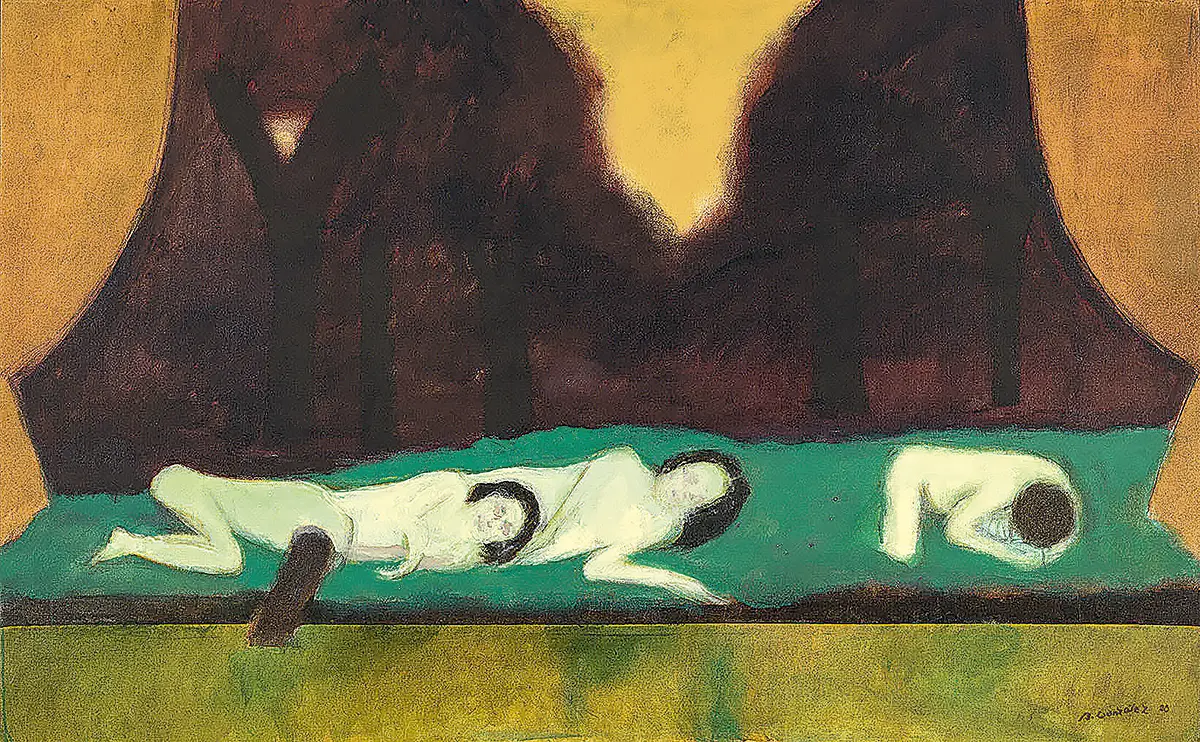
Funebria. Blurred silhouettes, as if the wind had erased the face, the hands, the limbs, while a spirit—poor, ragged and mute—cries in silence. They are things of death; of death by an extreme violence that returns in a new cycle, slow and persistent, yet devastating in consequences that cloud the geographic horizons of the global South: there, out of sight, in territories where wealth is extracted, dispossessed, oppressed, squeezed; while meaning is expelled, life is slain and with it, those who defend or inhabit it: each day, each name and person, each being, each form, drop by drop. Everyone is silent. No one sees. In the solitude of shadows, fear creeps in. Silhouettes repeat themselves incessantly like macabre patterns from the history of the dispossessed; wanderers forever haunted by horror. Where is the light? Maybe at the back. Inside that box. In the dark bottom of this coffin. What incantation of women in vigil, what sacred alliance with the forests at the break of dawn, or twilight, will come at this hour of death with twitching hands and gestures?
animal thrown upon its distant trail
or naked girl sitting in oblivion
while her broken head wanders weeping
in search of a purer body.*
Funebria. Another miracle of painting, where the colors inhabiting sites of remote burials and a gesture of the mourner who waits on this side of barbarism, encrypt the memory of that instant for eternity, in crystals of transparent understanding, which is fleeting and will pass, but with the promise of reappearing at the sight of History.
But they will teach us that Eternity is the Standing still of the Present Time, a Nuncstans (as the Schools call it); which neither they, nor any else understand, no more than they would a Hicstans for an Infinite greatness of Place.1
Memory encrypted by the miracle of painting, perceiving and caressing it, touching the extreme experience, touching justice, condolences, mourning and grievance; fused in blood and ashes. Sensitive memory embodied in these blurred bodies of mist; the weeping captured forever. The weeping of those who wept alone, inaudibly; and now, the ceaseless weeping of magnificent forces.
the castaways behind the shadow
embraced the one who killed herself
with the silence of her blood
the night drank wine
and danced naked among the fog’s bones*
Beatriz González takes slow steps at this time of her life; a time when her art flies farther, as if it carried the weight of those forces no one understands and that in her work have blossomed at last, clearer than ever. Brushstrokes free of any doubt, although born of the clumsiness of hand and eye—made of glass also—with which she can see only into the mysterious sphere that Borges also gazed at… I saw the circulation of my own dark blood; I saw the coupling of love and the modification of death; I saw the Aleph from every point and angle, and in the Aleph I saw the earth and in the earth the Aleph and in the Aleph the earth; I saw my own face and my own bowels; I saw your face; and I felt dizzy and wept, for my eyes had seen that secret and conjectured object whose name is common to all men but which no man has looked upon—the unimaginable universe. I felt infinite wonder, infinite pity.”2
Brushstroke by brushstroke, the simple coffin is painted. The excavation. The earth. The shadow. The night vigil. The torso bent in tears. The funeral song. The dawn. The painter has vanished. Blurred, the painting is left in charge of the silence lingering in the crystals of encrypted memory.
silence
I join myself to silence
I have joined myself to silence
and I let myself do
I let myself drink
I let myself speak*
The exhibition that Beatriz Gonzalez has given us at Zurich’s Peter Kilchmann Gallery is a moment to treasure.
NOTES
* All verses are by Alexandra Pizarnik. In order of appearance: “Memory” (Cecilia Ross, trans.); an extract of “Diana’s Tree” (Carlos Rojas, trans.); “The Castaways” (Lydia Merriman Herrick, trans.); “Silence” (L. M. H., trans.).
1 .Thomas Hobbes (1651), Leviathan, extract from Book IV. This passage is also the epigraph of “The Aleph,” (1945), by Jorge Luis Borges.
2. Extract from “The Aleph” (Norman Thomas Di Giovanni, trans., in collaboration with the author).
M. BELÉN SÁEZ DE IBARRA