Strange and unfair as it may seem, this is the first solo exhibition of works by Venezuelan sculptor Asdrúbal Colmenárez (1936) in a museum in the French capital; he has been present only in three group shows (1) and in a solo outing in the southern city of Arles, at the Musée Réattu, in 1981. Yet Colmenárez’ history in France, and specifically in Paris, where he arrived in 1968, is long. He presented his earliest psycho-magnetic creations in 1969 at the Paris Art Biennial, invited by Frank Popper (whose assistant at the University of Vincennes, as well as a friend, Colmenárez became.) The following year, the French Government granted him a study fellowship. Colmenárez currently divides his time between Paris and Tenerife, in the Canary Islands, where he works part of the year. Between 1988 and 2003, he created several monumental works in different countries, among them Japan, South Korea, Colombia, and Venezuela. He didn’t have any commissions for urban spaces in France though, a whole aberration all by itself.
The Musée en Herbe, established in 1975, presents art exhibitions adapted for all ages, “from 3 to 103,” as its presentation leaflet has it. A series of collaborations with internationally renowned artists such as Murakami, Niki de St. Phalle, Louise Bourgeois, Salvador Dalí, and Hundertwasser, gave credence to the seriousness and freedom of the museum’s proposal, where children continue to be the protagonists (and collaborators) of the interactive visits but all generations are invited to contribute. With this appealing focus on art that calls forth playfulness and humor, the Musée en Herbe attracts over 130,000 visitors each year.
Colmenárez sees being invited by the Musée en Herbe and working with children as “an achievement” and an “evident result,” inasmuch as the true foundation of his creative focus is the interactivity that exists in the viewer’s motion, transformation, and participation. The artist, now 85, was given free rein to intervene the museum’s spaces, which displayed nearly forty of his works in six galleries, combining older productions with new items created specifically for the occasion. Asdrúbal Colmenárez has Calder’s physical stature and also shares the child-like, mischievous gaze with which the American giant contemplated his circus in 1931.
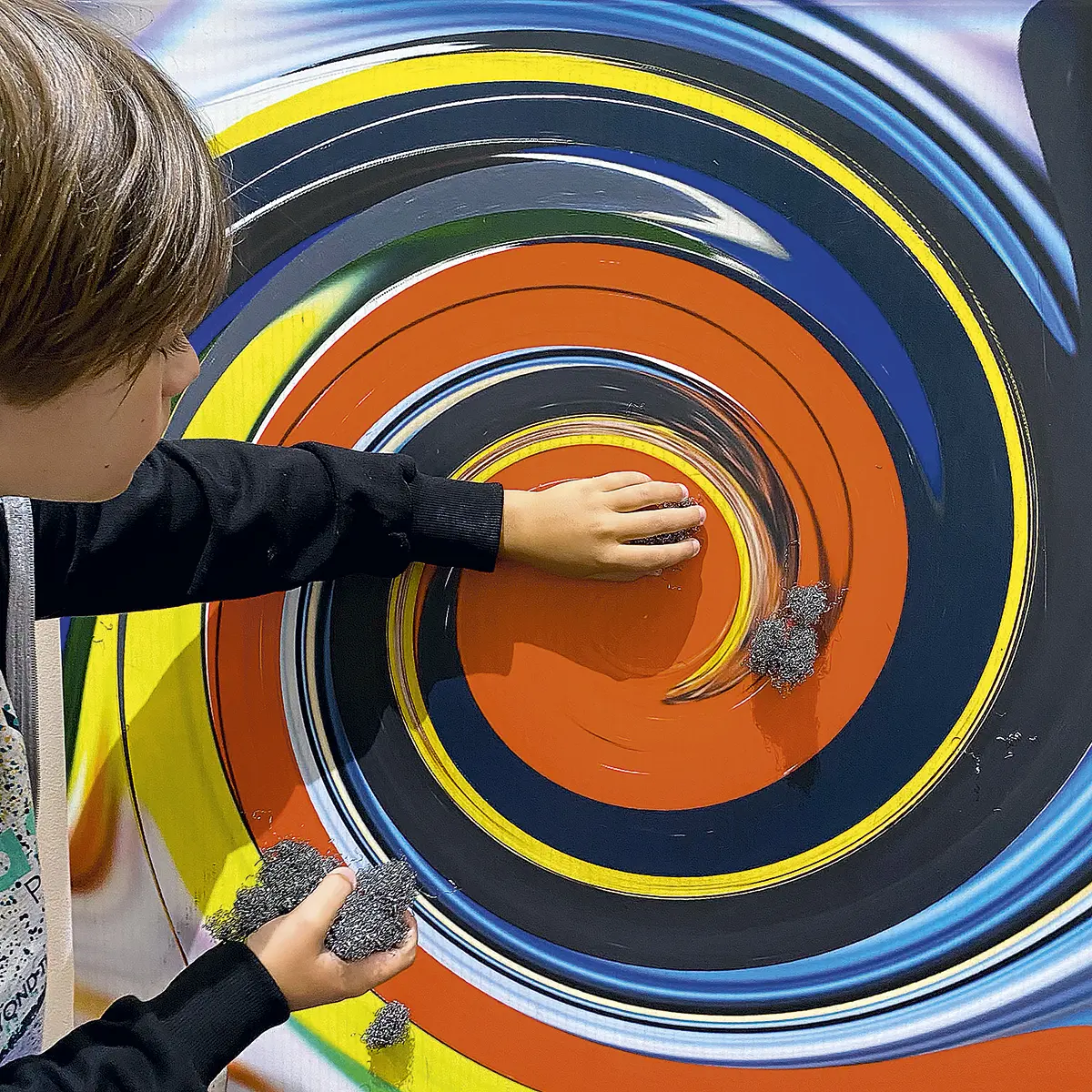
From the very entrance to the museum visitors are invited to immerse themselves visually in the optic games generated by the geometric paintings and relief (3D) elements that cover the walls. After this initial plunge into the artist’s plastic, polychromous universe, the first gallery holds works that connect Colmenárez’s private world with his creative project, in a display cabinet featuring articulated metal toys, crime novels, and photographs of his favorite artists, filmmakers, and philosophers (Jackson Pollock, Donald Judd, Godard, Sartre), along with small metal robots, invented models like the Don Quijote, from 2018, etc. A veritable emotional and intellectual selection sharing the space with Colmenárez’s famous giant multisensorial alphabet. Created between 1971 and 1978 (three versions), the latter work invites visitors to manipulate letters manufactured in various materials (fabric, metal, pelt), bringing to bear both their sense of touch and their playful delight. In the second and third galleries we encounter, first, the Psychographiterres miroirs (2012), Colmenárez’s interventions on metal dust adhered to the surface of the support, which can be modified. Next are the Psychomagnétiques, where manipulable magnetic strips open up infinite possibilities or the transformation of the work.
The fourth and fifth galleries invite us to play with color, but this is much more than an anodyne game if we keep in mind Colmenárez’s color-blindness, this is to say, the fact that his perception of color is distorted yet does not constitute an obstacle for him. There we encounter a veritable challenge with his Psychorelatifs in fluorescent colors that can be moved manually across a transparent plastic screen. In the sixth gallery, freedom to manipulate is complete, and children of all ages can enjoy themselves thoroughly as their adventurousness to express itself in full. The exhibition’s final section offers visitors a chance to navigate between a device for drawing on walls, “giant” pinball machines, an immense blue psychographiterre, and to participate in the creation of an outsize sculpture from plumbing pipes.
Magnet, motors, metal, plastic, mirrors, metal dust, stone, fabric, pelt, etc.: Asdrúbal Colmenárez sets no limit to his desire to be who he is: an artist who thinks, lives and shares with others his joy in creativity. In the most recent interview he gave on the occasion of this show, the artist said: “I am interested in the idea (...), when you are able to put your idea into practice. Only when you are having fun you are able to do things! An artist does not seek a better economy. The artist transmits the sense that life itself can be better. What irks me about people are their certitudes! I want my art to provoke doubt and prompt questions.”
NOTE
1. Transferts group show (with Marcela Gómez, Frida Baranek, Gladys Nistor and Patricia López Merino), at the Maison de l’Amérique latine, Paris, May 18 to July 21, 1995, an exhibition I curated (catalog).
CHRISTINE FRÉROT