The vigorous relationship between originality and influence emerges in the wide spectrum of artistic achievements, and in all other fields of life. Across the centuries of national artistic developments, those who studied and generated works of historical, natural, abstract or indigenous references, are consistently framed in any of these categories. Ángela Gurría, without ignoring these aspects, developed early original and personal conceptualizations that do not seem to possess major influences, but rather interior immersions, spatial experiences, and social concerns. To compare Western-European parameters with indigenous ones is not a common practice in relation to works of art. There are indeed instances where some coincidences are treasured, although little attention is paid to them by students, artists, theorists, critics, or collectors. The gaze exerted on finished works and those on display generally does not promote assessable comparisons due to the usual “Do Not Touch”, for example. Comparative frames of reference are dimension, color, illustration, synthesis, or detail, which are exercised above all through quick glances at the surface planes of extremely diverse works in origin and results. Moreover, no relevant depths are attained because most people lack training in both fields.
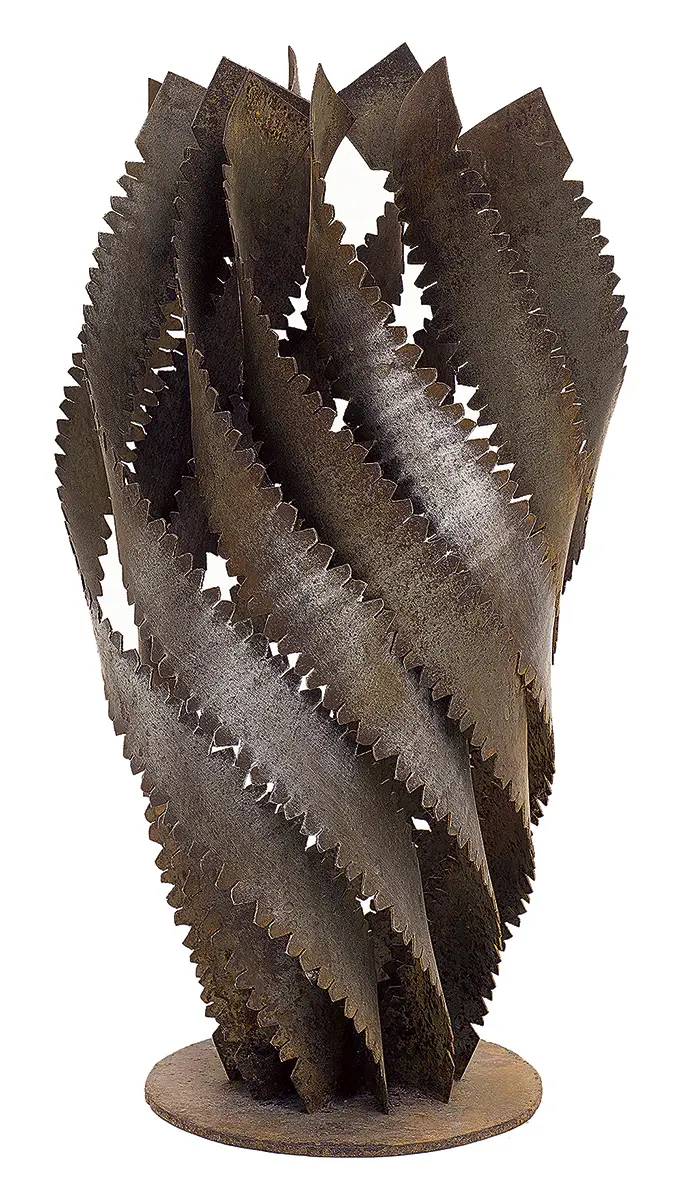
Since pre-Columbian times, a resounding axiom reveals a situation: Escuchar la materia (Listen to matter). This is the title of Ángela Gurría’s exhibition at Proyectos Monclova in Mexico City. Likewise, it is a phrase that those of us in the visual arts have heard and said countless times. Although there are works in various disciplines that make such integration explicit, it is most evident in sculpture and its ramifications. My thoughts on this subject refer to something that seems to occur in a triadic tandem: artist, material, and work. Escuchar la materia. What matter? Gurría has worked predominantly in stone and metal, although she was occasionally interested in mid-twentieth century expressions and materials, which was a dynamic and intense period in Mexican art. She seems to have followed in the footsteps of two ancestral elements that have left us testimonies from remote times, without closing the door to new situations. Listen to matter... and, the same time, keep your eyes open. This is how Angela Gurría generated her versatility. Representing emblematic vegetables such as cacti, the artist chose a unique and multifaceted Mexican vegetation that is allied with drink, food, and symbol. In the works of this remarkable artist, both stone and metal are perceived with softened curved angles or very sharp ones. Within her relationship with geometry, circles have a resonant voice in her compositions and establish a discreet relationship with the heavenly bodies.
This critical review takes a bird’s eye view of this prolific artist. Bypassing biography, this review reflects on the wide spectrum of her achievements and their distinguishing features. Her work did not seek ornamentation; Gurría incorporated carved edges in low relief, or predominately geometric projections with animal and vegetal references, such as Reclining Woman with Owl from 1962, ¡Ya basta! (That’s Enough!) from 1992—one of Gurría’s humanist claims—or Lattice with Butterflies from 1993, and The Flight of the Butterfly, from that same year. To give an idea of the breadth and range with which Ángela Gurría has worked, it should be noted that material mass and interspaces appear in her production, as well as marble plates and a variety of metal ribbons.
Ángela Gurría, born in 1929, is a milestone in Mexican art. Discreet, intensely prolific, her work seems to constitute a bridge linking modernist and contemporary art, but also—seen under this very lens—a ship that had previously crossed the waters from pre-Columbian to modernist times. As mentioned before, the mid-twentieth century was an eloquent period in the arts. At that time, she and a few others were working with Germán Cueto, who foresaw this postwar demographic explosion. One of her major non-individual endeavors was her participation in La Ruta de la Amistad (The Road of Friendship), the public project curated by Mathias Goeritz. Both Cueto and Goeritz are pillars of twentieth century art in Mexico, and of which Gurría is a leading voice. Was it by chance that Ángela Gurría took the paths of synthesis through territories of indigenous cultures to simultaneously traverse the movements of postmodernity? The authenticity of this artist is indisputable. That is why we believe in her deep intra-territorial views of languages, dances, rituals, textiles, and signs, such as Señales (Signals), which has stood since 1968 in the Peripheral Ring, as part of the outdoor corridor of sculptures that make up La Ruta de la Amistad.
GRACIELA KARTOFEL