Alex Trimino, a Miami-based Colombian artist, has widened the pathways opened in earlier centuries by the Arts and Crafts Movement and later by the Bauhaus, by combining two sources from different cultural eras: the millenarian use of fibers, with the incorporation of embroidery, weaving, crochet, or twine and threads on all manner of textiles; and the legacy of the pioneers in neon art who, starting in the 1960s, deployed in their minimalist, post-minimalist and conceptual works of art a material characteristic of advertisements in the society of the spectacle. To create her sculptures and her textile and light installations, Trimino picks up the thread of textile work that extends from prehistory, almost always in the hands of women, and disassembles it in order to produce new forms. And with those fibers, which contain signs of the memories both of her own ancestors and of the original cultures of the Americas, she painstakingly covers the tubes of the neon industry—almost always in the hands of men—or, as can be seen in her Shadows Play, from 2021, makes them malleable to her own expression, achieving sinuous curves that are almost impossible in that medium, interweaving vital cultural gestures and traces.
In the exhibition text for HyperLeak, arranged in precise dialog with the work of Felice Grodin, who also engages transformative forms that correlate with a “contradictory world” that, as she puts it, “is simultaneously global and territorial and essentially vulnerable;” critic Patricia Hernández writes that Trimino’s art “filters through the cracks of the present” and reveals “historical connections stronger than anticipated.” In adolescence, Trimino resisted learning to knit, because she saw the women in her family, all knitters, confined to the domestic space, and she felt an instinctive urge to sever the bonds that tied both the maternal grandmother who helped raise her, a Colombian descendent of Italian immigrants, married to a Polish-American man, and a generation of women in her paternal family, who “were always either cooking or knitting.” For her part, Trimino lived “taking everything apart” and developed a deep fascination with mathematics and technology. It was decades later that she found in textiles a three-dimensionality absent in other media and understood the algorithmic progression that operates in a crochet piece. She understood that “in their way, our grandmothers possessed and transmitted that knowledge.”
Trimino’s Loom (2011) is revealing: on the floor-to-ceiling installation of a loom, she projected the image of her own torso extracting fragments of wood, that, in turn, appear physically attached to the device and scattered. The virtual and the material come together on her body and give rise to an artistic oeuvre that has been reinventing itself for a decade with its cultural nomadism and its continuous technical experimentation. It could be linked to Nicolas Bourriaud’s “radicant art”, a term that “designates an organism that grows its roots as it moves forward” and originates the “pathway-form” capable of “setting in motion its own roots in heterogeneous contexts and formats, denying them the ability to define our identity, translating ideas, transcoding images, transplanting behaviors, exchanging... in favor of a multiplicity of simultaneous or successive enrootings.”
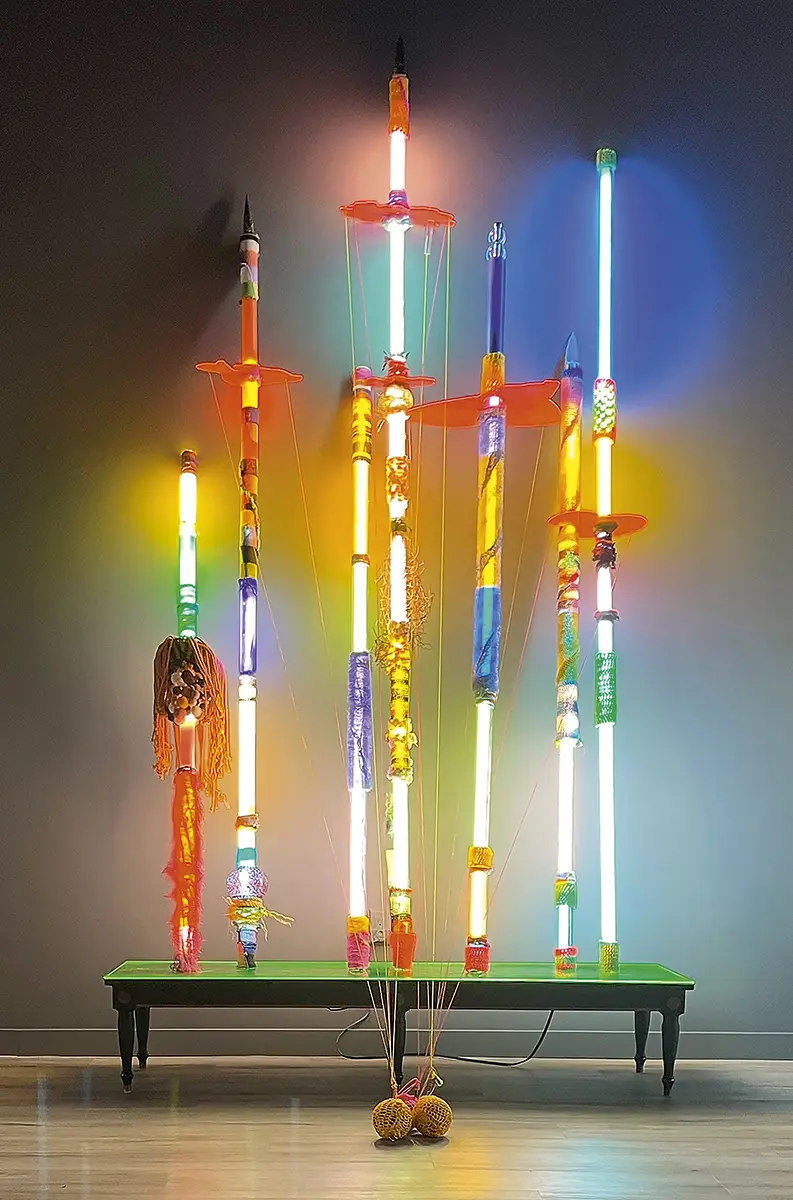
With the exception of Hallucination of the Insane, from 2015, a playful, biomorphic, self-referential work about the creative “madness” of her incessant practice of wrapping neon tubes with textures, tassels, patches, threads, textile ties, or to incorporate them into objects that contain fragmentary stories, all the works in HyperLeak were created in 2021. Each one responds organically to vital memories. Trimino incorporates objects that belonged to her family or are donated by friends, and which have a history, in the same way that she revisits the textile legacy of living indigenous cultures like Colombia’s Wayúu. “I cite their geometric patterns when it comes to connecting pieces. In making those connections, I take into account the legacy woven by women who in that way transmit a memory of the origin of the universe.” Those fragments of revisited mythical connectors appear in the unfolding of Artillery. This group of fluorescent tubes intervened by myriad textiles projects into space by means of tense threads culminating in tassels. The installation extends its field of colors onto the wall, as well as onto the luminous, reflective cover of fluorescent-green plexiglass that transforms the surface of an inherited bench. This work signals an experimental process, with the recent incorporation a fascinating material that “without light, reflects light” and possesses the poetic power of an artificial object that occupies space in a natural way. The cultural heterogeneity that emanates from Trimino’s works translates into shapes that resonate for their convergence between personal and collective experience: Trimino interweaves the pathways of various cultures in order to bring them together into an experimental vision that moves away from that which Bourriaud decries as “the standardization of imaginations decreed by economic globalization.”
Shifting Positions I and II, from 2021, comprise a diptych that refreshes the ways in which memories are stored. Trimino used silicone to transfer the shapes of a traditional crochet-knitted patchwork quilt. The white opacity of the printing material emphasizes negative space, while the residual mold preserves traces of the weaving’s colors. She installed the resulting sheets under lighting in colors programmed to change at a rhythm as subtle as that of the fans that move them. The cycle begins in chromatic synchronization, later broken to culminate in four tones that irradiate their light into space. Alex Trimino certainly sheds light on the passage towards a diverse cultural imagination that contains—without hegemony, without exoticizing approaches, without operations of uniformity—a tactile and textile, luminous and visionary language where the traces of multiple cultures and timelines speak of what we can create at the present point of to which the radicants call us.
ADRIANA HERRERA