The MALBA museum reopened a project it had originally launched in February but ran into an impasse due to the latest pandemic-related restrictions. It is a dialog between two contemporary Latin American artists connected by their drive to redefine boundaries of painting. The exhibition program Paralelo 1||3 (Parallel 1||3) is arranged in two galleries on different levels of the museum. Although it had to be postponed, the MALBA team was able to take advantage of the impasse and improve the conditions of exhibition for a selection of works by two women who met only via zoom, on the museum’s initiative. The exhibition titled Fuera de serie (One of a Kind), created during Gabriela Rangel’s term as Malba’s Artistic Director, was curated by Francisco Lemus, who sought to make it clear that the idea was to present sections of each artist’s oeuvre, teasing out their points of contact as they follow their individual paths, something they call choosing “the freedom not to be liked.” Indeed, both have demonstrated great capacity to propose undisciplined experimentations that are nourished both by under culture and by certain narratives in the tradition of applying color to canvas. Bringing together Leda Catunda (São Paulo, 1961) and Alejandra Seeber (Buenos Aires, 1968) allows the curator to map out two scenes that remained highly active in the crucial decades of the 1980s and 90s, marked also by the end of a period of dictatorship in both their countries of origin.
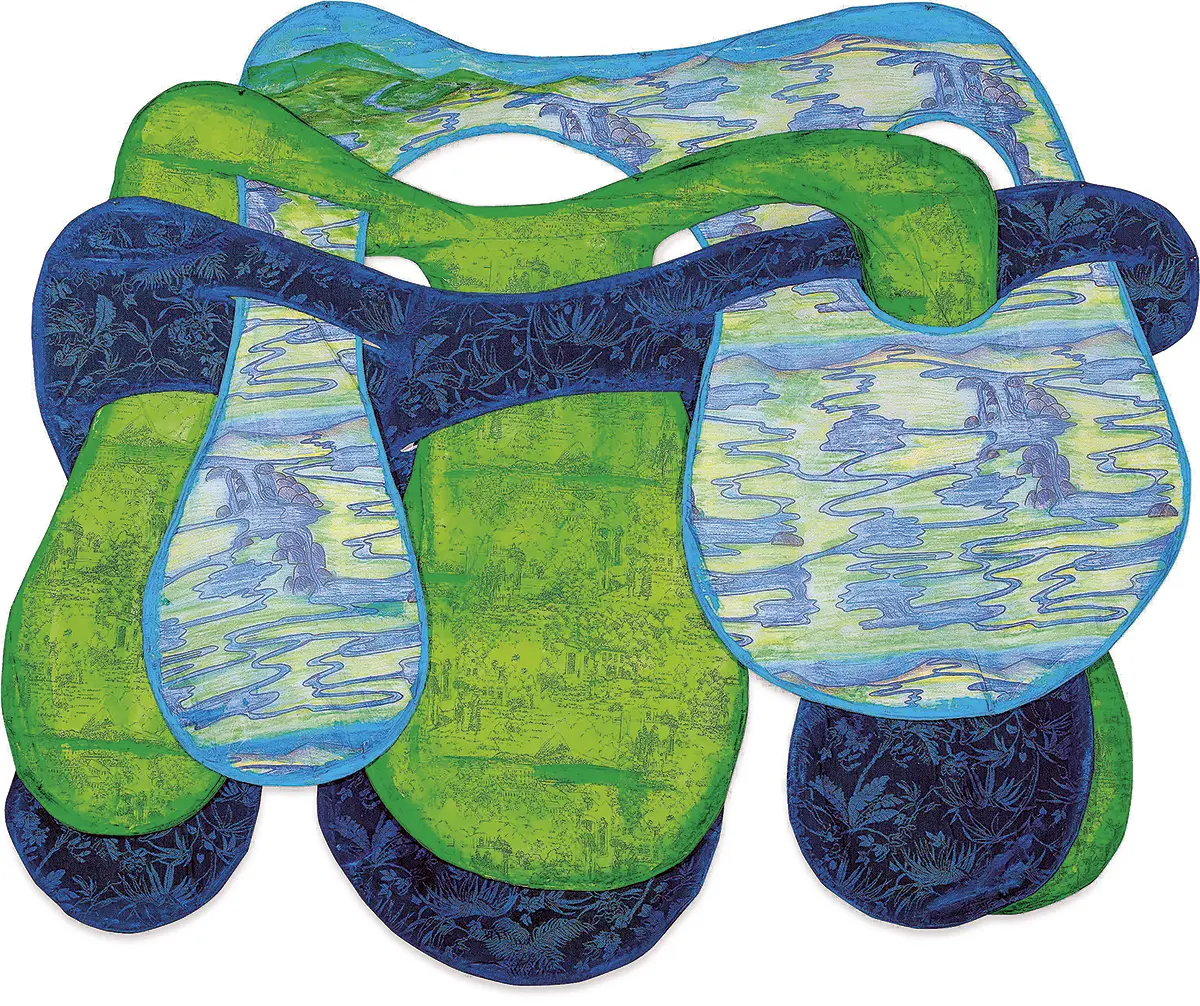
Leda Catunda started out as an artist in the early 1980s, at the age of 21, and very quickly moved towards replacing the traditional practice of painting on a white canvas with the use of various printed fabrics she collected, the most common and workaday, machine-sewn to form singular, colorful textile surfaces built with several layers in ascending, superimposed planes, or in soft volumes that articulate like scales or intertwine to give density to the lightly thickened plane hanging from the wall. These are the most ordinary fabrics that circulates in the community, with a detail Catunda likes to emphasize: they must have print designs on them. Once selected, Catunda works on them an abstract painting, clearly signaling an expansion of the genre and transforming the everyday into an object, with a visuality present in her appeal to certain discernible shapes such as tongues, bellies, droplets, candles, or insects, which, as they condense into a work of art, also connect with clothing, with consumption, and are part of the artist’s household universe. Living in a megalopolis such as São Paulo, she says she needs “the fissure of the city to become inspired,” and acknowledges that her work retains a degree of familiarity with neo-concrete art, with popular culture, and with the natural world.
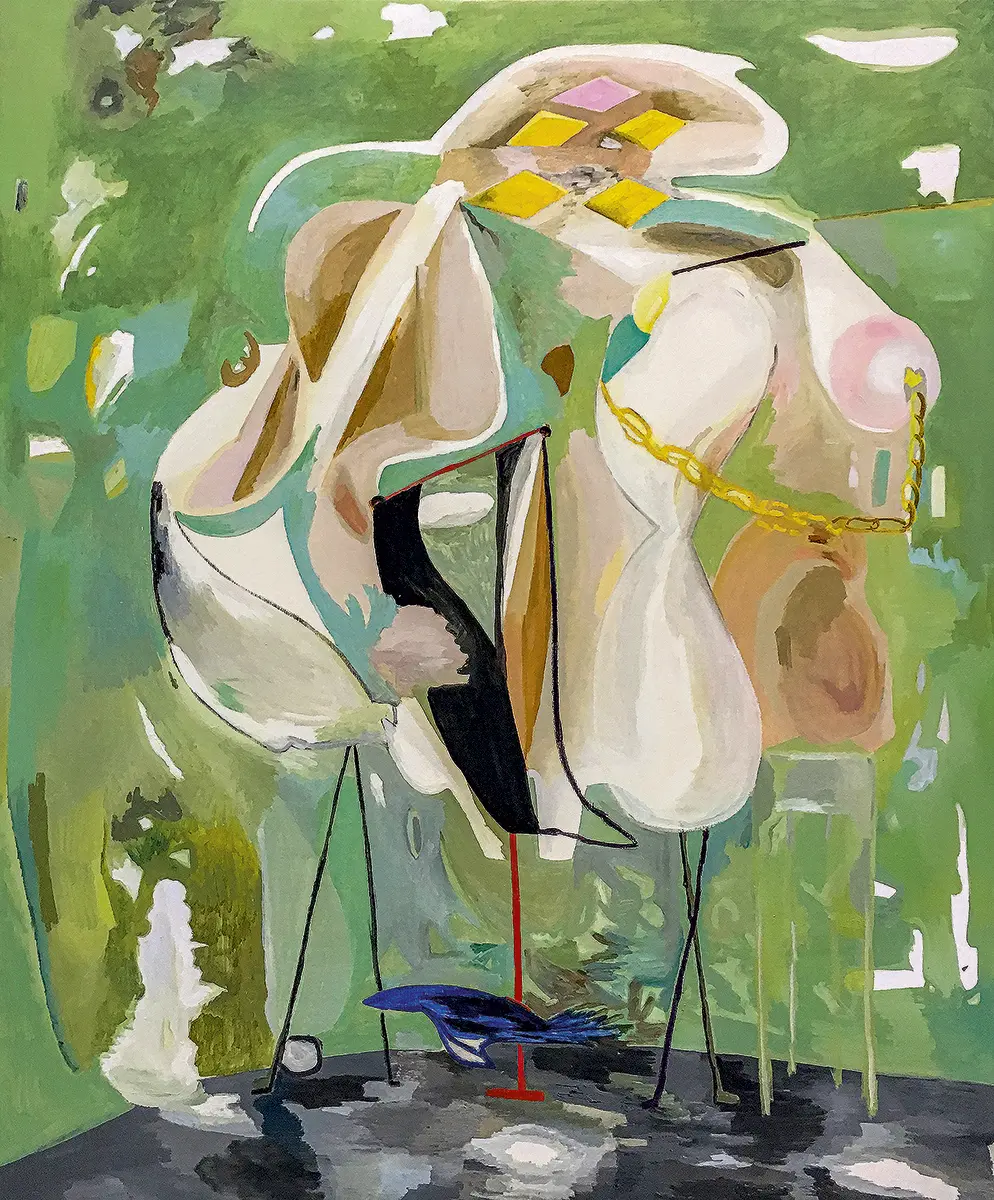
Alejandra Seeber’s work is also based on experimentation, to which she adds the value of moving freely forward on the canvas, starting with an idea that can be the aftertaste of the previous day’s walk, recovering pieces of signals from her surroundings as she physically moves toward her studio, or in lightly sketched interior spaces. Seeber’s work first gained prominence in the 1990s scene in Buenos Aires, with a new concept that sought to erase from the work any direct association in order to keep it as pure abstract painting. From the start she was after a kind of other beauty outside the canon, capable of being more critical and ironic. Thus, she declares herself influenced by the off and under circuits, scenes that dare to leave part of the production process in plain view, underscoring that there is no need for perfection. Working in New York since the year 2000, Seeber has been able to leave a mark on several generations without being as present, with a kind of process on the canvas that retained the less-than-glorious moments, parts that may not be all that pleasant to contemplate, as she remarks in the video accessible at https://www.malba.org.ar/evento/seeber-catunda/
The pandemic altered the rhythms of production, but not much of the new is on display. In the presentation of the show’s content that can be accessed from the official site, Seeber comments that, impeded from going to her studio, she returned to focusing on small narratives of what was around her, a kind of log similar to the format that emerged in the year 2000 and can be seen in this exhibition. Catunda understood that she didn’t need to rest from anything, and, taking advantage of the fact that because of the pandemic she wasn’t moving in order to work, she created a large piece to which she could devote plenty of time. The site offers an excellent opportunity to see it and enjoy it, albeit virtually.
PILAR ALTILIO