Wooden ornaments covered in gold, stucco, or plaster in order to fake their finish: you could scratch the surface and find the essence underneath the fiction. Baroque architecture reflected the need to seduce by means of appearances; its characteristic excess concealed a crisis —the crisis of the Seventeenth Century. The stories that Baroque architecture represented through those materials transcended their lack of nobility, narrating that which they hid. Our first contact with Adrián Gaitán’s exhibition Nobleza obliga (Noblesse Oblige) refers us to that world: like a plaster façade, it tricks the eye in the same way hollow gilding or fake marble do. The artist provides certain clues and, on that basis, viewers must reconstruct, just as the exhibition title starts a sentence it could be up to us to complete. What does noblesse oblige to? To begin with, it obliges us to explore the weave of social fiction and the ornaments that sustain it.
Curator and academic Julia Buenaventura builds the exhibition’s curatorial discourse form the starting point of a historical event from the latter part of that century, the selling of titles of nobility to finance the Spanish King Carlos II’s wedding. Buenaventura revisits that transactional practice and incorporates the selling of official government positions in the Americas, used to finance, for example, the South Sea Navy. These concrete facts are a fertile groundwork for the dialog between artist and curator, helping navigate the subtle deceit or the brute truth represented here. As Buenaventura puts it: “From all this gold, all that is harvested is indebtedness.” Post-colonial society is built upon such indebtedness to the present day. Always in debt to another, always in need to reciprocate the favor.
The large installation in Nobleza obliga (first floor) is a space within the space, a device filled with questions, with digs and jabs to be observed critically if one is to avoid the trap —a series of provocations replete with a serious sense of humor that take the viewer to a theatrical terrain, to a “mise-en-scène,” in Gaitán’s own words. (Theatricality is key here, given the importance that the theater and ephemeral stagings had in the Baroque.) A wall with motifs cut in hanging paper allows us both to peek inside and to peek from inside, experiencing the work’s dynamic of inclusion and exclusion. The exclusivity of the privileged “inside” becomes a stage to be observed, reviewed and critiqued. On the other hand, the shadow of the illusion of those who wish to belong, those who take note of what must be done, is projected into “the outside” from “the inside.” From a distance, the wall appears to be made of a fine fabric, but upon close inspection, a different identity is revealed: it is made of canvas, sackcloth, and plastic tarp. On “the inside” we find, among other things, a piano wrapped under a mattress picked up from the street (the smell of which can only be imagined); a fallen grandfather clock with a palm tree trunk for its body, as though the tropical element dismembered a desire for good taste; to the sides, pillars made of wood remainders—like St. John’s Night giants—a chandelier made from tea bags through which a light warm and oriental like the leaves that fill it gently seeps. There is even the suggestion of the design for a French garden featuring a kind of succulent—Kelanchoe—that is entirely devoid of any Versailles-like airs. Such symbols of power, wealth and nobility are formally present and can be recognized as something we have seen in reality or as representations in the homes of our relatives, in books, or on TV, but once we touch them with our eyes, once they are subjected to our scrutiny, the materials reveal themselves as they truly are: coarse, cachet-less, vulgar, common, throwaway, and because of that very gesture we can’t avoid launching into interpretation, into interrogation, and we can’t suppress a smile as we come to understand the game of riddles that Gaitán is engaged in.
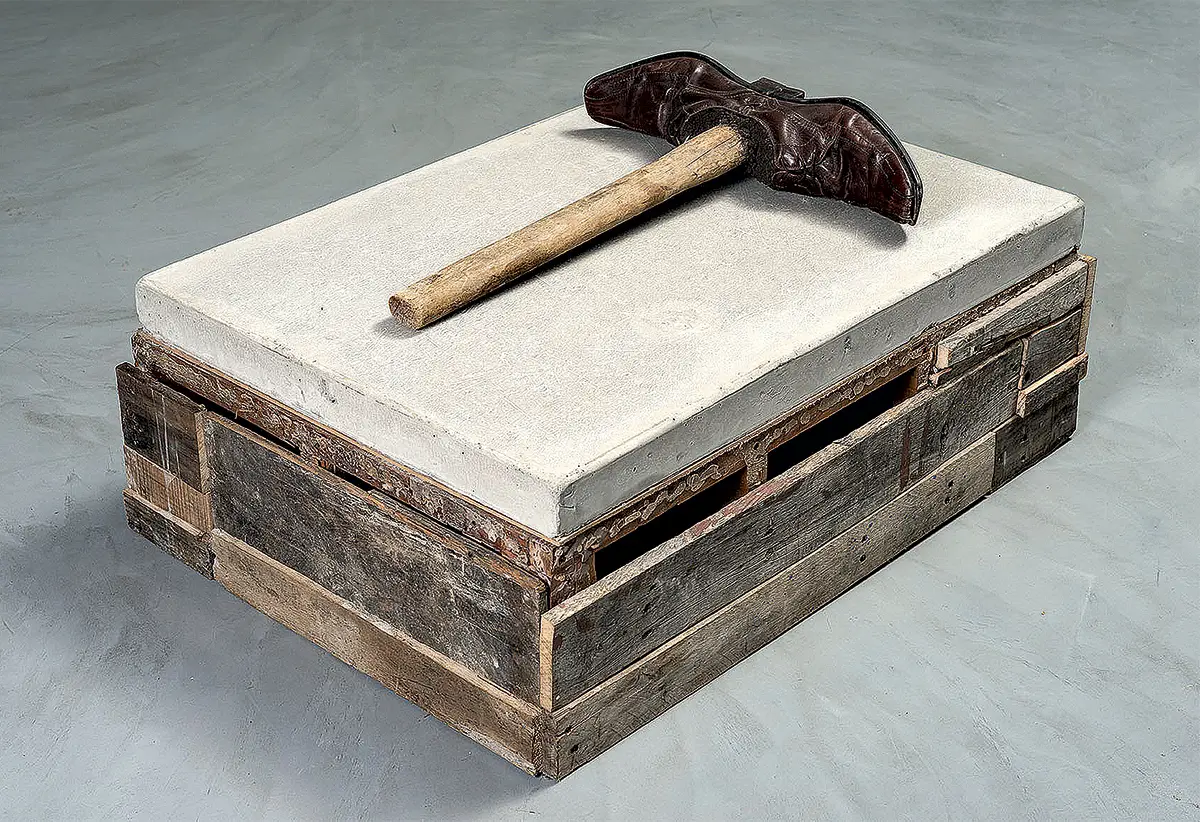
The story can be stretched into the present day. The continuity of meaning that traverses centuries, generations, and societies gives Nobleza obliga a timeless character that can be understood from the contemporary age. Symbols intertwine as one thinks about the present from the necessary historical standpoint. In the second floor, Nobleza obliga #5 (Noblesse Oblige #5) features a pickaxe, only its head has been replaced with a pair of men’s dressing shoes. You can see they are heavily worn and there is no money for a new pair, yet they have been carefully shined. These are a worker’s Sunday shoes, purchased with the fruits of sweaty labor, shined as one must, lest anyone talk. Artistic fiction and curatorial narrative go hand in hand here, in a collaborative pact that provokes and challenges a society that continues to validate surfaces and the superiority of certain modes of doing and seeing.
CARIDAD BOTELLA