
Eros is the second solo exhibition of Zilia’s work at Galerie Lelong’s venue in New York City. This exhibition features new sculptures finally executed for the first time. These works had only previously existed as maquettes. Constructed in exquisitely shaded striations of white Carrara marble, some of which retain the elements of circular concentric forms of her paintings, which is quite striking when viewed in close proximity of the paintings, where that circle is sometimes the point at which a blue background will surround the white protuberance, sometimes divided in two, at the center of the composition. Vesela Sretenovic, senior curator at The Phillips Collection, where Zilia recently had a retrospective exhibition currently on view at the Museo del Barrio in New York, describes the impact of Zilia’s sculptural works as: “implying not only a spatial depth but a pulse of life, a living body.”
In the most prominent space in the gallery, the piece that gives its name to the exhibit, Eros (1976/1998), is comprised of two freestanding parts, is made up of two opposite volumes in forms that compliment each other in a unifying equation. This sculpture is monumental in size and is undoubtedly one of Zilia’s most accomplished works; it clearly establishes space for sexual tension between the male and female totems that look like they are about to gravitate towards each other, as if about to merge into a third unit.
Although constructed in wood with her unique acrylic on stretched canvas signature shapes, the impression upon seeing it, even from a close distance, is of a much heavier material, like marble or stone, as they appear so firmly rooted in their voluminous formation.
Another piece, Lunar Blanco (Moonish White), is derived from a much smaller maquette. The two protuberances in the middle meet in a diagonal positioning, balancing the center of the circle. In an interview video from the Museo exhibition that can be viewed on the website, Zilia speaks about the importance of the number two, for her, it’s using duos and duality that she creates an aesthetic balance. Still, she also makes a point of emphasizing that it’s also what stands out as a symbol for life itself, the coming together of two entities.
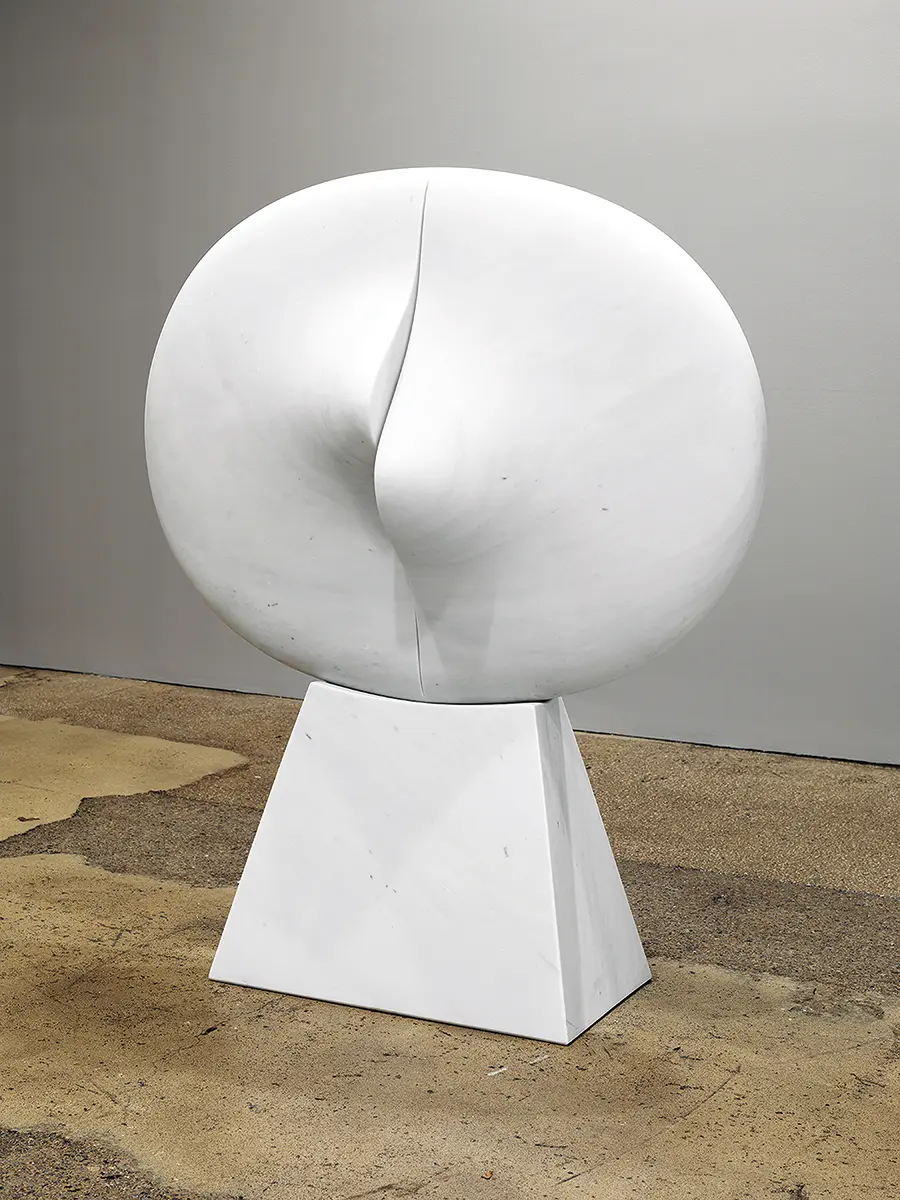
Another marble, Luna Lunar (Moonish Moon), is an imposing roundness in white marble that references Cycladic sculpture, it rests on a pedestal where it looks suspended, the piece is wedged in a locking position, a triangular form inside the circle pins, which in a Cycladic format would be a symbol of fertility, here establishes a geometrical balance with its apex pointed to the intersecting point; there are two small wedges in the center of the composition which bring to mind this new device that is also present in the new paintings in the exhibit as there are several where Zilia has introduced this use of wedges. Two paintings illustrate this point: Mirar que pasa después de todo (Look at What Happens After Everything) and Sin título (Untitled). Both from 2019, they introduce rectangular wedges that balance the compositions, two in the first one and four in the latter painting, which create the balancing of space which we are accustomed to seeing with the round or pointed shapes in her works. These wedges are more emphatic in delineating space and concentrating attention on the middle of the composition as if it was from there that the wedges had been ejected into place.
A more traditional Zilia composition is Conjunción (Conjunction) 1998/2019 the two dates account for the creation of the piece and reworking by the artist on the second date. This piece, which unites five egg-shaped white protruding double pointers within a square light blue background, is reminiscent of the Troyana series where similar constructions, though elongated and vertical, create the effect of a walled formation. This grouping, in particular, like the work of Lee Bontecou, brings to mind the constructed panoramas of the interior of space modules from science fiction films.
Zilia’s favorite colors, white and blue, reaffirm her preference for the sidereal, a creative interpretation of her astronomy informed vision. Bringing these elements together provide a metaphysical depth to her work, a degree of timeless serenity that continues to replenish our perception of her work.
ALBERTO BARRAL