Under the curatorship of José Falconi, Ximena Garrido-Lecca and Ishmael Randall-Weeks have developed an ambitious collaborative project: a mud building produced with “black soil” from the banks of the Chilca lakes (which is said to have healing properties) and a pulp made from Peruvian newspaper clippings.
This construction, created over several months, is based on the design proposed by the philosopher and theologian Tommaso Campanella in his utopian treatise City of the Sun, originally published in Frankfurt in 1623: a city modeled after Nicolas Copernicus’ solar system and whose walls would be covered with all existing knowledge, making it easily accessible to its inhabitants.
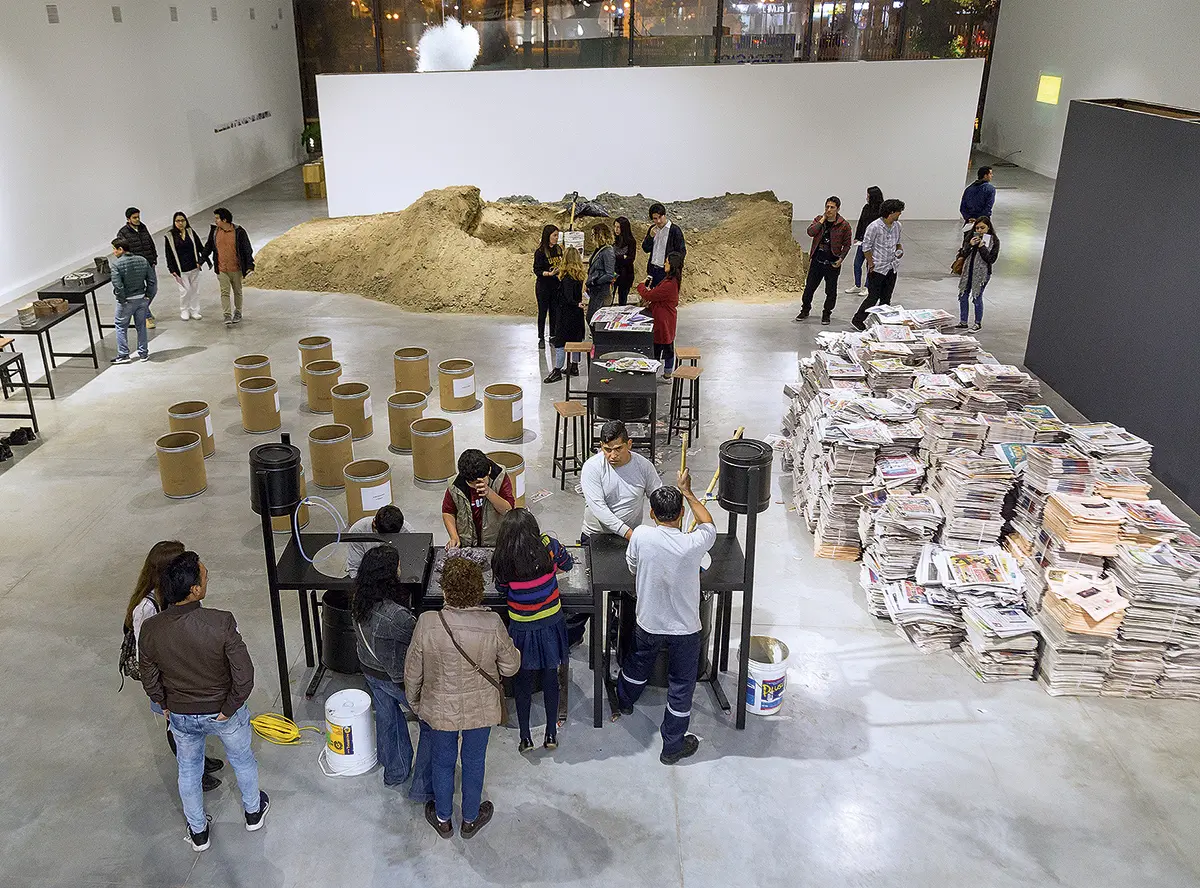
Reelaborated by Garrido-Lecca and Randall-Weeks on the coast of Lima, the Dominican friar’s utopian city echoes with other constructions that refer to different deities and other worldviews: the pre-Columbian temples dedicated to the Sun. Just as they refer to the history of ancient Peru, they also reflect its beliefs (the magical properties of Chilca clay), and at the same time, refer to our immediate present via the journals used for this edifice. However, against Campanella’s aspiration to divulge all the accumulated knowledge of his time, what the artists have gathered here is current information to the point of saturation. In this sense, the newspaper paper mortar they use seems to materialize the idea of “infoxication,” which implies the impossibility of deepening the information and even discerning between serious, sensationalist, or even false news. This was further enhanced by reading aloud daily news during the construction period.
Collaboration and its dynamics are implicit themes in this participatory project. Material evidence of the public’s participation is found embedded in the clay structure itself. A wide range of objects was given as offerings: passport photographs, business cards, movie tickets, bus tickets, flip-flops, hair bands, pens, drawings, and toys, among others. These offerings reveal the enthusiasm of the participants. But, considering the abundance of photos and personal cards, there is also a latent demand for recognition, which perhaps suggests the need to be part of a community that is not purely anonymous. Perhaps more importantly, the artists also address the potential for collaboration beyond this exhibition: the one necessary to build a citizen-based project whose horizon must be grounded on the common aspirations and hopes that enable us to work together.
This query is written on the very walls of this utopian city, which at the same time evokes a construction in progress, like so many others in Lima. It is also a ruin, like so many pre-Hispanic vestiges made of adobe, thus situating us between the present of urban expansion, and the past of millenary cultures. Not only that. Since the materials embedded in the walls include things like candy wrappers, medicine bottles, plastic bags, old lottery tickets, a box of toothpaste, a condom, and a sanitary towel, they create the sensation of a sedimentary accumulation reminiscent of Lima’s garbage dumps. As if this “City of the Sun” were an archaeological excavation of the future. The question then arises: What are we building together today?
When walking through the concentric forms of the structure, it seems, at times, that one is inside a labyrinth with no clear idea of what the building looks like. Two stairs, on opposite sides, lead to platforms that allow us to see it from above, to achieve a more panoramic view of the project. The installation includes a clothesline with Peru’s newspapers, packages of newspapers, a big pile of earth, and the equipment and containers in which the mud and the newsprint pulp had been prepared. The molds used to make the clay bricks and the plans and models used for the construction are also on display. By including all these elements, the artists have given an account of the fundamentals of collaboration: we must be able to have a perspective on what is being done and what we want to do; in other words, we must be able to connect with the project as a project.
Finally, among this set of plans, diagrams, and models, some correspond to Campanella’s City of the Sun. In this way, Ximena Garrido-Lecca and Ishmael Randall-Weeks suggest that the collaboration does not only take place in a shared time and territory but that it is possible to collaborate on a project and aspiration from another time and another location. The hopes of a better life, a better city, a better world endure and are being updated every day by our actions.
MAX HERNÁNDEZ-CALVO