Vik Muniz presents in São Paulo a new series of twenty-two unique works, all produced in 2019. The exhibition opened to the public last October, at Nara Roesler Gallery.
The collection was inspired by an extensive investigation of paintings that are known, in the collective imagination, for their reproductions. Vik Muniz first developed that interest in 1993, after relocating to the United States; in grand U.S. museums, he began to interact directly with original works of art he knew only through the many publications and replicas that circulate around the world. A question thus emerged for Muniz about the ambiguity between, on the one hand, experiencing the work’s presence directly, and, on the other, relating to it analytically through reproductions. This issue has occupied the center of Muniz’s investigation about the real and its doubles during the last three decades.
Muniz’s preserves in his repertoire the memory of a conversation with his grandmother, who said: “the world is made of real things and imagined things.” Her words have influenced the artist’s way of thinking, feeling, and creating based on that dichotomy. What is the relationship between things and ideas? The paintings featured in this exhibition incorporate that personal concern into works of art that provoke sensations between layers of the real and the mental. Illusion and reality sharpen the imagination using formal construction.
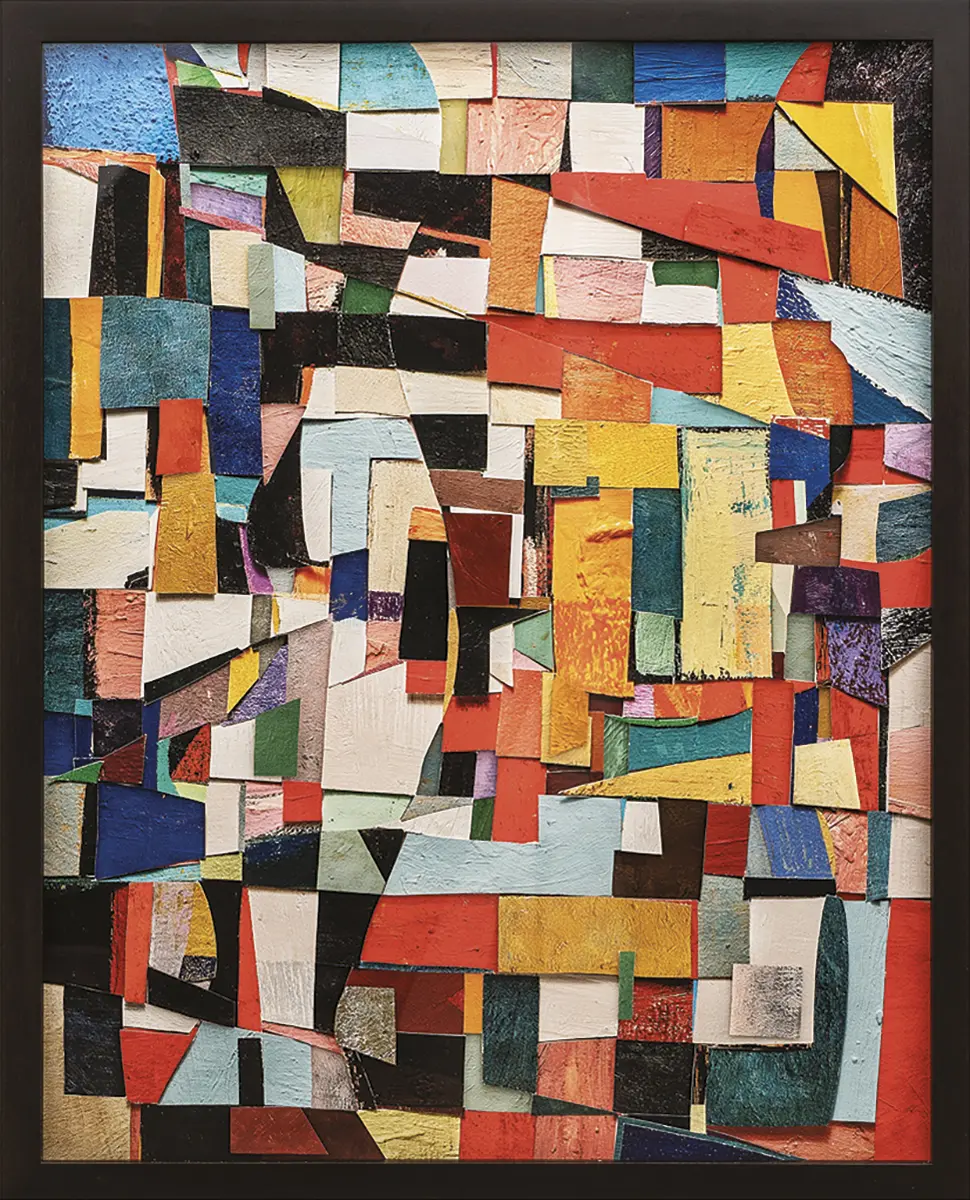
Vik Muniz breaks with the concept of temporality in photography through the ambiguity that results from his juxtaposition of painting, assemblage, and re-photography, which establishes a distance between time and space. What results from this work is three-dimensionality. By being photographed, painting lets go in Vik Muniz’s art of its chronological dimension, the moment when the encounter of brush and canvas took place. In that process, the artist again paints on the photograph, re-photographs each stage, and achieves a kind of time and space flight from the processual act of creating the work of art. This illusionistic play shines a spotlight on the unsettling encounter of illusion and reality.
An architecture of overlaps, of adjusted layers, and the shadows that each one projects onto the others, emerges using this processual logic. It reveals directions of representation, a kind of aura for each surface, which begins to function as a cradle for another one that will come to add to the whole.
The works in Superficie (Surface) were built based on quotes of abstract paintings by different artists and of varied origins, such as, for example, Waldemar Cordeiro in Ideia Visível, industrial latex paint on plywood laminate panel, revisited by Muniz in Leque (a cross-hatching of diagonal lines). Muniz reconstructs Cordeiro’s work using inkjet impressions on archival paper, arranged in layers.
In the process of deconstructing and reconstructing a given work of art while retaining the reference to the original, Muniz plays with Walter Benjamin’s concept of technical reproducibility, at a time when photography is present in a flow of everyday images. In that play, Muniz restores the aura of the reproduced artwork, being as it is other and unique. The works and presented on surfaces, and they explore two approaches that have reappeared often in Muniz’s artistic vocabulary: one, a material in search of meaning; the other, an image in search of physical renewal.
The entropic negotiation between loss of material and virtual gain prompts the viewer to question his or her relationship to the physical experience of the work art, in a context where the images and the very notion of reality are mediated by the digital technology that permeates our daily lives. For Muniz, the viewer’s physical presence is critical for their understanding of and dialoguing with the work. The effect he seeks is for the viewers of his work to experience the transition between experiencing it as a real object and to reflect on the repercussions it has on their mental plane.
The phenomenon of a reality reconfigured by the advent of new technologies is how the images are put in circulation. Muniz takes advantage of this to tear down the paradigms that have traditionally set painting and photography as opposite poles, salvaging the relationship between the material and the pictorial elements present in his production since the beginning. In one of his earliest series, Best of Life, Muniz drew famous photographs based only on his recollection of them, then photographed his drawings and exhibited the resulting images.
Even though Muniz’s works use painting both in their process and in their concept, they are not paintings; yet, as photographic images of works that have an autonomous physical existence, they are not abstractions, either. They are non-reproducible photographic images that, ambiguously, add value to painting’s material and conceptual surfaces and require the physical presence of the viewer to succeed.