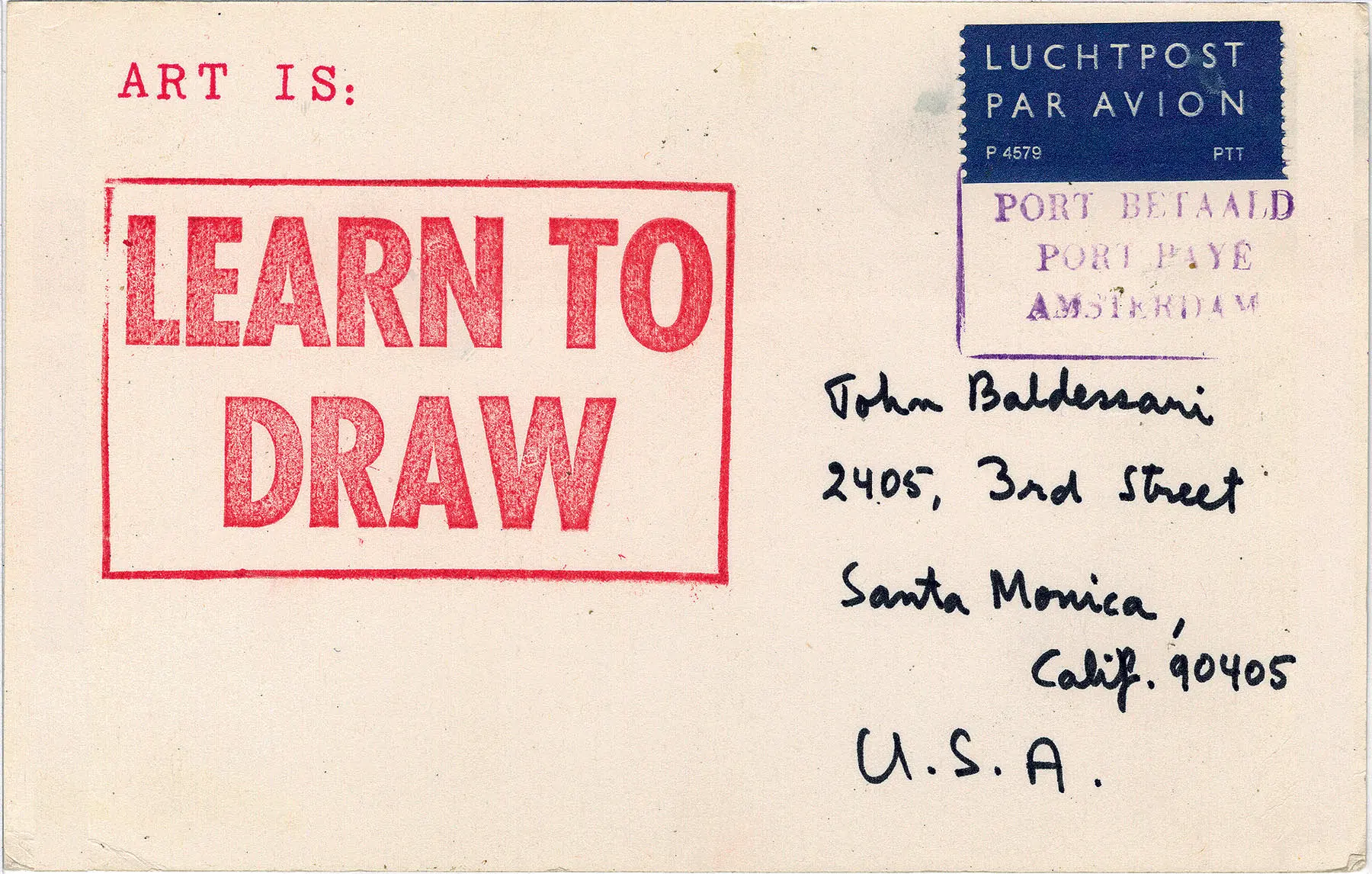
At the New York headquarters of the Institute for Studies on Latin American Art (ISLAA)1, you can see part of the archive of “mail art” by Ulises Carrión (Ulises Carrión: el gran monstruo). There is one document that particularly strikes me, and that is part of the “Definitions of Art” project (1997). The Mexican artist sent letters headed by the phrase “Art is:” to be completed with a personal definition by various senders. John Baldessari was one of these senders, and he answered from Santa Monica, California: Art is: “learning to draw.” The answer has a leg-pulling sense of humor, but, seen in another way, it is a biographical note. Carrión had to leave Mexico and go to Amsterdam to make conceptual art, while Baldessari was learning to draw in California, which was once Mexico.
Movement was essential in the work of Ulises Carrión. According to his known biography, he studied literature at the Universidad Autónoma de México (UNAM), followed by the Sorbonne in Paris, the Goethe Institute in Germany, and the University of Leeds in England. When he arrived in Amsterdam, he wrote: “There, books were cheaper.” It is not difficult to imagine how “mail art” emerged through this cosmopolitanism. In a letter to Octavio Paz, he comments: “My texts are structures set in motion […] Their own movement constitutes the meaning of the structure.” For the vast majority of the classic conceptual artists of the 1970s, the text became an aesthetic object, which is, in reality, a static structure.
Nothing implies more movement than the idea of correspondence. A letter is sent to a sender, and in the process, the message is modified. Carrión began by testing this idea. At first, he made use of the postal service: its bureaucracy, its transportation, and its postmen. One Poem (1973) consisted of sending a sentence whose response implied the transformation of the meaning of the original message through simple interaction with the sender: “To be or (not) to be erased.” The reader had to erase part of the content of the sentence or not. After this minimalist act, the postcard had to be signed. While in Shakespeare the phrase has a value of a sum, of existence, the theme here is loss as a creative agent. If Jorge Luis Borges postulated the birth of the reader in a story (“Pierre Menard, Author of the Quixote”), and Roland Barthes “the death of the author” in his famous essay, Carrión summarized these two ideas in One Poem. The future of literature would consist of erasing or being erased, reading as artistic authorship.
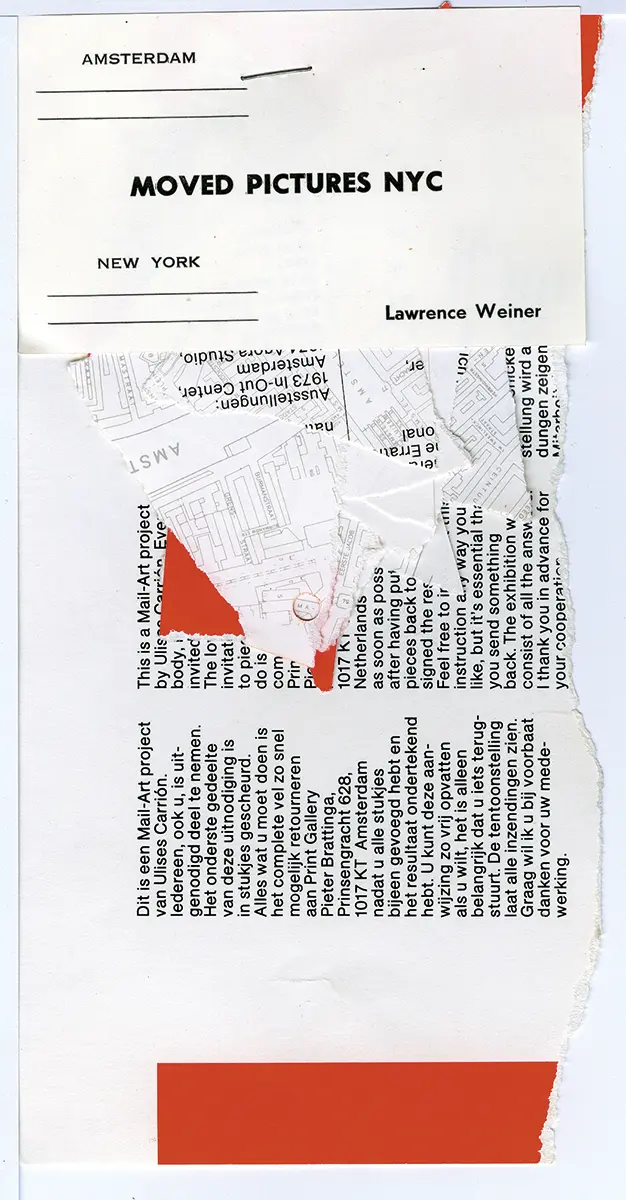
During the sixties, Guy Debord had said: “The sense of the art of the future will be the reversal of situations, or it will not be.” To the European Situationism of the second half of the twentieth century, a “situation” was an event outside the predominant social logic, an obstacle placed between two cogwheels to break down a machine. Carrión was not detached from this influence: “mail art knocks at the door of the castle where the big monster lives.” It is easy to associate the “big monster” with Society, capitalized in that way, an international order that by the 1970s had already been considered unjust for more than a hundred years. “The war of mail art was like that: a battle against the big monster,” writes Aimé Iglesias, curator, and author of the exhibition catalog.
The main work produced through a relation with official mail to stimulate the recipient’s creativity was feedback pieces (1981). Ulises sent the printed invitation for his next personal exhibition cut up into pieces from a gallery in Amsterdam. The aim was for the senders to be able to physically reconstruct the document, although some restored only what it meant to them. The question Ulises Carrión asked himself was again a genetic, essential question: “How does art come into the world?” The answer seems to imply a necessary misunderstanding, a misreading, a “deviation” from the original text (an idea) turned into an object.
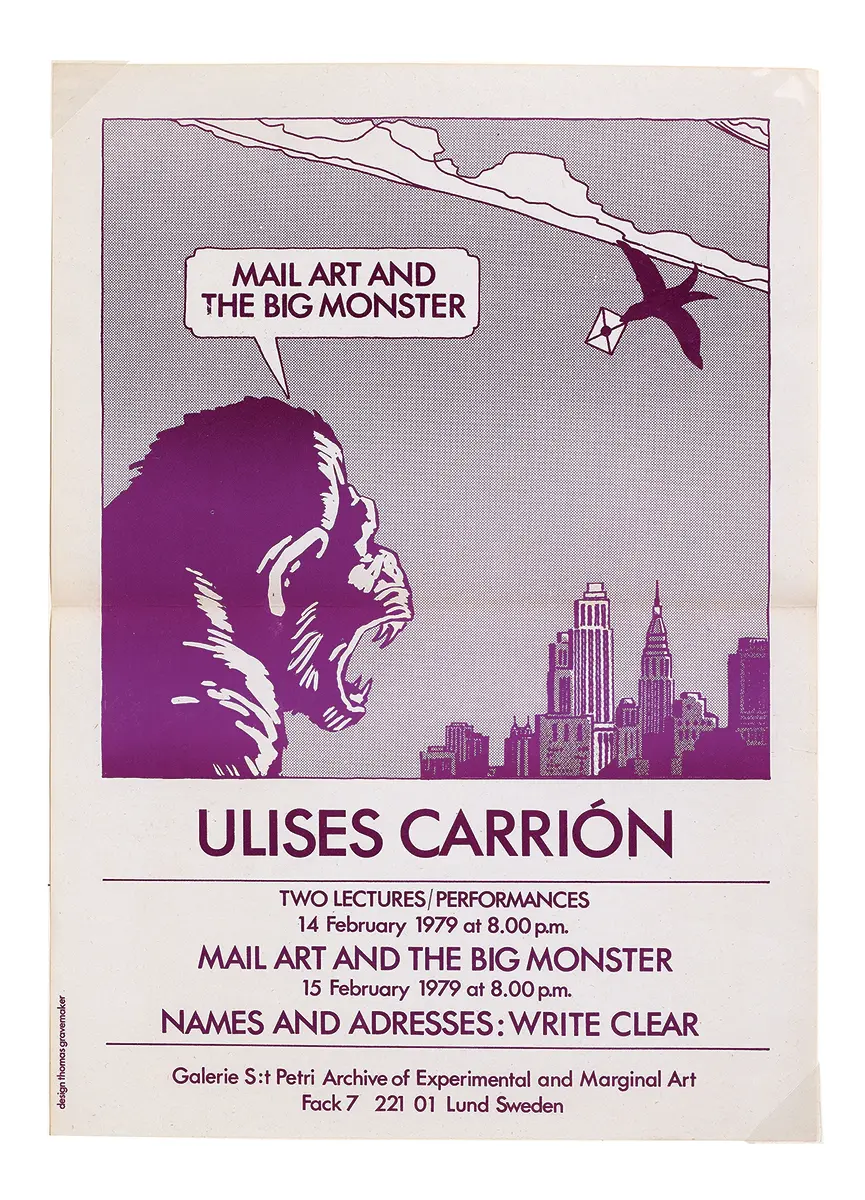
The term ‘feedback’ suggests a movement of the senses. The answers arrived in various ways: a small desiccated fish with a piece of paper in its mouth, a jar full of clippings from the destroyed invitation, or a matchbox with more clippings. Lawrence Weiner preserved the entirety of the first half of the document, where the instructions for the small and intimate performance were written. Still, he piled up the second half unrecognizably, precisely where one could read Ulises’ question. He also added a New York business card, which reads: “moved images.” The structure moves, and “its own movement constitutes the meaning of the structure.” No one knew how to answer the question as well as Lawrence Weiner, who, together with Carrión, led the search—undertaken by the conceptual artists of those years—for the castle (the language) where “the big monster” (the established order of all things) lived.
However, through the standard postal service, it isn’t easy to avoid the established order, and Ulises was aware of this. He, therefore, created one of his most interesting projects: E.A.M.I.S. (Erratic Art Mail International System, 1978), an independent post office. To the regularity and impersonality of the industrial machine, he opposed human contingency. Transportation was no more than a map of the journeys of his friends, whose main objective was to evade the system. There were no defined times, no stamps, no bureaucratic details. Carrión restored to the mail not only its function as an instrument but its importance as a medium. The messages sent by mail were no longer just a “structure in motion” from whose feedback emanated sense, but it was the “movement” that constituted the structure itself. In other words, traveling for E.A.M.I.S. transactions had a subjective value, and embedded enormously relevant content into the message. Hence, this was his most political project. At last, he had created a “situation.”
NOTE
1. ISLAA is a philanthropic, entrepreneurial, and socially committed entity dedicated to supporting advanced research in the field of Latin American art studies.
ABEL GONZÁLEZ FERNÁNDEZ