Some artists need no introduction. They come preceded by the formidable aura of their work. Most such auras are luminous, golden, almost an ecstatic halo. A few, however, lunge at us in a fearsome whirlwind: as if born of the abyss, they grow in a vertiginous spiral, with a centripetal power that changes everything it touches. No point in holding on to a gaseous gilded epiphany, then. What we find there are not beings touched by God, but creatures from the underworld storming the heavens.
Tomás Esson (Havana 1963, lives and works in Miami) is one of the most momentous contemporary Cuban painters. His undeniable savoir-faire guides us by the hand into a state of pictorial ecstasy, to which we gladly submit only to be suddenly shaken from our lethargy by the subject matter on display. Grotesque, lewd, scatological, kitsch, and violent elements combine in Esson’s work to produce a unique visceral incarnation of the caged rage that is human existence. Vulvas, penises, horns, semen, spit, pubic hairs, all referring to those indescribable beings, who share the tortured condition of the demigod: animal in heat and spiritual being all at once.
Esson has been obsessed with disentangling the human throughout his career. A graduate of the ISA, Havana’s Instituto Superior de Arte (1987), his early work, rooted in neo-expressionism, is part of what is known as the Nuevo Arte Cubano movement (New Cuban Art).1 The human aspect, which in the Cuban context cannot be decoupled from the ideological, emerged as a woeful symbiosis where the public and the private, the personal and the political, coexist in agonizing, self-annihilating unity.
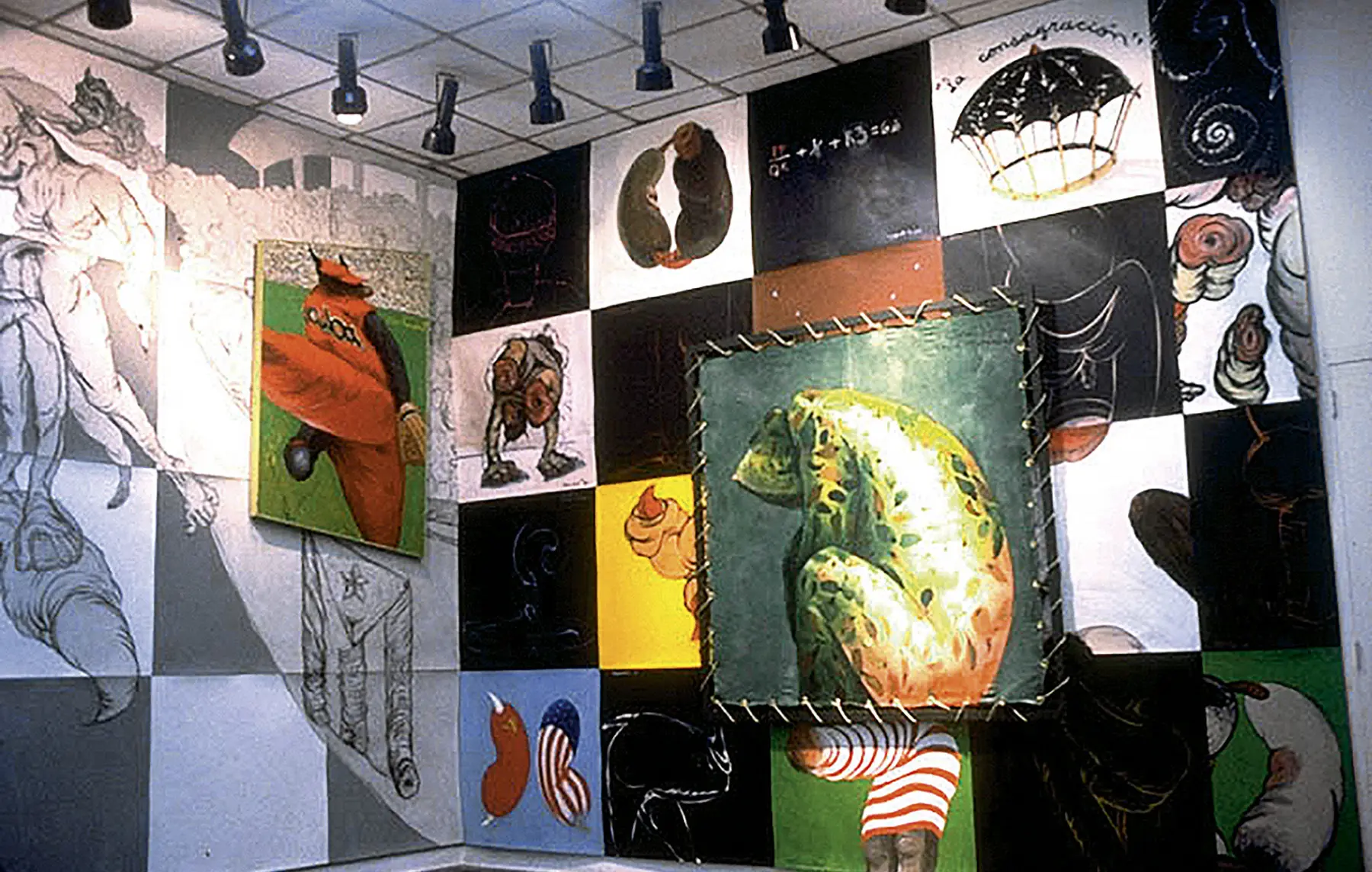
A Tarro Partido II (Centro de Arte 23 y 12, 1988), the solo exhibition Esson won with his 1987 thesis show at ISA, as the Institute’s most artistically/creatively outstanding graduate of that year, tested the boundaries of the permissiveness of power in Cuba. Heavily visited, it was cause for great concern in official circles. Tomás Esson came to the unwelcome attention of the political police, which questioned the use of national symbols in his art.
And indeed, A Tarro Partido II spared nothing and no one. The island of Cuba itself; the mambises (Cuba’s irregular army during its War of Independence); the national pastime (baseball); the untouchable heroes (Che, Martí, Fidel); the symbols of the national State (the seal, the flag); even ballet—all were given new meaning in shocking, grotesque/expressive entities that signaled the suffocating omnipresence of ideology as it turns into nightmare, popping up everywhere, even in the middle of coitus, to politicize everything, even orgasm. In the Cuban Revolution of 1959, the sacred had been displaced by the political; following the logic of that race to the bottom, Esson transformed the political into sacrilege. The body, the sole remaining space of freedom, became an arena for excretions, mutilations, and lasciviousness to fight—yes, tooth and nail—over the last remnants of dominion and survival.
Every single work included in A Tarro Partido II was the object of authoritarian censure, but the focal point of the regime’s tantrum was, of course, Mi homenaje al Che (My Homage to Che, 1987).
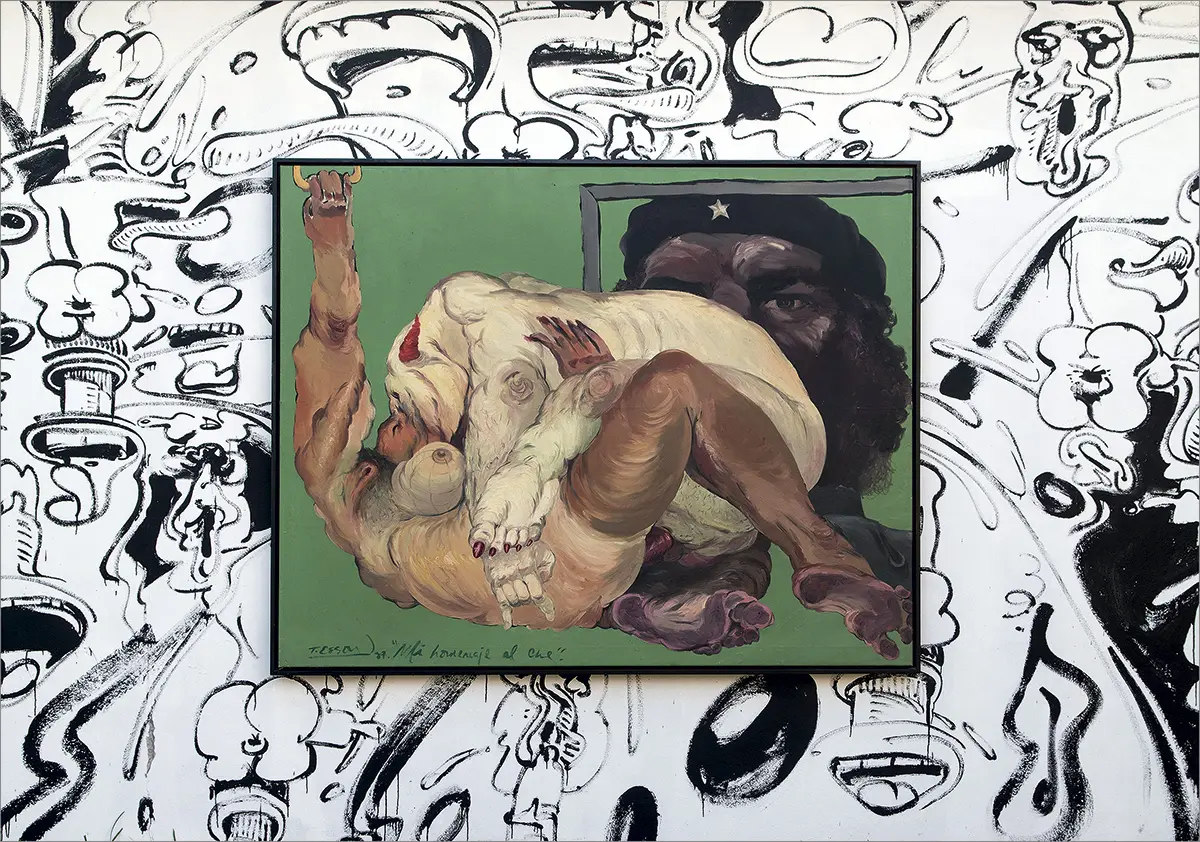
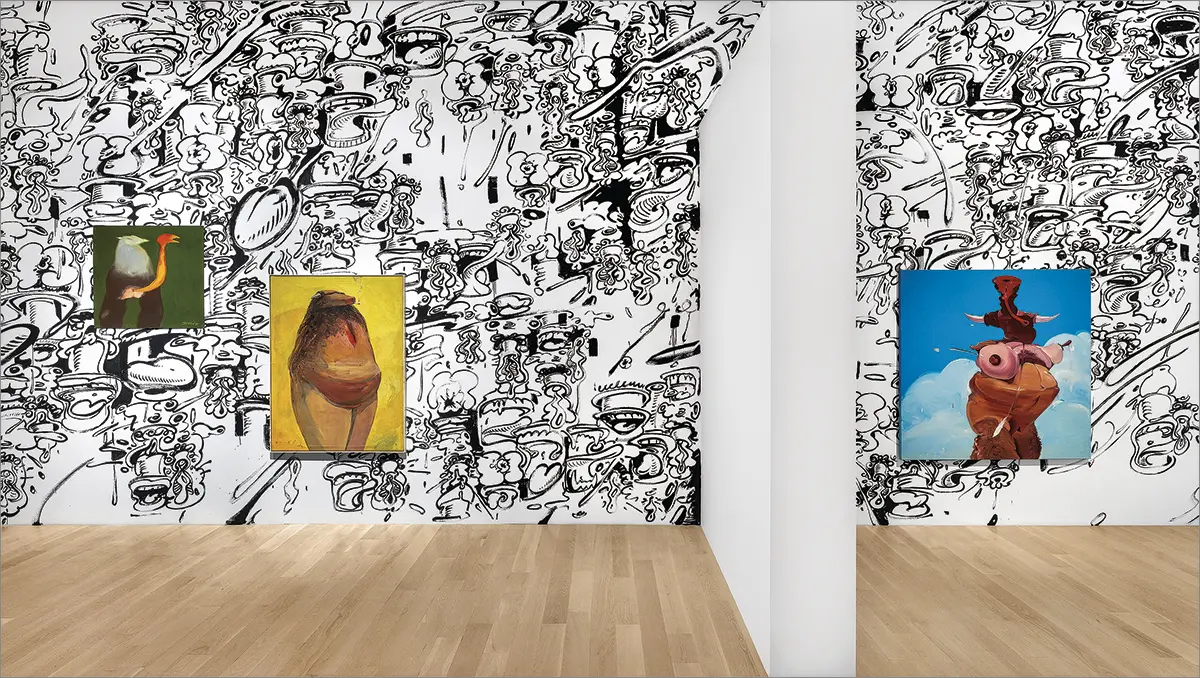
Outlined against an olive-green background, two controversial characters give themselves to lust with furious abandon. In a jumble of flesh and horns, with their nails (or are they hoofs?) painted red, they fornicate in front of a portrait of Che, who, thanks to a foreshortening effect, appears to be giving cunnilingus to one of the characters. And in case this affront was insufficient, Che—the beret on the furrowed brow and the Korda-inspired image leave no room for doubt—is a mulatto. To resonate with his already scandalous paintings, Esson had the walls of Centro de Arte 23 y 12 covered with a checkerboard structure where horns, boots, amputations, protuberances, flags, excreta, state security officers, and talismans repeated kaleidoscopically. Amidst all that, and precisely placed on the upper left corner of the widely vilified portrait of Che, a Cuban flag; its stripes, made from half-extirpated bowels, suggested stumps shooting out spit or semen.
A cathartic sense of humor was quick to emerge around this event, and soon, a joke was making the rounds: Esson no se hace2 (“That’s not done”, with the artist’s last name substituting for the word eso, Spanish for “that”). Popular sarcasm thus summarized the pathetic paternalism of power in its dealings with the island’s intellectuals, while at the same time signaling that creative freedom remained operative inside the iron cage of “within the Revolution, everything goes; outside the Revolution, nothing”.3
Closed down barely ten hours after opening, A Tarro Partido II is not only one of the most significant examples of the spirit of renewal that characterized the second half of the 1980s in Cuba, but also a marker of the beginning of its end. It inaugurates the period of redoubled censorship that would ultimately frustrate that transformative moment in the country’s visual arts.
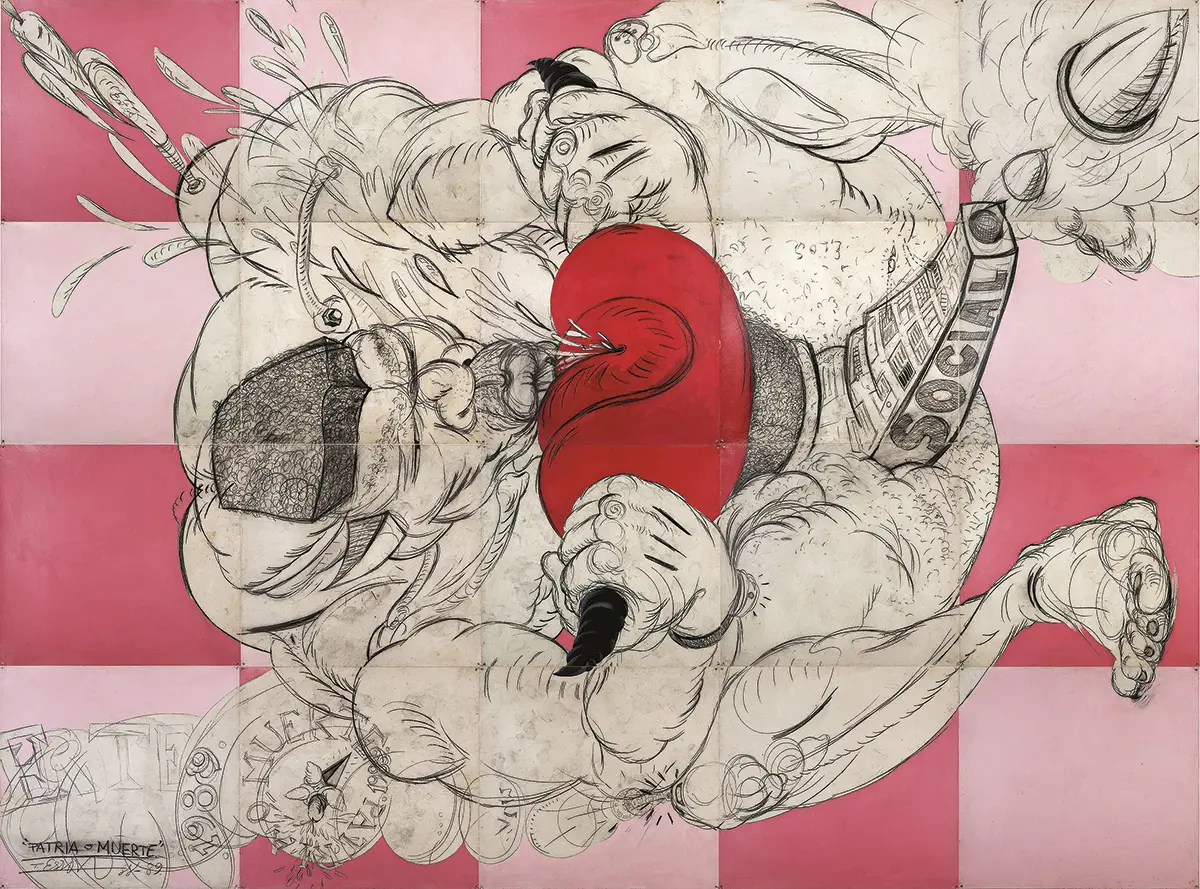
In 1989, as part of the fleeting project Castillo de la Fuerza (Castle of the Force), Esson exhibited another crucial work of this period of his career: Patria o muerte (Fatherland or Death, 1988-1989). Also featuring a checkerboard structure (twenty squares, alternatingly pink and red), Patria o muerte is a charcoal drawing of giant proportions (at over six meters in height, this work has never been exhibited in a vertical position, as it was originally conceived by the artist). It presents viewers with the climax of an abduction scene. Indeed, the full title of the work is Patria o muerte. Europa. Occupying the entirety of the canvas, a sort of squatting faun, all muscle and horns, halfway between beast and cyborg, licks the prey (the talisman): we are witnessing its final moments of delectation before the fatal denouement. The faun’s erect penis, engorged by its prey’s lifeblood, shoots out its missiles in a barrage.
Exhibited in its intended vertical orientation, the faun-cyborg’s penis would be at eye level, in frontal dialog with (or attack) the viewer’s gaze. It is nothing other than Revolution Square (formerly Civic Square), reconverted into a kind of micro-brigade building, with windows that resemble now flags, now bars. Pushed by a fart to the upper left corner is the coin from which the work takes its title, yet another symbol reworked by the revolutionary abductor. From “Fatherland and Freedom” to “Fatherland or Death”. The copulative conjunction is replaced by a disjunctive; life is replaced by death.
Esson has explored the portrait genre from very early on in his career, first as a means to hone his technical skills, later as a way to engage the distinguishing characteristics of his native country’s psychological makeup. His choice of portraiture for these purposes was not an accident: in the history of art, portraiture is the quintessential self-affirmation and empowering genre, long associated with ideological functions, be it religious, political, or economic. By the mid-1980s, portraiture allowed Esson to focus on the character that obsesses him, a mythological entity situated by its condition halfway between human and beast, yet more earthly than empyrean in its designs. This resulted in works of unparalleled beauty, Elegante (1984) and Relevo (Relief, 1985).
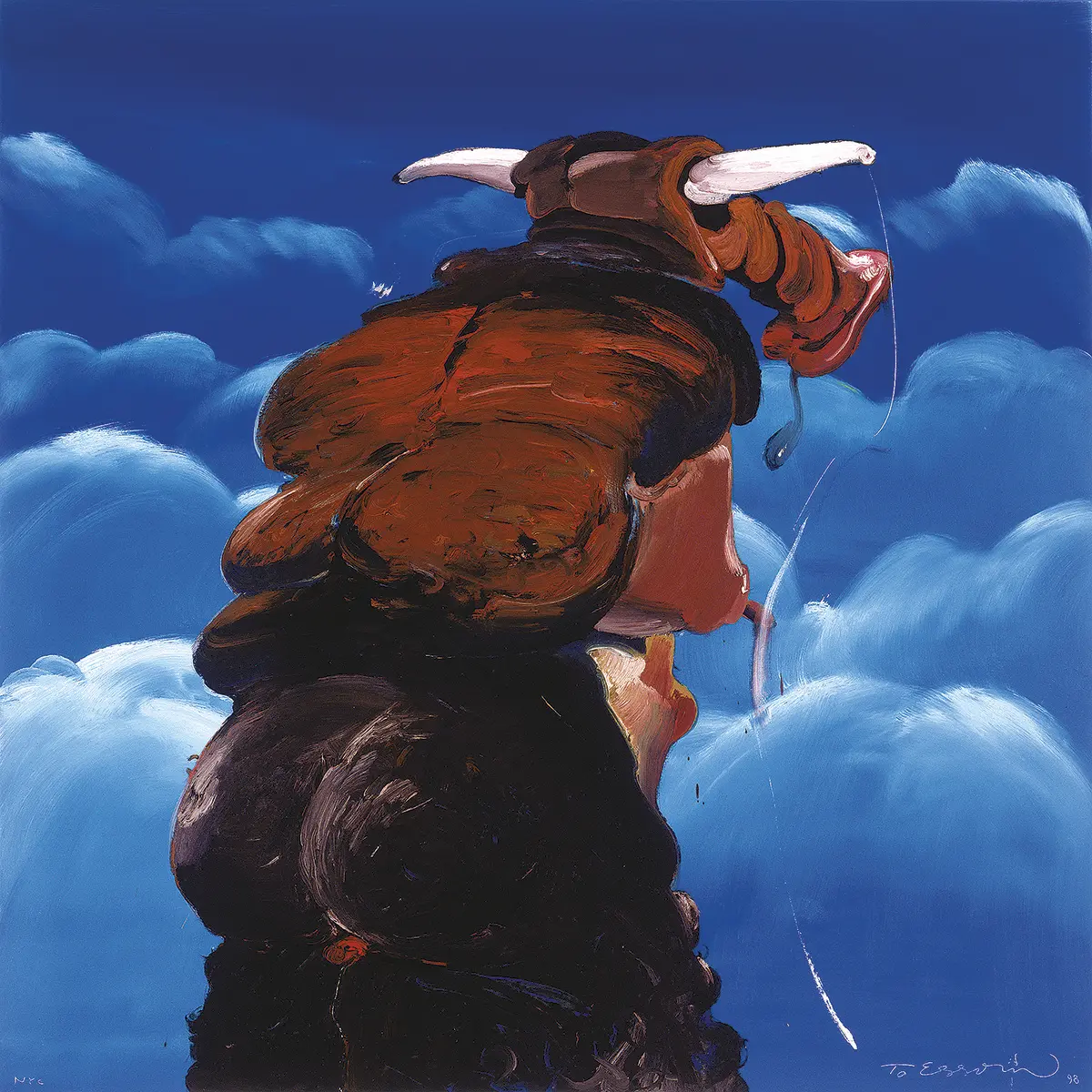
Esson’s portraits, always whimsically dignified, became even more elaborate. Freed from the omnipresence of the political, his haunting creatures continued to evolve, with the black humor and lewdness of their fanciful, expressionistic contortions bringing into sharp relief the prudishness that defines usual approaches to the topic of sexuality. Low angles are dominant in these rara avis of a confrontational and radical beauty, exalting the subjects in their uncivilized, primal condition. Belly and genitals are magnified while the tiny head, crowned by horns, is relegated. Esson’s Rubens-like treatment of flesh emphasizes an erogenous element in beings that are closely familiar and arcane at the same time.
Black Angel I (1994), a large canvas in shades of black, white, and pink, is a three-quarter portrait of a dark winged figure. Hunchbacked, with prominent buttocks, the incipient wings sprouting from its armpits like bloody abscesses are rather unpromising as instruments of flight, even as Esson’s feverish brushstroke evokes their flapping.
Around the mid-1990s, Esson’s portraits began to undergo another mutation, echoing an inward personal change that drove him to reassess his work as a whole. In this process of rebirth, hair—that inner-rooted elongation of the visible self in the direction of others—became a symbol and affirmation of identity.
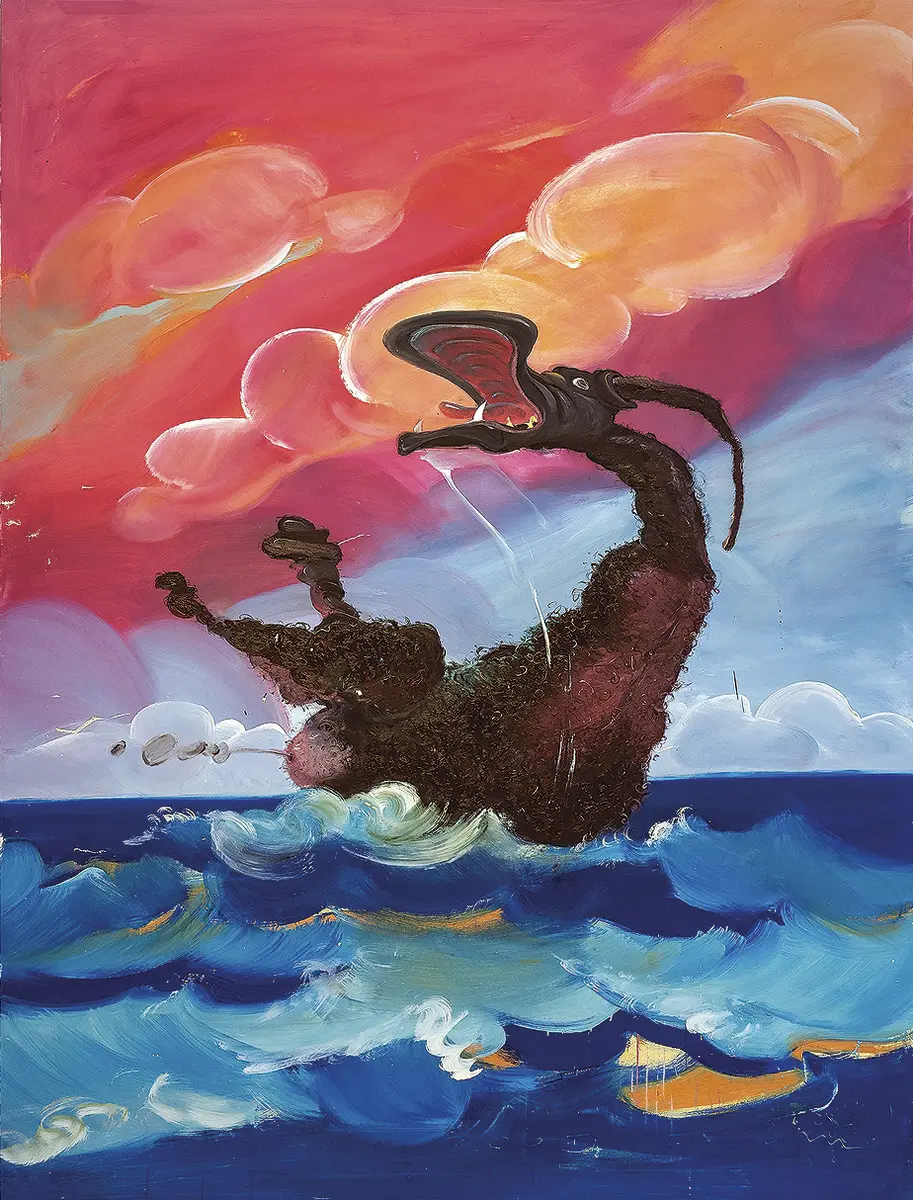
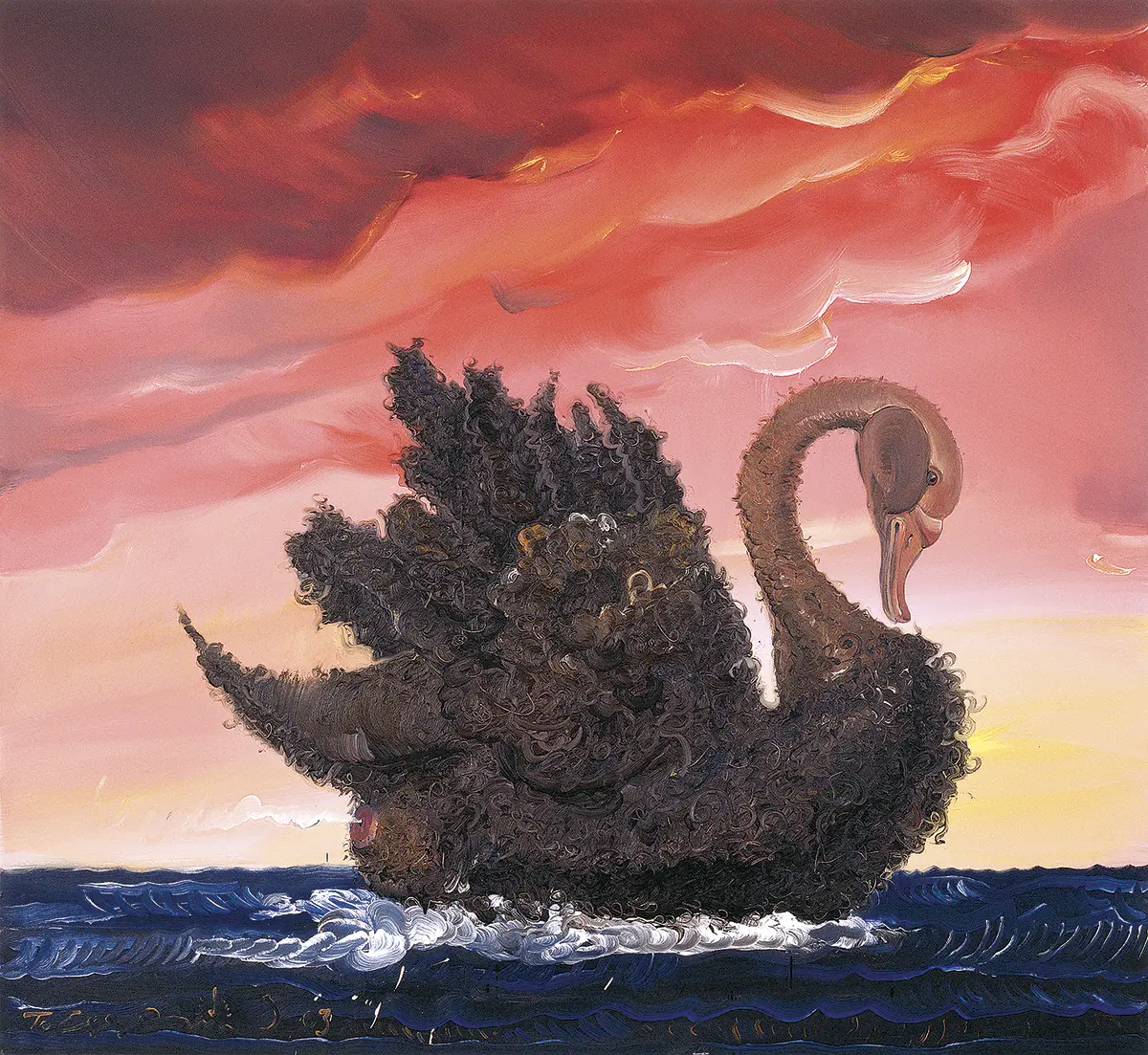
Bobochanti (2005) is a kind of artist’s statement and self-portrait. At dawn, over red strips representing tumultuous sea waves, a whimsical, hairy faun floats adrift. Armless, he is propelled by a liberatory flatulence that purifies the organism, like giving birth. The focus of attention in this work is the tactile quality of the faun’s whirls of hair. The title is a reference to Bobo Shanti or Bobo Ashanti, a Jamaica-based Mansion of Rastafari: Bobo (Black) and Ashanti (from Asante, ancestors). Bobochanti thus encapsulates the condition of the African diaspora, outlined by the artist’s own life experience. In fact, perhaps what we see is not really a faun, but a dreadlocked person adrift in the middle of the Atlantic. Two years prior, in 2003, Esson painted Hairy Swamp, which could be seen alongside Bobochanti as an incarnation of the Talis and the talisman, the Talis being the new personal pentagram by means of which the artist recapitulates the five life-bearing elements: vagina, breasts, mouth, anus, and penis.
Like Cézanne, obsessed with Mont Sainte-Victoire, Esson devotes himself passionately to portraiture. Portraiture is for him what that mountain in the vicinity of Aix-en-Provence was for Cézanne: the key that, through the reinterpretation of a singular motif, gives access to a previously concealed ultimate reality (in this case, the one that hides behind the body.) Retratos (Portraits), a series with sequential numbers for the titles of the individual works on which Esson has worked in earnest since 1995, was born of that compulsive obsession.
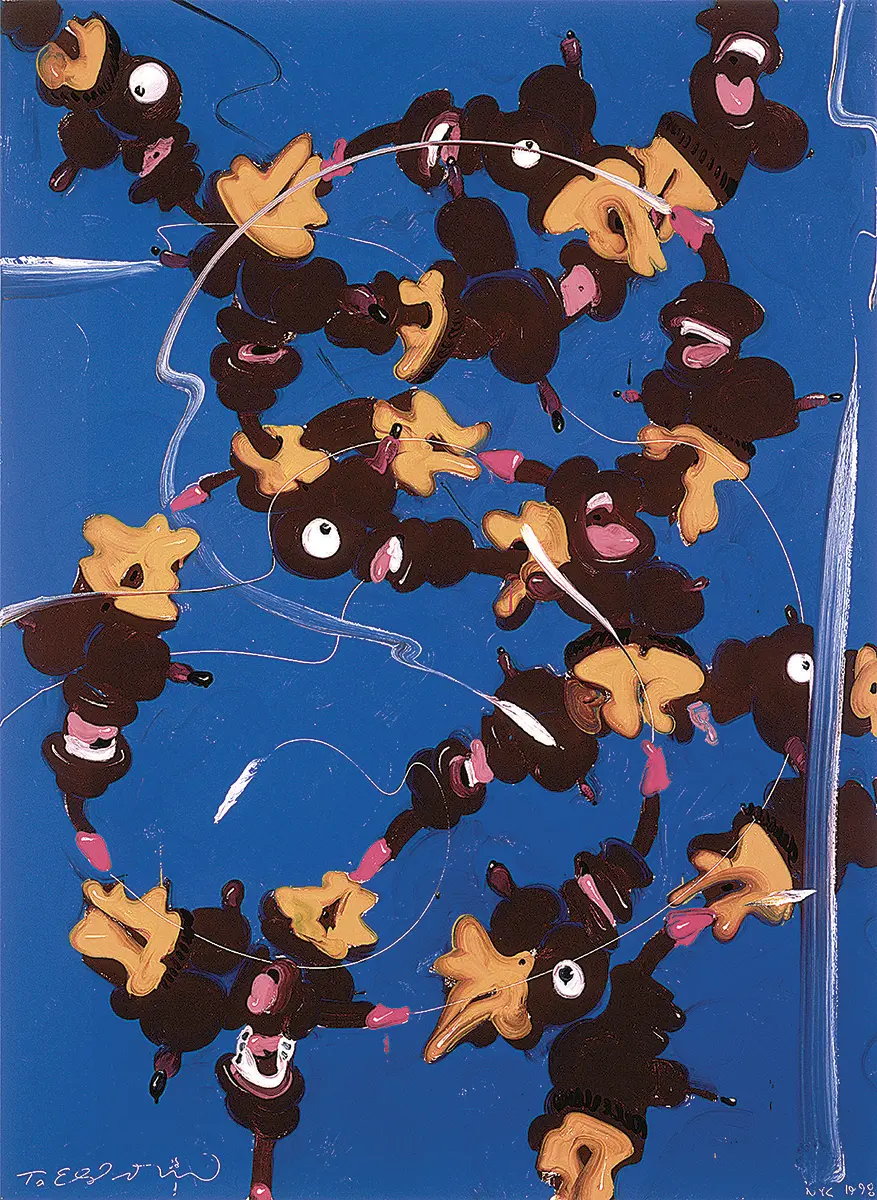
A second medullar series also emerged as a result of Esson’s mid-1990s spiritual rebirth: Wet (Wet Paintings and Wet Drawings). Taking the central motif of the Talis as its starting point, Esson explores the erogenous as a sequential element, capable of regenerating the sequence ad infinitum. The very quality of wetness associated with bodily fluids is incorporated to the technique. The freshness and spontaneity that characterize Wet series’ Matisse-like dance, are determined by Esson’s use of drippings, drops, and splashes, and by his breathless, cathartic gesture, which, like a psychic automatism, reproduces the module time and time again on the medium’s surface, in every possible variation and concatenation.
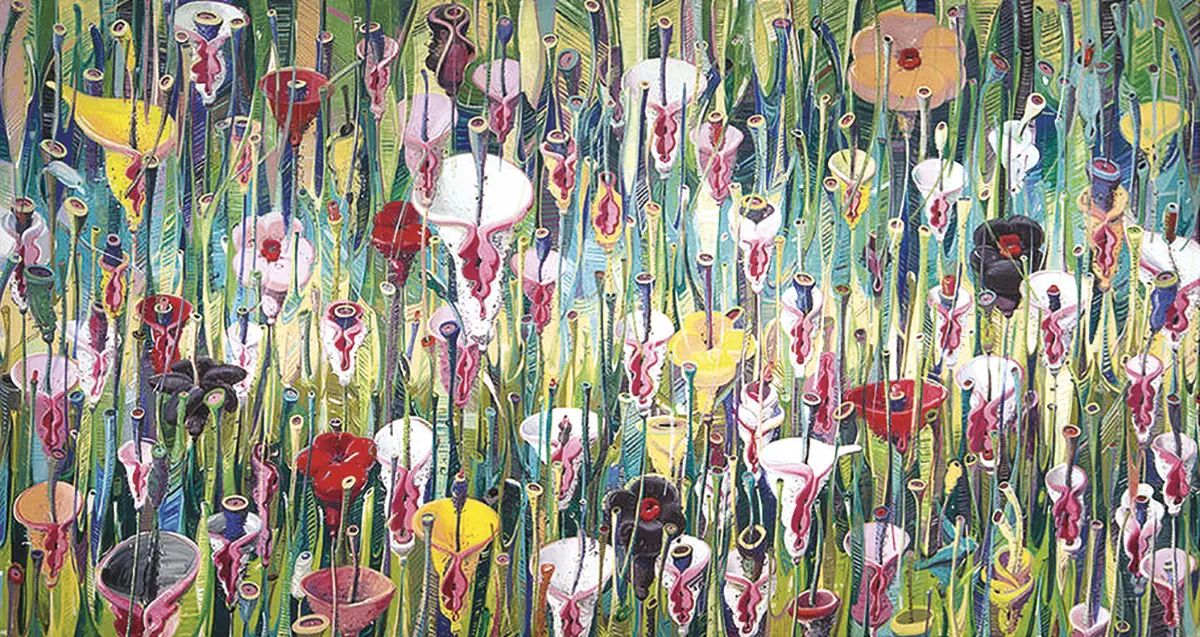
It was precisely through the practice of portraiture that Esson arrived at the landscape genre, in a process of constant re-focusing (zoom in, zoom out) from the particular to the general and vice versa. As he worked on one of his oft-revisited subjects (Penelope), where the weight of the vegetation around the main character is key, Esson realized that all the symbolism was contained in the simple plant element. Thus, a new turn. The orgiastic tangle, the element of serialization, and the wetness of Wet all came together into the floral figure. The artist worked at a frenzied pace. The result would be his most recent series: Miami Flow.
In the exuberant biomorphic landscapes Miami Flow, Esson’s pastel palette, previously restricted to the ground of the portrait, bursts to the fore. The fleshy colors that dominate Wet give way to a range of South Beach hues. In a feast of unbounded forms, the notion of flow is inseparably associated with the sensual and the unstable. The flower (vulva) becomes the central element, with vines, stems, and pistils (hair, definitely) as its seconds.
This series, where a floral element expressed in spiral shapes takes the canvas by storm, imbibes directly from American Pop Art and abstract expressionism. The flat, emphatic colors, the use of industrial paint, and the element of serialization serve as the basis for a spatial relationship where tension and harmony guide our gaze across the canvas. Deprived of any focal center of attention, the viewer’s overexcited gaze jumps from one end of the painting to the other; both Newman’s zip as a vibrato between pistils and Hoffmann’s push and pull through rotund color fields are in clear evidence.
Oráculo (Oracle, 2017), part of this series, inevitably brings to mind two central art-historical works: Monet’s Nymphéas (Water Lilies) and Lam’s La jungla (The Jungle). The landscape we encounter features both the former’s motion and impressionistic relish, and the latter’s exuberance and anthropophagic voracity.
In its unrivaled coherence, Tomás Esson’s work itself describes an ascending spiral, with each new series contained in the previous one. Before, we saw ourselves reflected in his portraits like Narcissus in the waters of a spring, with all our ancestral fears and passions; in the new series, we are carried away by the flow. We are the character in the painting, for the first time emboldened, if anything, to confront itself.
NOTES
1. The term movimiento de Nuevo Arte Cubano (New Cuban Art movement) was coined by Gerardo Mosquera to designate the formal and conceptual renewal in Cuban visual arts that started in the late 1970s and lasted through the 1980s. Its leading figures were, for the most part, graduates of the new arts education system established by the Revolution. “The most important change brought about by Nuevo Arte Cubano—which emerged in the island in the late 1970s—was to push the culture towards social and political critique (...) In the mid-1980s, unexpectedly and without denaturing themselves, the visual arts took on roles of assembly and mass media (which are fully State-controlled in Cuba), and became a space for the expression of the people’s concerns and grievances.” Gerardo Mosquera. “Arte y cultura crítica en Cuba” (1999). El nuevo arte cubano. Antología de textos críticos. Magaly Espinoza and Kevin Power, eds. Spain, 2006, p. 195.
2. As a Pyrrhic compensation for the closing of A Tarro Partido, Esson was offered another show, this time in the secluded facilities of the ISA itself. For the occasion, the artist selected drawings and paintings from his childhood notebooks, where patriotic images appeared unencumbered by any “problematic” content. The title of this second show could not have been any other than ESSON SÍ SE HACE (ISA, 1988).
3. This precept, formulated by Fidel Castro Ruz in a speech known as “Word to the Intellectuals” (National Library, June of 1961), while commenting on the censorship of the documentary PM, defines the course of Cuban cultural policy to this day.
*Courtesy: Tomás Esson & ICA
JANET BATET