
For those of us who study the intricate and complex relationship between art and drugs in Colombia, what happens in Medellín is still an enigma. In a city marked with the deepest wounds, extraordinary filmmakers and writers have profoundly dealt with the issue. Yet, artists have responded only partially and intermittently. Several reasons could explain this.
On the one hand, there is the need to forget and, in some way, the well-known pride of the city’s inhabitants prevents them from accepting their shameful past and their uncertain present, since drugs never left the city. On the other hand, the weight of tradition and loyalty to that which is familiar and established have conditioned Medellín’s artists to gravitate around predictable forms and themes: the landscape, whether urban or rural, constructivist abstraction with strong references to architecture, academicism, the influence of José Antonio Suárez and his ways of drawing and etching, and a particular convention that is periodically updated such as the inevitable portrait in graphite or coal of the traditional miner. Things are beginning to change, perhaps due to the massive success of the series dedicated to the figure of Pablo Escobar, which has brought thousands of (narco)tourists to the city, and the resulting implosion of the Monaco building—the last visible trace of the trafficker’s empire—executed by the mayor of Medellín to neutralize this type of tourism,
The Antioquia Museum has decided to undertake a series of dialogues on the history of the narco-phenomenon in Medellin—from the standpoints of architecture, economics, politics, literature, and art—as groundwork for a future exhibition. In the solo show “Alias,” hosted by the city’s SURA cultural space, Camilo Restrepo’s last twenty years of work are summarized, including his anthological series dedicated to social narcosis, such as This is a Pipe, Figuritas en el suelo (Figurines on the Ground), and new large-format drawings, including Bowling for Medellín, a sort of Guernica of narcoterrorism.
In this vein, the exhibition “Crime and Ornament” by Sebastián Múnera was hosted by the Museum of Modern Art in Medellín. Múnera is a young artist who deals with one of the mythical properties of the drug baron: the Hacienda Nápoles. Located in the Magdalena Medio—a warm-climate zone between Medellín and Bogotá—this huge property served as a recreational home, a drug-trafficking operations center with an airport and a large zoo open to the public, where giraffes, ostriches, antelopes, zebras, rhinos, and hippos roamed freely. Assaulted and destroyed by Escobar’s enemies, and later by treasure hunters in search of places where money could be hidden, it was left in ruins until the last decade, when a group of investors decided to build an amusement park and a recreational aquatic complex, capitalizing on its sinister legacy.
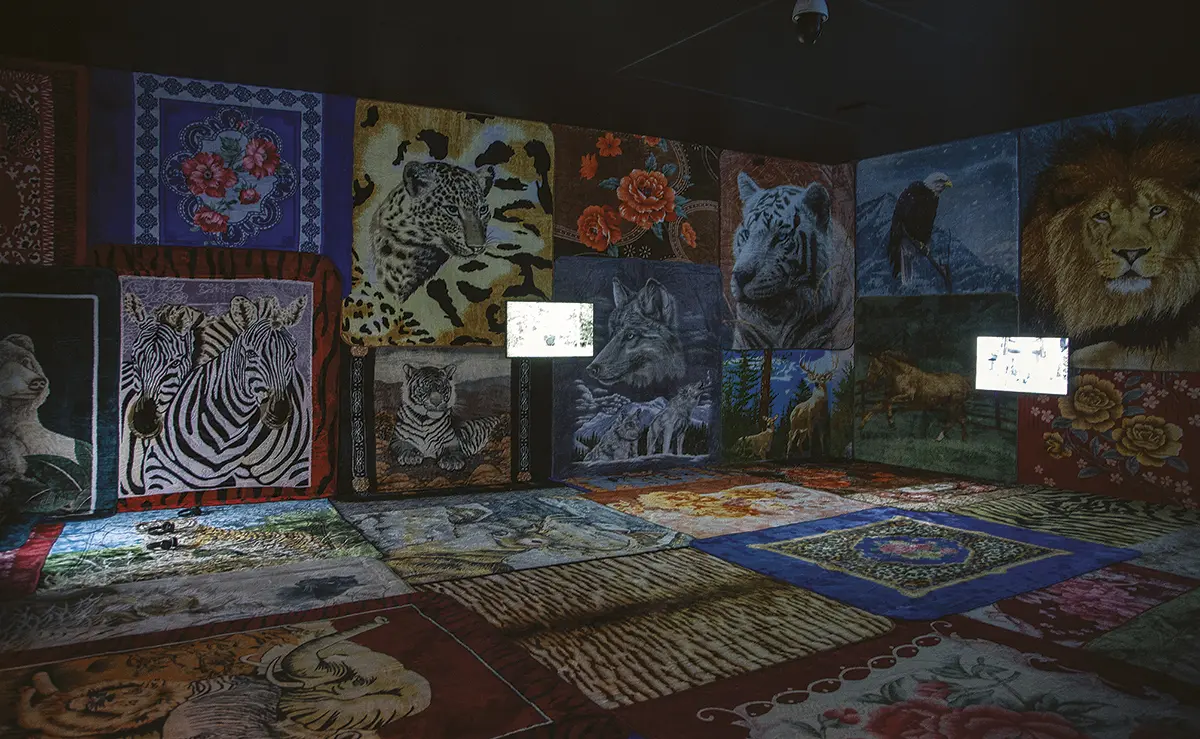
In “Crime and Ornament,” the main argument relies on the fact that the theme park is next to El Pesebre prison. The clash of these two realities—past and present, recreation and confinement, leisure and business—was the primary motivation for the installation the artist created in the museum. Room C, dedicated to projects by emerging artists, was covered from top to bottom with the very colorful and popular Ecuadorian throw blankets.
In a space flooded with the psychedelic iconography of these blankets—where large cats, palm trees, orchids and lush vegetation abound—we had to find the crime. The artist also installed several videos where we could observe different scenes inside the current theme park. Instead of crime, we found leisure. With his camera, Múnera inspects the families of bathers frolicking in the pools: a kind of allegory of the citizens’ innocence and ignorance about the narco-problem. Other videos showed the precarious infrastructure of the park. Hence, the narrative thread proposed by curator Erika Flores suggests that by viewing these almost motionless videos, we are partakers of the stalking and the waiting, of authorities’ and criminals’ game of cat and mouse in a tragicomic drug-Jurassic park.
This robbers cave transmitted a nostalgia for the bygone exuberant narco-aesthetics—others prefer to call it Narco Art—and also constituted a cold examination of the actual social context. Sans crime, the exhibition was an example of how a new generation relates to its distant and humorous past, in a city where the preferred tourist selfie is taken beside the picture of Pablo Escobar shot dead on a rooftop and signed by Fernando Botero.