What narratives are given history’s seal of legitimacy? What figures and events are elevated to an elevated position, and who decides to keep them in the pantheon? Finding answers to such questions is not always easy. At any rate, for something or someone to be inscribed in the historiographical record, documentation is required, often accompanied with images as a testament to its validity. This is true both for historiography in general and for Art History in particular. In earlier eras, such images came in the shape of sculptures or paintings. Since its advent, however, photography has been entrusted with the responsibility of proving the authenticity of events.
Rosângela Rennó’s Documento-monumento/monumento-documento (Document-Monument/Monument-Document) questions this role of photography as the indubitable evidence of an event. For a long time, Rennó has collected images from a variety of sources, ranging from public archives to family albums, and including different mass media. Her investigation of the consequences of those registers and the framings they promote is a sharp rebuke of the supposed objectivity of memory, be it individual or collective. In Rennó’s exhibition at the Vermelho gallery, the results of this investigation present us with a critical look at the discourses that are disseminated from the intersection of a given image with a given narrative.
The reproduction of massively-circulating visual information can tease out meanings that have taken root in the collective imaginary. Exhibited above the entrance on the building’s red façade is the black silhouette of a man in an emphatic pose. The image has circulated widely all around the world for more than one hundred years, both in the man’s honor and in his criticism; many visitors will recognize him as Lenin. Inside the gallery, at ground level, is Good Apples/Bad Apples (2019), comprised of more than 800 framed photographs of monuments erected to the Soviet leader. Rennó describes these photographs, the result of a two-year research project, as “observations based on the act of collecting photographs of statues of Lenin.” They show what happened to the monuments over the years, during and after the fall of the Soviet Union. Each image includes Rennó’s manuscript notes and the drawing of an apple resembling the American tech giant’s logo, an emblem of capitalism.
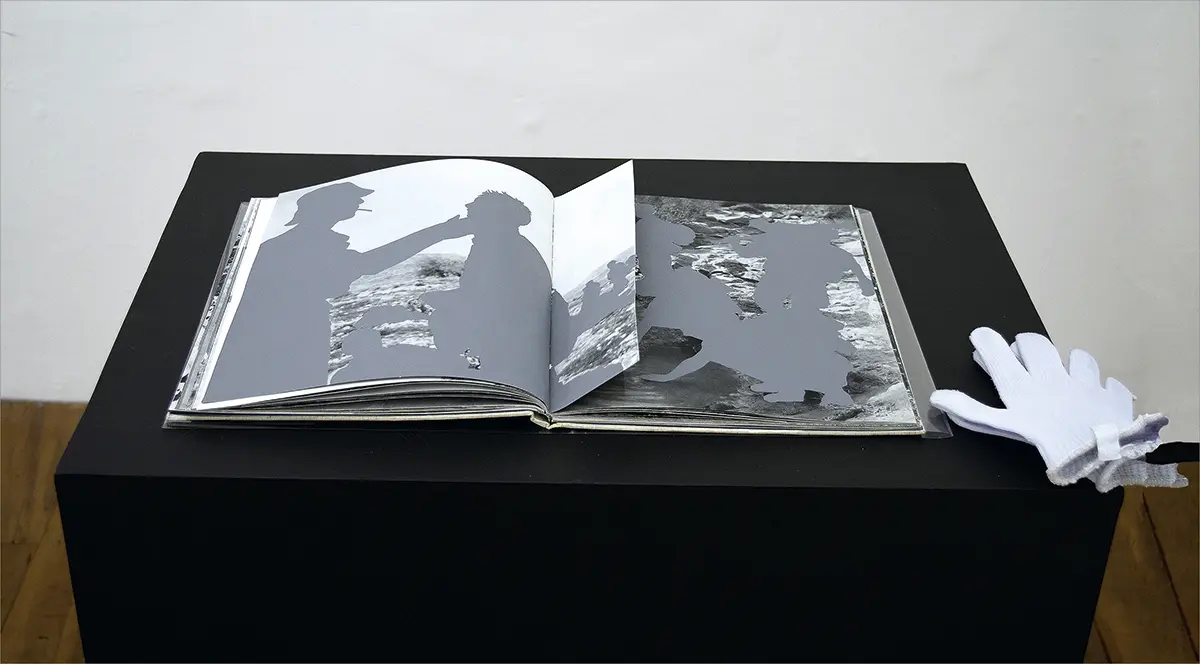
On Aucune Bête au Monde (No Beast in the World, 2019), Rennó’s procedure is analogous to her intervention on the façade. The work’s French title comes from a 1959 book on the Algerian Independence was, fought between 1954 and 1962. The book includes photographs and stories from the war and was authored by two officers in the French army. The faces of the authors have been masked under gray ink, and all the words have been cut out. Without the individualization provided by the faces, the fact of this being an armed action remains evidence. Whether it is a war, a humanitarian mission, a rescue, or a training exercise can no longer be determined, nor can it be established where in the world it took place. Yet, some realizations are inevitable: the weapons are recognizable, even in outline, as they are part of everyday experience for any person living in a complex society, and their appearance immediately implies the proximity of danger. The aggressor and the victim are not identified, and there is no justification or explanation for the hostility between them. Confrontation, on the other hand, is universally understood.
Rennó’s artwork-provocation Exercícios de 3D (transparência) # 4 (3D Exercises (Transparency), 2019) deals with the overexposure of specific images in the mass media. Short texts describing famous photographs are nailed to the wall. At the same time, an old device for visualizing 3D images, accessible on a shelf, presents a descriptive passage with letters that shift, making reading uncomfortable. The material is part of the Universal Archive that Rennó began in 1992. It collects descriptions of photographs so intensely circulated in the international press that reading the texts is (in most instances) is enough for our memory to bring forth the corresponding image. Such images are incorporated into the visual repertoire of most people with access to general circulation newspapers and magazines.
In the middle of such broadly universal matters, one of the works Rennó shows here deals with her country’s local realities. Brazil’s typical Havaianas, a type of flip-flop sandal, have become a worldwide symbol evoking the country’s image as a relaxed, sensual paradise with an exuberant natural environment. In 2019, an extreme-right government gained power in Brazil, determined to repress a freedom-loving culture and wholly unconcerned with environmental issues. Brasil (Brazil, 2019) features two right-feet Havaianas sandals in the colors of the country’s flag, green and yellow, with the year 2019 carved in bas-relief. The singed tips are at the same time a forewarning the coming witch hunt, and a reference to the fires that devastated the Amazon throughout that year.
SYLVIA WERNECK