To understand the recent works of Rosa Navarro—who was born, studied, and lives in Barranquilla—one would have to go back, curiously, to Nadaism: Colombia’s main poetic movement during the second half of the twentieth century. Although born in Medellín at the end of the 1950s, Nadaism’s most immediate and loyal Caribbean followers were two essential artists from Barranquilla: Norman Mejía and Álvaro Barrios. It was precisely the latter who, from the mid-1970s until the late 1980s—the years of Navarro’s formation—defined the experimental art scene in that city through the prism of Nadaist principles and practices. As an artist, curator, and teacher, Barrios understood the concerns of the young artists in Barranquilla that made up the collectives El Sindicato and Grupo 44. Togeher, they developed a language that was rebellious, performative, anticlerical, but also ritualistic. Strongly influenced by Barrios’s persona, his Nadaist vocation, and his cult of Marcel Duchamp, these artists sought to embody their poetic narrative through process art and the photographic index. Anthological works such as Eduardo Hernández’s La letra con sangre entra (The Words with Blood Enters) were the result of the birth of art as an idea in Barranquilla. Others reveal Nadaism’s humorous iconoclasm, such as Antonino Ingino Caro’s The Effervescent Body of Christ: a sequence portraying a full moon melting away, which was a dissolving Alka-Seltzer. These works belong to a moment when there was no memory for the unforgettable.
Inserted in this Caribbean conceptualism is the work of Rosa Navarro, an artist whose trajectory erupted with full force in the early 1980s and then flourished gradually, and more privately, over the next three decades. Like Herazo, Bernal, Cepeda, Suárez, Caro, and Hernández, Navarro recorded her performances in black-and-white photographic sequences. In her self-portraits, she played with the image and sound mimicry of the four letters of her name, with an evident Caribbean zest; in other words, with humor, character, and self-exploratory pleasure, whether in intimate settings or at the seaside. Like her contemporary Barranquilleros, Navarro never forgot that her guiding star was Marcel Duchamp, to whom she paid a small tribute by renaming herself in one of her works as R-Rosa.
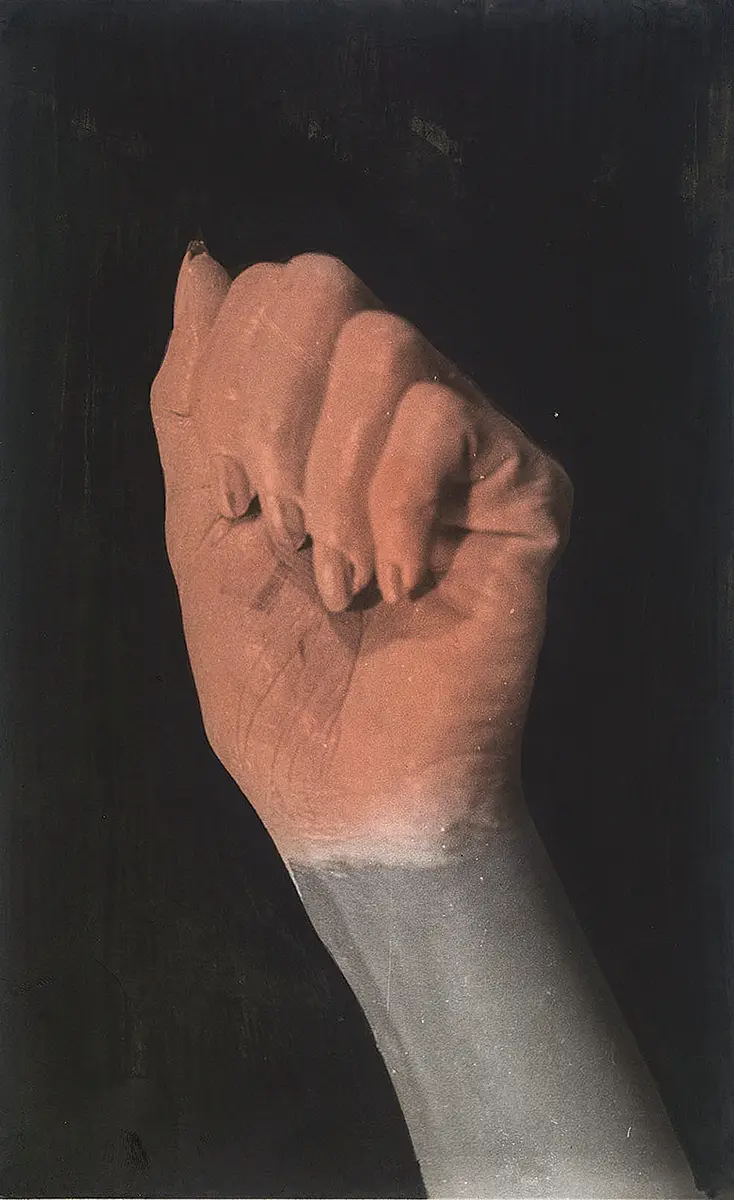
The task of articulating Navarro’s oeuvre was entrusted to curator Silvia Suárez, who had the opportunity to present it as if for the first time. Suárez, who lives in Bogotá, chose the calligram as a guiding symbol: a text/image “where the calligraphic arrangement iterates the content of the text, and vice versa.”
Although this is not necessarily true, the calligram serves to define Navarro’s series as acts of reciprocal masking. This is true whether she appears with roses on her eyes, as in Birth and Death of a Rose (1982), or when she photographs her hand separately and in sequence, drawing each letter of her name in a purely visual language, as in Rosa in Sign Language (1981).
The exhibition was mainly comprised of black-and-white prints, contact sheets, and painted and color photographs. Although we were left wanting to know more about Navarro’s work and its evolution (the show only focuses on what she created during the first half of the 1980s), this show begins to pay our debt to Caribbean women artists of the twentieth century which were long forgotten or, like Navarro, still unknown to new generations. It also helps us return to the path of Caribbean conceptual art, which has yet to be further explored and where clues can be found to recognize what art on the coast was, is, and will become.