Although the role of photography was believed to be eclipsed in this millennium, and the online storage and communication technologies that use video as the primary source would end the life of the still image, it still occupies an invincible niche. The biometric identification system—which works by capturing the image of the iris: something like the fingerprint of the eye—implemented at airports, for example, updates and refines the photographic-profile identification system created by Alphonse Bertillon in the 1890s, which we still use for our personal documents. On the other hand, our excessive desire to comply with the photographic ritual every time we want to commemorate a social event with our selfies, made to be shared immediately, has caused photography to occupy a central place in our current lives. These two realities connect us with Óscar Muñoz’s exhibition, which deals with all of this: the portrait, the airports, the memory, the individual identification, and the photographic ritual. For a couple of decades, at least, Muñoz has demonstrated a broad interest in the forms and formats of technical, commemorative, and identity photography. In Breath (1996-2002), for instance, he resorted to circular metal plates in which he recorded the frontal portrait of an individual. Invisible at first sight, it can only be activated by a sudden change in temperature, as when the spectator facing the work gives it a breath of life, exhaling over the latent image that begins to appear with the resulting steam, as an evocation and a memory.
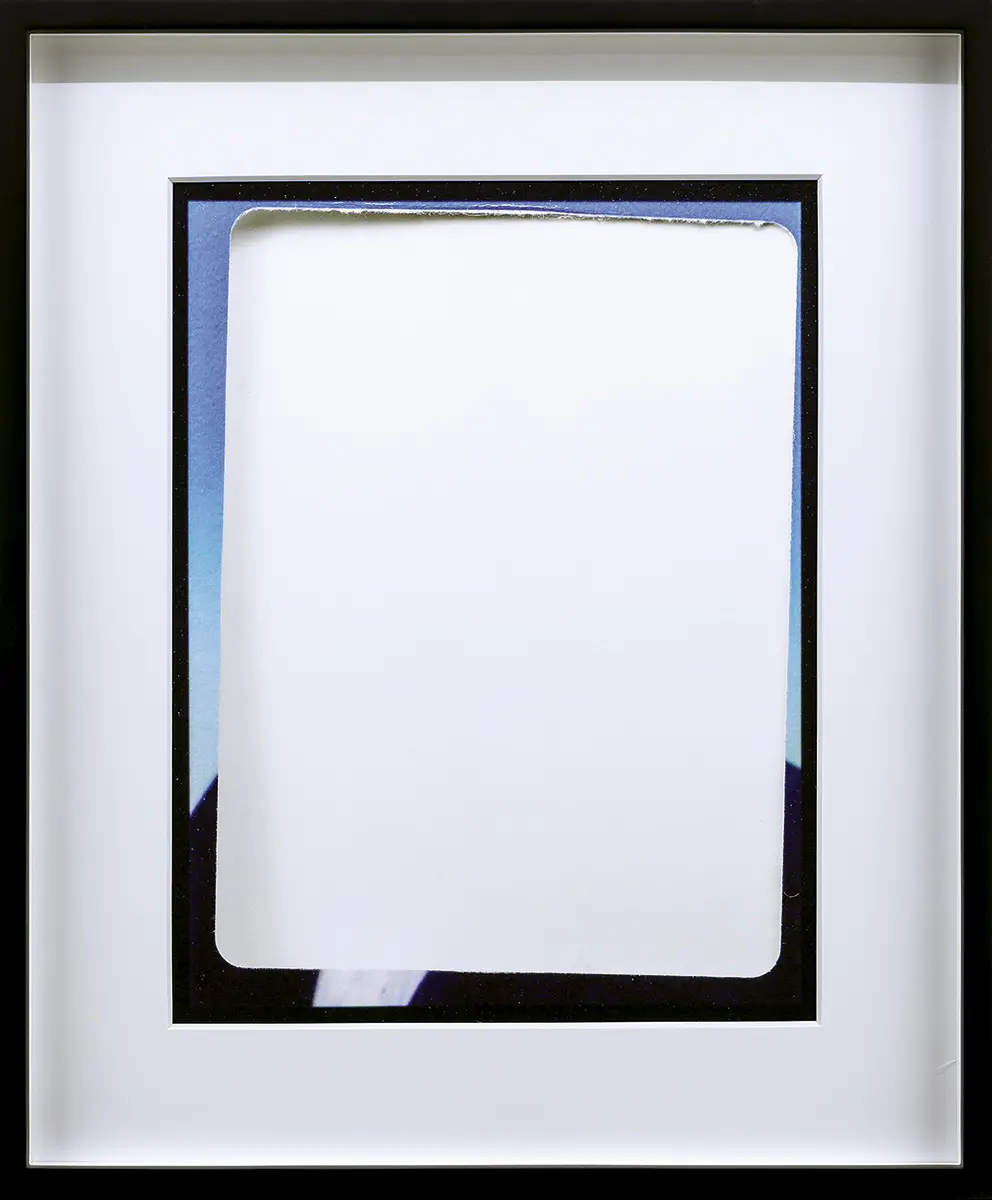
The artist kept his strong interest in the ways photography and its embodiments become extinct, survive, or transform. For Marginarios (Marginaries, 2018), he took the waste from the photographic studios that operated near the passport-issuing authority of Cali. In these businesses, registration procedures are done quickly and diligently by shooting, printing, and defining the size of the portrait according to the required document: be it a visa, a resume, or a passport.
This ritual ended when the Government began to shoot and print the photographs directly in the legal documents; in low resolution, by the way. Faced with this disappearing economy, Muñoz, an attentive observer of the collective memory, began to compile an archive, not of portraits, but of the sheets of photographic paper from which the photographs had been extracted with a die or by hand. In other words, he kept the outer margins of the portrait, the residue. This material— collected and rephotographed to reproduce the originals, obviously respecting their central void—is the focus of this exhibition. We can still see some details of the subjects whose portraits were taken: a blouse, the fabric of a jacket, a piece of hair. In short, the confines of the aspiring traveler, of the dreams of a better life in a country that expels people, and of someone who survives thanks to the remittances sent by their relatives from Aruba, Spain, United States, or China. These pieces connect us with the migratory phenomenon and the absence of family members or friends who left, who are not there anymore.
Possibly, the artist wants to testify to this absence, or perhaps only to the disappearance of an era, the end of the use of an analogous technology and a material—paper—to be replaced by the online screen. Perhaps, on the other hand, it constitutes a metaphor for excessive exhibitionism in social networks. Be that as it may, sowing doubts about what we see or remember has always been the task of Muñoz, who leads us to several questions: Why embalm the absence? What happens when (the image of) the head is missing? Does it strip the image of its magical and conjuring power? What do we have left to see? In the absence of who are we? What would we see if, instead of these remains, we were in front of the complete archive of the citizens’ IDs or driver’s licenses? Would the abundance of experiences necessarily lead us to better results than their absence?
SANTIAGO RUEDA PhD