Nan González (María Luisa González) is a pioneering explorer of contemporary languages in Venezuela, having posited for herself, since the late 1970s, a new process-oriented and ephemeral logic for artistic production, based on performance, video art, and photography. Early on, she worked in collaboration with Jennifer Hackshaw, under the collective name of “Yeni & Nan.” Their partnership extended through 1986, after which Gonzalez continued as a solo artist.
On this occasion, she exhibits a group of photographs and video installations made between the 1980s and 2019. The concept of time connects the works selected. The exhibition’s general discourse is based on several axes. One is a review of the artist’s oeuvre and her use of technology. Certain elements in some of the works were updated with new supports, while others retained the original components. The reflection about what is an inescapably necessary part of a given work of art and what can be altered brings forth the issue of what is the impact of time on the work’s initial configuration. To what degree is the work nourished by current technologies, and to what degree must it remain untouched as a testimony of an era? The show’s curator, Sagrario Berti, believes that we face a “recontextualization and resocialization of the material,” thus, a nostalgic approach to the initial moment of conception of these proposals is avoided.
The other axis is repetition as a dialectical notion of time. Time is unrepeatable, linear, and chronological. By means of repetition as an aesthetic concept, González moves towards different ways to represent is in a purely utopian and tautological state, challenging a temporal logic.
The nine works on exhibit, some of them previously seen and some not, are organized along a path that starts with Autorretrato (Self-Portrait), from 1982, a photographic document where González uses polaroid photography on pencil-intervened paper. This work presents several records of an action, which in turn creates a grid of times gathered in a fragmentary way. The exhibition continues with Códigos del tiempo (Time Codes), dated 1994, a video installation comprised of a closed-circuit TV, a video camera on its tripod, three TV monitors situated at the center, and eleven metronomes distributed on the walls. The camera records one of the metronomes, the out-of-focus image of which appears on the monitors. The tic-tac of the metronomes, each set to its own time, results in a penetrating sound environment. This is one of González’s most complex proposals, one that introduces viewers in a distinctly sensorial, experiential, and emotional space with the simultaneity of times, images, and sounds.
This work is followed by Obertura 3 “Y se destruye el tiempo” (Overture 3: “And Time Is Destroyed”), also from 1994. It is comprised of three analog large-format photographs, intervened with pigment and charcoal. The image of a metronome appears in each image. The motion of its pendulum captured as it oscillates to the right, left, and middle. The emphasis is on the observation of stopped time. El vuelo interior (The Inner Flight), from 2001, is an installation comprised of eleven pipette-shaped glass bottles and a parrot feather that reveals interiority and a restrictively protected kind of symbolic freedom.
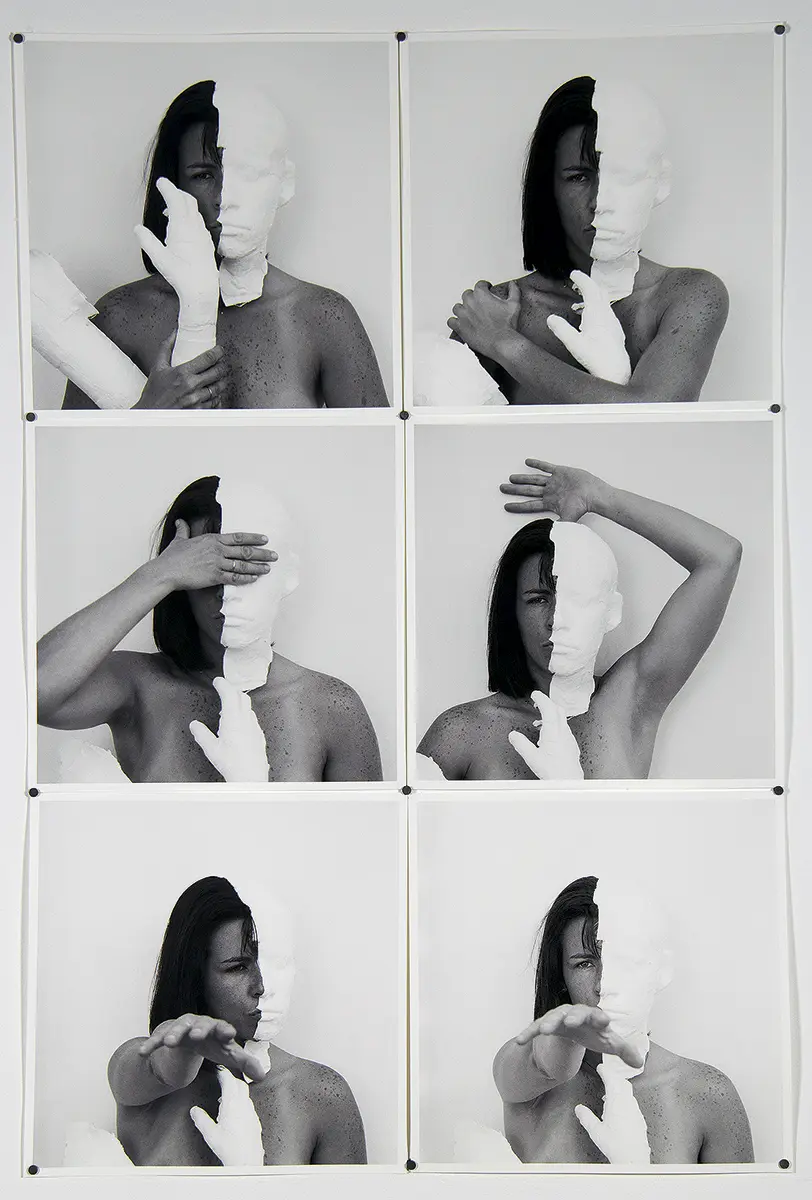
Next, Homenaje a: Clock (One and Five), de Joseph Kosuth, 1965 (Homage To: Clock [One and Five]), by Joseph Kosuth, 1965), is a video installation with clocks, made in 1992. González highlights different levels of perception of and interaction with reality though the site-specific object, the object’s video recording, and the object’s printed image; to wit: eight hanging clocks, the video of a clock, and the photograph of two clocks. Proceso del pensamiento (Process of Thought) is a video installation from 1991-2019 that uses hands to illuminate the concept of time in the creative process. The video presents out-of-focus images of hands in motion, and fifteen photographs of the black and white screen were captured. Again González reproduces the instant and uses paper as a printed record, showing several stages of reality. Autorretrato (Self-Portrait), dated between 1983 and 2019, follows the same principle. Tiempos inexistentes (Non-Existent Times), from 2002, is the projection of a clock on the wall, with four hands and fictional figures substituting for the conventional numbers. Finally, Tiempo (Time), from 1994, is an installation with twenty-one clocks on the wall and floor, each telling different times.
This exhibition is a journey through and with Nan González’s time. The quality of relativity has been amply explored, by intervening, suspending, accelerating, and multiplying spatial, temporal, and historical dimensions, teasing out new, interwoven, inconclusive, shifting narratives. Despite the imaginary scenarios thus created, a series of questions emerge about our understanding of the uncontestable persistence of the clock’s tic-tac and the human pulses that are the evidence of a life bound to the present.