“Fractals,” Mónica Vilá’s (Bogotá, 1987) solo show at La Tertulia Museum (with the C de Celsia Program), offers traces on different scales of two places: the house and the body. Calidoscopio Collective’s curatorship approaches these places from the perspectives of femininity and memory, interpreting how Vilá’s memories are built on the notion of an intimate territory where pain, absence, and wounds occur. The parental home, as I see it, is an original territory where the first sensations (the body) are experienced. The exhibition bonds projects made at different times, treating memory and photography as language itself and not merely as a resource for the creation of works.
As we observe the show’s installation and the staging of the photographs, we sense that there’s something more. A series of specific meanings escape curatorial analysis and reveal a great vitality when we contemplate the photographic language developed by the artist. The images in the exhibition shift from one scale to another, suspending the standardized point of view of an omniscient spectator and giving way to the unknown, to the need for a snooper, for someone who not only sees but can reconstruct the stories, who stops and reads.
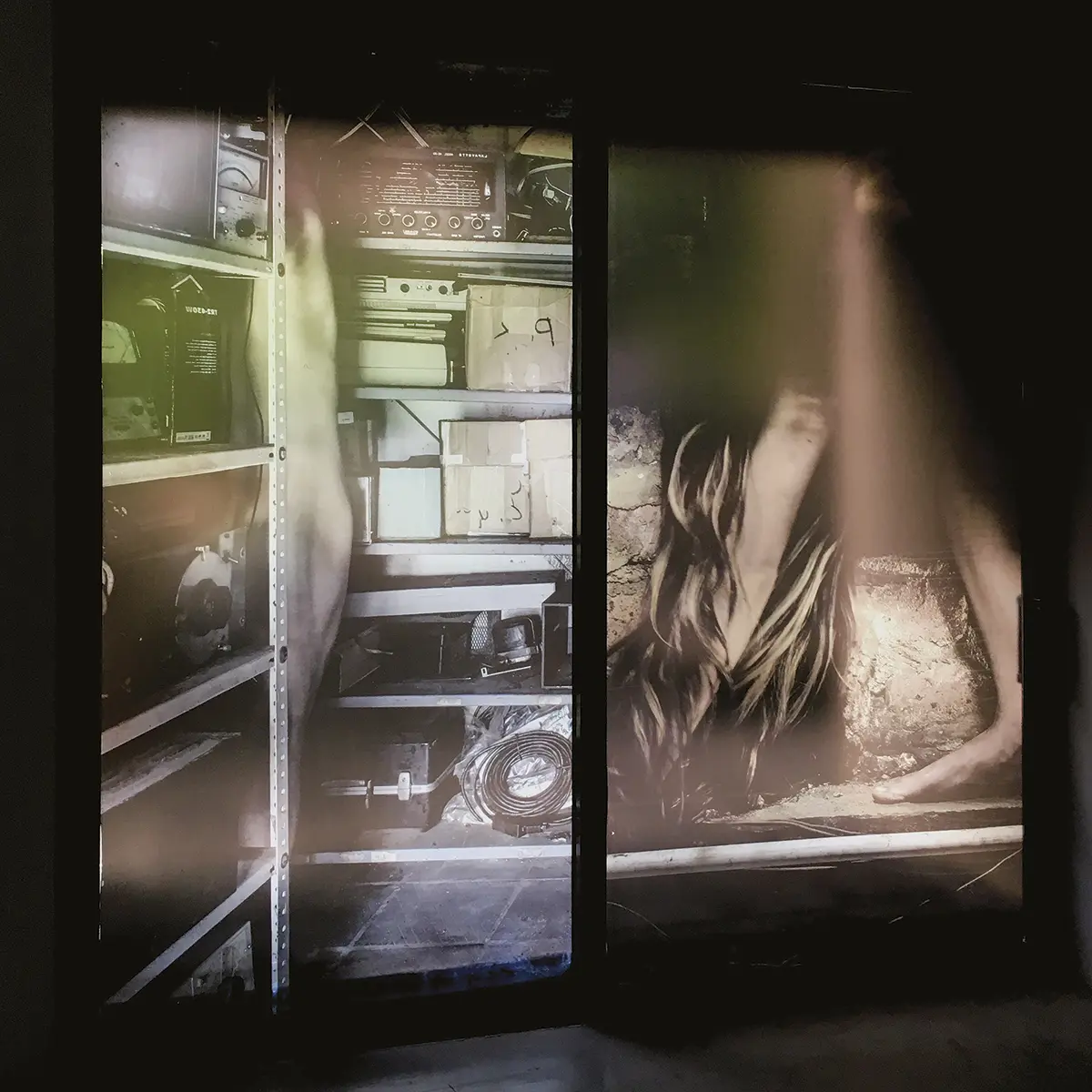
The images appear in ways that transcend the prints. Some of them are projected on windows where a video beam confronts the sunlight; this layer of transparency camouflages an image that, in turn, contains hidden elements. Nothing is shown directly. If a photograph includes a wound behind the wound, there is a chain of marks and experiences; if voices are heard behind other voices, something is not spoken; if a projection shows a part of the house, there is a veiled body among the objects and plants. If there is an installation of glass jars, inside them, there are still lifes that want to be preserved like memories.
In a text on the series Lembrar, the artist says: “I grew up in a large, old house; one of those houses where big cobwebs are formed and one can keep quiet if she wants to; one of those houses full of plants in the front yard, in the garden, and inside; with many old things; some new things, and others abandoned or forgotten.” This reminds me of a dream I had a long time ago, in which I entered a house that belonged to someone who kept memories in glass jars because memories were liquid; and that someone told me that this was a new file format, fluid, transparent-like water that could be sprinkled or spilled. Something about Vilá’s exhibition gives the impression that the works are not exactly photographic.
The images are shown in a grid (Haptics, 2018-2020: marks and fragments of bodies), in video transitions (Wounds, 2009-2020: injuries and accidents), in projections against the sun (Dysmorphias, 2013-2014: original spaces; body and house; body coded as stain and object) and in prints (Lembrar, 2015-2020: details of insects and broken objects). No image is disconnected from the others, so the projects cannot be read separately. Likewise, an ensemble implies— rather than shows—a concept beyond image and memory. This constitutes a device close to allegory, by an artist who has a background in literature. To disguise, pretend, blur, suggest, deform, and circle around a theme are some of the strategies that she employs to detract us from fully knowing her intentions; we can only guess them.
Self-similarity is a characteristic of fractals, since the parts that make them up are identical to the whole, changing only in scale and, at times, slightly in shape. Translating this idea into the photographic field one could relate it to “the part for the whole” structural method, a synthesis and abstraction procedure that reveals without revealing, suggesting a blind universe that does not appear in the image, but is strongly anchored to what we see. A clue or a fragment cannot help but give us the whole. This way, the contours get lost, exiting the frame, and the bodies spread out endlessly. They are no longer bodies: “I grew up with the feeling that nothing is forever, that the connections with the world around us are both light and dark, but always fragile” (Vilá, Haptics). Perhaps this exhibition is an attempt to amputate those fragile connections by cutting off all the motives through the framing and the reduction of the field of vision, which paradoxically multiplies the connections with our world since it becomes impossible to determine only one thing. On the contrary, everything bonds again.
BREYNER HUERTAS