
Renowned for her technical and aesthetic sophistication and her innovative, foundational work in printmaking, as well as for her penetrating photo-performances, photographs, and videos, Matilde Marín (Argentina, 1948) displayed an early interest in fire in her work. The exhibition under review, Cuando divise el humo azul de Ítaca (When I Sight the Blue Smoke of Ithaca), at Del Infinito Gallery, finds its inspiration in other fires and other smokes. However, I still remember works included in earlier series. The works in La tierra prometida (The Promised Land) and Laberinto (Labyrinth)—which for their volume and texture seemed to want to be sculptures—were painted using smoke, engraved by fire to transfer images and mark tones on 100%-cotton paper. Years later, a penetrating smoke reappeared across the unfathomable sky of Argentina’s vast pampas, in a series of photographs in Itinerarios (Itineraries).
An insistent concern with medullar and central human themes, and her many travels all over the world, enriched Marín’s art and drove her to understand the artist as a witness. “I have been given everything in my travels,” Marín said in a conversation with the critic Adriana Almada. Since 2001, but with greater emphasis since 2005, she has been collecting hundreds of images and videos of smoke clouds found in newspapers, online publications, and TV newscasts. These images are the journalistic reflection of wars, natural disasters, and environmental catastrophes. Part of this work in progress is included in Cuando divise el humo azul de Ítaca. The selection of twenty-eight works—which hark back to the artist book of the same title published in 2012, with images selected by Marín, essays by the art historian José Emilio Burucúa, and a musical piece composed by Marta Lambertini, presented at Teatro Colón’s Experimentation Center—features emblematic visions of tragic situations.
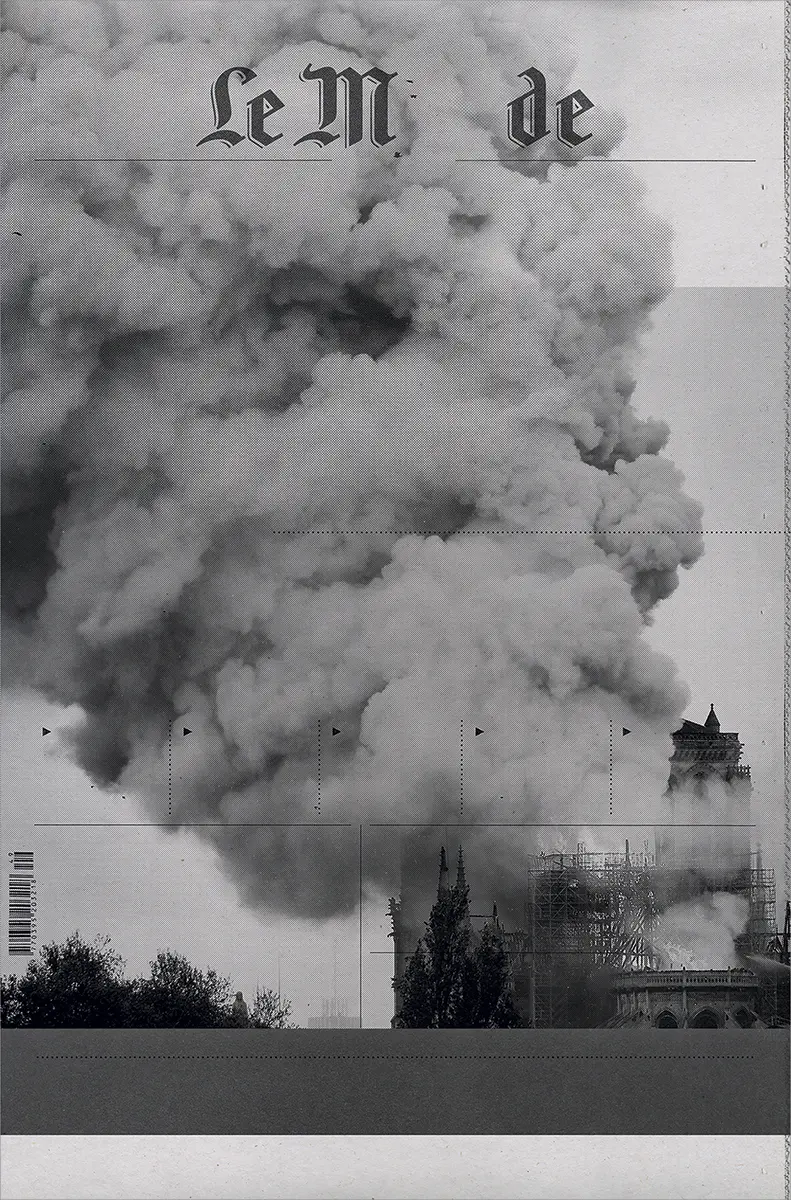
Marín searches for, finds, and clips heartrending vistas from the relentless ocean of representations offered by all present and past news publications. The exhibition takes us through various times and geographies, including Santiago de Chile and the 1973 fire at the presidential palace of La Moneda, during Pinochet’s coup. It also takes us to street riots in Paris and Algeria (based on a still photo from Gillo Pontecorvo’s film The Battle of Algiers, which portrays Algeria’s struggle for independence from France). Marín records smoke in an Eastman Kodak plant in Rochester (the company produced the implosion using explosives, in order to use the site for a different purpose); mushroom clouds from nuclear-bomb experiments in French Polynesia; columns of smoke and ash erupting from an Iceland volcano; pollution caused by the Belchatow electrical plant in Poland; and more.
The works are arranged in the manner of a large installation, comprised of shelves were unframed, life-size scans of magazine covers, printed on newsprint stock, rest. The exhibition also features a timeline presenting headlines and names taken from the media placed high above the works. A large vinyl of the smoke produced by the terrible, uncontrolled (intentional?) burning of the Amazon forest presides over the gallery. Of course, had the exhibition opened more recently, the heartbreaking damage caused by the Australia fires would surely have been included as well, both for the ecological tragedy and the irreversible loss that it signifies for the world, and for the emotional ties that connect the artist with that continent.
The “blue smoke” of the title refers to the benevolent smoke that used to rise from Ulysses’ home, which the hero longed to see again when he finally returned. Burucúa points out that in the Classical Greek language in which the Homeric poem was written, there is no word for “blue”; it appeared only in the Fifteenth Century. “A translation error inserted the adjective blue in places where it was not found in the original version,” Jimena Ferreiro writes in the catalog. “A big favor to the history of images and to these chronicles organized by Matilde Marín, which allow us to think of that smoke as possessing other qualities.” And even if even fire can be constructive or purifying, the images here don’t find it extolling the human or praying to the gods. Here, there is no ambivalence to smoke: it represents catastrophic situations. With her allusion to the “blue smoke,” the artist is perhaps inviting us to dream and revert the disaster.
Marín’s images are stirring both as poetry and as a document, like her vision of the fire consuming Paris’ Notre Dame cathedral in April of 2019. Because of its powerful historical and symbolic value, that vision perhaps reverberates more strongly for Western observers. That day, European culture burned again, “our history” was lost, and the cathedral of Paris became Notre-Dame de la tristesse, as another photograph and another headline in the show have it.
VICTORIA VERLICHAK