
We find ourselves gripped by a concern for the speed of time’s passage more and more often these days, as we are confronted by the evidence that images provide. This phenomenon is bolstered by the fact that our own photographs are always within hand’s reach, in social media, or on the cell phones we carry. The range of temporal validity for what occurred a few days ago, or even five years, seems to have been altered.
On the other hand, how much do a person’s dreams change from one year to the next, of between decades? And if those dreams come to pass, are they immediately replaced by others? Does long-held dream, kneaded over time, take root, and become something else? How long before it turns into a desire? These are a few of the many questions prompted by a visit to Mapa de sueños Latinoamericanos (Map of Latin American Dreams), a stirring photographic exhibition that traverses the continent just as its author has done since the 1990s. The show had its last Southern Hemisphere stop at Buenos Aires’ Parque de la Memoria, on the banks of the La Plata river, with 100 spotless photographs in a variety of formats on display across three exhibition rooms.
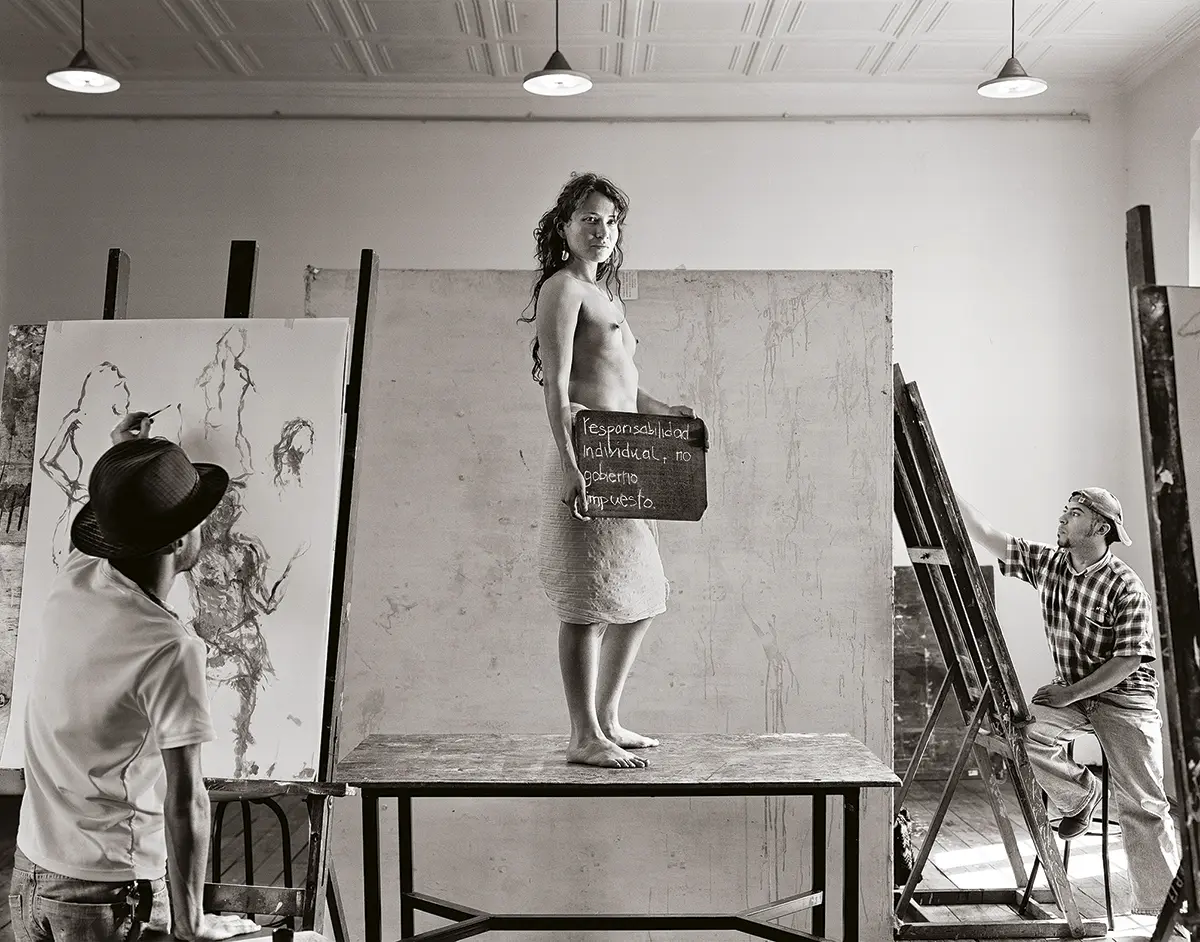
It is possible that twenty-two years ago when Martin Weber first received fa Guggenheim Fellowship and later a couple of Hasselblad grants and additional financial support that allowed him to work on his Mapa, he did not imagine that the individuals he portrayed would gain spokespeople status for their dreams at the end of the second decade of the twenty-first century. Subjugated by the beauty of the images, by the perfection of grays and shadows that only black and white photography can achieve, we wonder, then, whether their dreams remain alive for those individuals: whether they were fulfilled. It saddens one to know that in many cases, such dreams have no completion date. And that, in consequence, Weber’s map accurately traces the shape of a series of structural injustices.
Another question: Is it possible to take the pulse of a continent, in all its vastness, through individual dreams or yearnings? And in that case, how can the diversity of the continent’s inhabitants be covered in full? If something distinguishes the Americas is their diversity. The region has seen the influx from every continent. Added to its native multifariousness, it forms a map of hybridity, of the impure, a land of mixtures.
To explain his work and the phenomenon of time, Weber refers to a quote from Milan Kundera’s Book of Laughter and Forgetting: “In the era when history still moved slowly, events, being few, were easy to recall and provided a well-known backdrop against which the throbbing theater of people’s private adventures took place. Today, time marches at a faster clip. A historical event may fall into oblivion by night’s end only to once again shine brightly in the morning, sprinkled with the dew of novelty, so that it no longer functions as a backdrop for a storyteller’s narration, but as a surprising adventure that itself occurs against the well-known banality of people’s lives.” Let us note that Kundera wrote these words in 1979, more than 40 years ago.
In connection with his project, Weber also quotes José Martí’s Our America, written in New York City in 1891. Weber foregrounds Martí’s call for unity among the peoples south of the Rio Bravo, his invitation for them to reappropriate the name “America.” It is not easy to frame, demarcate, describe the proper kind of photography for a region that extends from the northern end of Mexico to Cape Horn. In that sense, Weber wonders, after having attempted a Pan-Americanism threaded with dreams crystallized into portraits, whether Latin Americanism is perhaps only possible, as a historical and subjective construct, from the standpoint of exile, or from the vantage of those who journey outside themselves. Is it the result of the will, of imagination, of discourse, or politics? A staging? A reality? All of the above at once?
“This project extended for more than twenty years. In the vertigo of immediate transmission, paradigms shift all the time. And while Gardel’s tango said that ‘twenty years is nothing,’ the figure of Subcomandante Marcos, the superhero without a cape but armed with mass-media weapons, was rendered outdated.” Weber responds. “Something is dying to be born.”
Martin Weber’s photographs are so good, that the written fragment of each protagonist ‘s dream—the notes in chalk on a blackboard, the element that provides the series with its identity, the DNA of its concept and idea—becomes anecdotal. The girl and babysitting in Maclovio Rojas’ automobile are too powerful an image for the word “affection” to change anything. With all the information their portrait provides, does it matter that a Nicaraguan couple somewhere in their 60s, accompanied by their daughter or their maid (we can’t tell), a dream of “returning to Europe”? Or that the Argentinean girl contortionist wants to become a lawyer? Or that a group of Peruvian friends dreams together of social justice, of winning the lottery, and of being at peace with God as they drink chicha?
What strikes us is the effect of timelessness that the photographs achieve for their emotions, even if it is obvious that these nameless individuals’ dreams date from many years ago. Equally striking is the impact that each one of these men and women makes by themselves, bringing us in contact with a piece of the context where they were photographed, be it places we know or places we imagine. If anyone ever wondered what do the people of Latin America dream of, this show is a journey into a possible, intensely socio-visual answer. It portrays individuals from fifty-three cities and towns in eight countries in the region, who wrote their yearnings in chalk as they were photographed, and composed intangible cartography.