
If one thing defines Marlon de Azambuja’s art is its relationship with the decisive role played by the legacy of modernity in Brazilian culture. Cities like Río de Janeiro or São Paulo are unimaginable today without the imprint of modern architecture, and Brasilia remains to this day one of that architectural paradigm’s significant achievements anywhere in the world. Thus, it should not be a surprise that architecture has long been the subject, source of inspiration, and leitmotiv in the oeuvre of an artist like Azambuja, whose memory and imagination are so profoundly marked by that legacy. This was amply demonstrated in the present exhibition, which, being an anthology or a representative sampling of his production, provided abundant proof of what I’ve been saying.
Grouped under the title Potencial escultórico (Sculptural Potential) were several photographs documenting how Azambuja covers the empty spaces between columns, walls, or staircases to produce striking ephemeral sculptures. The photographs in the series Metaesquemas (Metaschemata), in turn, documented a different facet of his interventions in space. Using black adhesive tape, Azambuja connected the edges of the aqueduct or drainage-system covers and ventilation grills situated on sidewalks to compose closed geometric shapes, which he then photographed. An original way to draw using street elements, certainly, and also a way to propose for them a surprising rereading.
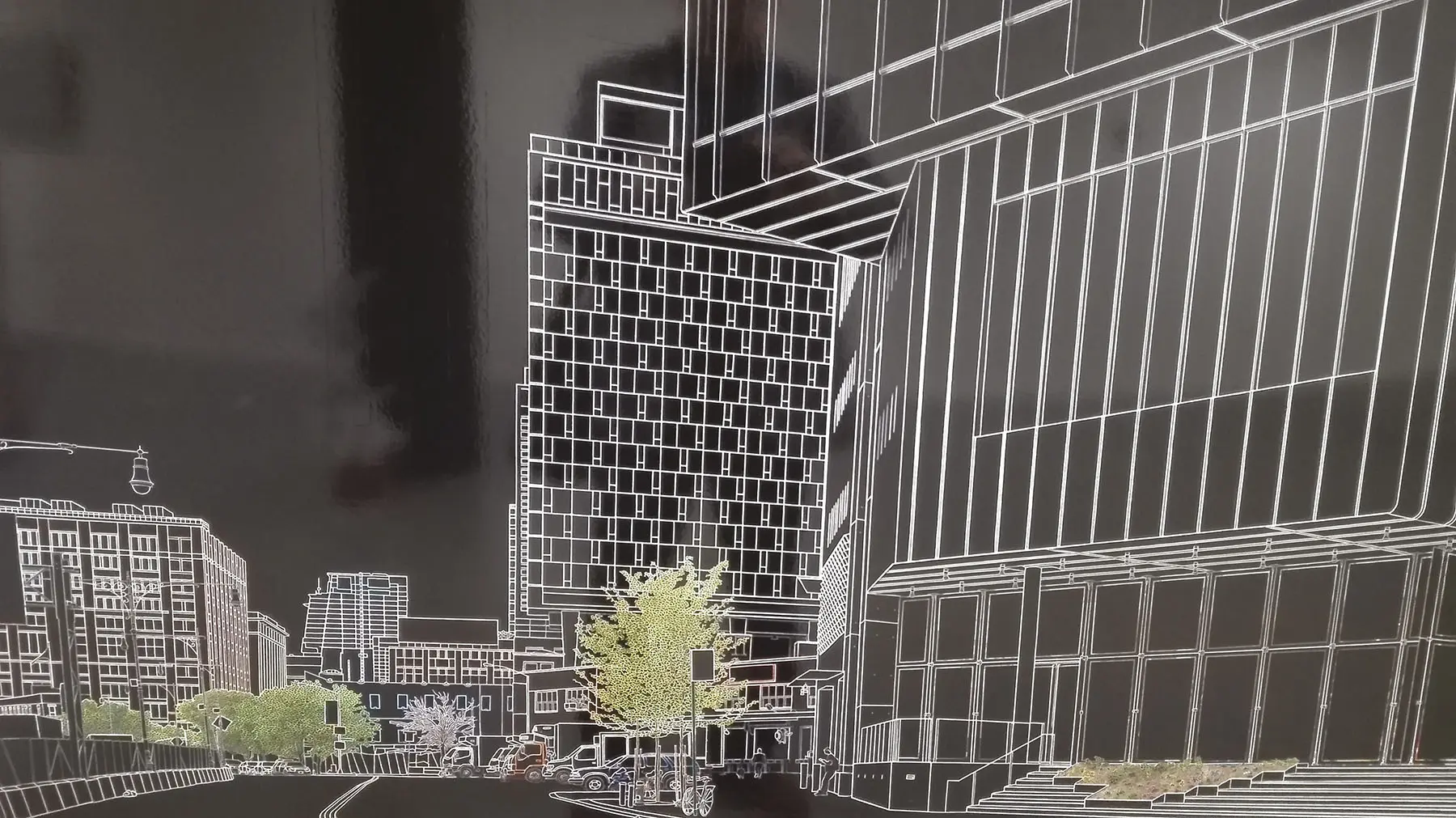
Those works were created a decade or more ago, but the will to reread and reinterpret architecture and urban scenes reappears in more recent ones. For example, in Gran fachada - New Whitney (Grand Façade – New Whitney), a series of drawings based on photographs of the new and impressive Whitney Museum building in New York City, designed by Renzo Piano. The large-format color prints were carefully masked using a black marker, with only the edges, bevels, and outlines of the sophisticated building left visible. The only touches of color in these images: the trees growing in the sidewalk and on what Piano dubbed his Piazza del arte. Even more recent are the twenty-four drawings that comprise Catalogue Raisonné / Grain Elevator, based on an equal number of photographs by Hilla and Bern Becher, the German couple who in the 1970s and 80s produced an exhaustive inventory of industrial architecture in their country. The photographs used by Azambuja are devoted to granaries. He covered the objects with a black marker leaving only the edges and outlines on view.
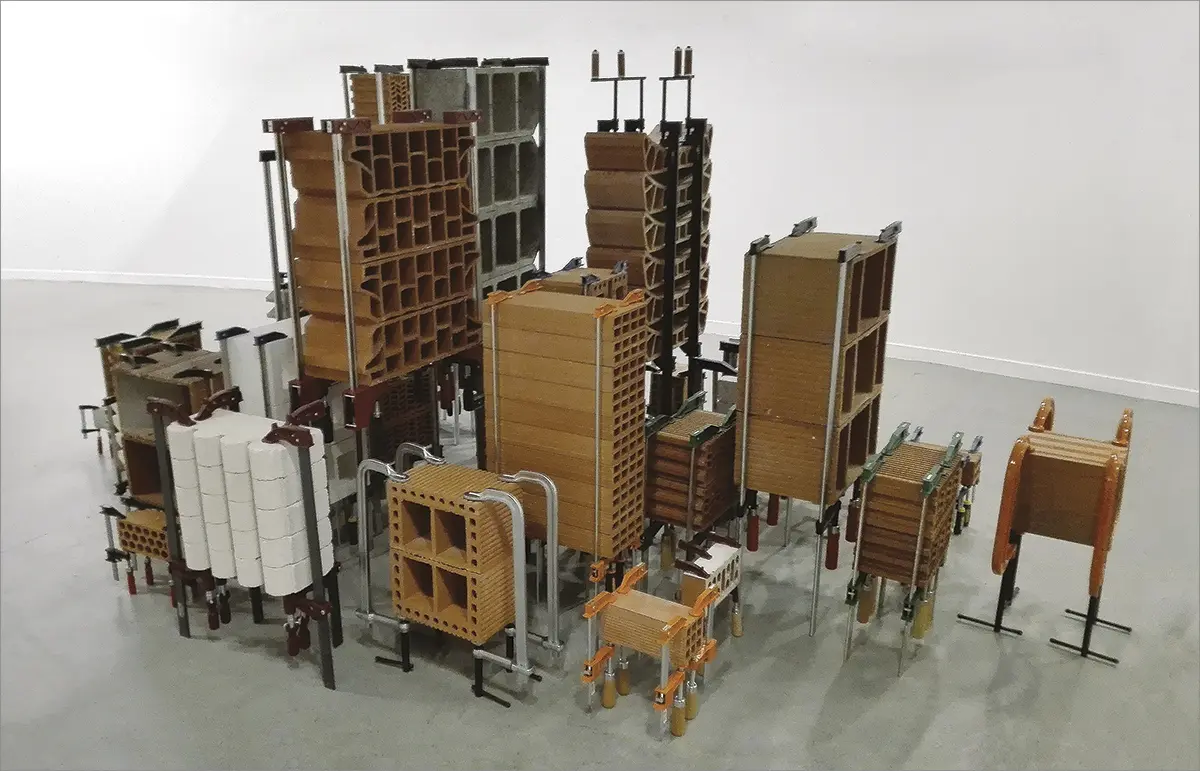
The most recent work included in this exhibition, however, is a sculpture made specifically for it. And I say “made” in full knowledge that “constructed” would be the more appropriate verb, because that’s what it is: a construction using building materials available in stores throughout the city, similar to a model of an agglomeration of unfinished skyscrapers. The title, Brutalismo (Badajoz) [Brutalism (Badajoz)], pays homage to that architectural style, in such stark contrast with the minimalism so dominant today. This work’s unfinished aspect is also present in Lecciones de pintura (Painting Lessons), although not as saliently at first glance in this case. The latter work is itself an unfinished project, a work in progress begun in 2013 that Azambuja plans to continue until it contains one thousand components. On this occasion, he presented all the artworks created so far for the series: 263 paintings in variable sizes, made using triangles, French curves, set squares, and other drawing instruments commonly found on an architect’s worktable before the advent of such software as AutoCAD.
Azambuja’s preference for architecture-related subjects didn’t prevent him, however, from presenting two works that interrogate or critique the will to order, stability, and permanence that fuels architecture. The first of these is titled Desembarque (Disembarkment). It consists of a podium upon which a flock of multicolor ceramic birds confronts a set of concrete cubes painted in impeccable white. It is difficult not to see in this work an allegory of the contrast between Brazil’s tropical exuberance and the geometric rigor that is the distinctive seal of the country’s modern architecture. The second work, Nocturnas (Nocturnal), features a group of potted plants with their leaves painted by Azambuja. The leaves absorb the paint and turn green again, only to have Azambuja paint them once more. Rather than an allegory, what this suggests is a metaphor, this time from Goethe: “All theory, dear friend, is gray, but the golden tree of life springs ever green.”
CARLOS JIMÉNEZ
Essayist and art critic. Lives and works in Madrid, Spain.