“Ceramics is, to me, the ideal combination of sculpture and painting,” remarks the artist Maria Elisa Pifano (Barquisimeto, Venezuela, 1958). Without a doubt, her first solo exhibition, entitled “Lienzos de barro” (Clay Canvases) and recently presented at the Graphicart Gallery, evidenced her expansion of clay’s boundaries and the achievement of pieces that involve the medium of ceramics in and of itself, as well as painting and sculpture. Indeed, she works clay as much in two dimensions as in three.
Ceramics have traditionally been associated with the creation of volumetric pieces, utilitarian purposes, and artistic intentions. In each of these modalities, clay is kneaded and worked on the potter’s wheel, molded like a churro, or—as in her case—formed into sheets of clay. There is no doubt that Pifano acquired mastery of this medium through the solid training she obtained since her formative stages and well into her professional practice. In the mid-1990s, she studied at Baldwin Pottery and Parsons School of Design in New York. At the latter institution, she became interested in the courses on tiles and murals given by Frank Giorgini, completing her academic journey as an interior designer. Years later, she went deeper into ceramics with Malinda Wright and Jake Alee at Tyler Junior College in Texas. Finally, in 2015, she took an intensive course in ceramic sculpture at Greenwich House Pottery during a temporary stay in New York.
It should be noted, however, that it is not only her formal education that has determined the qualities we appreciate in the recently exhibited works. The strong modern tradition, specifically the geometric abstraction that prevailed in the 1950s in Venezuela, has somehow molded her vision and the concept present in her compositions. To appreciate these “Clay Canvases” (to name only one of the four series that make up this exhibition) is to recall the geometric excellence that can be seen in certain facades conceived by Alejandro Otero in the Ciudad Universitaria of Caracas, or murals by other artists such as Víctor Valera, Carlos González Bogen, or Mateo Manaure, to name only a few. This constructivist reference is maintained throughout the four series presented in the exhibition, and their main difference is in the formal and technical solutions that exist between them.
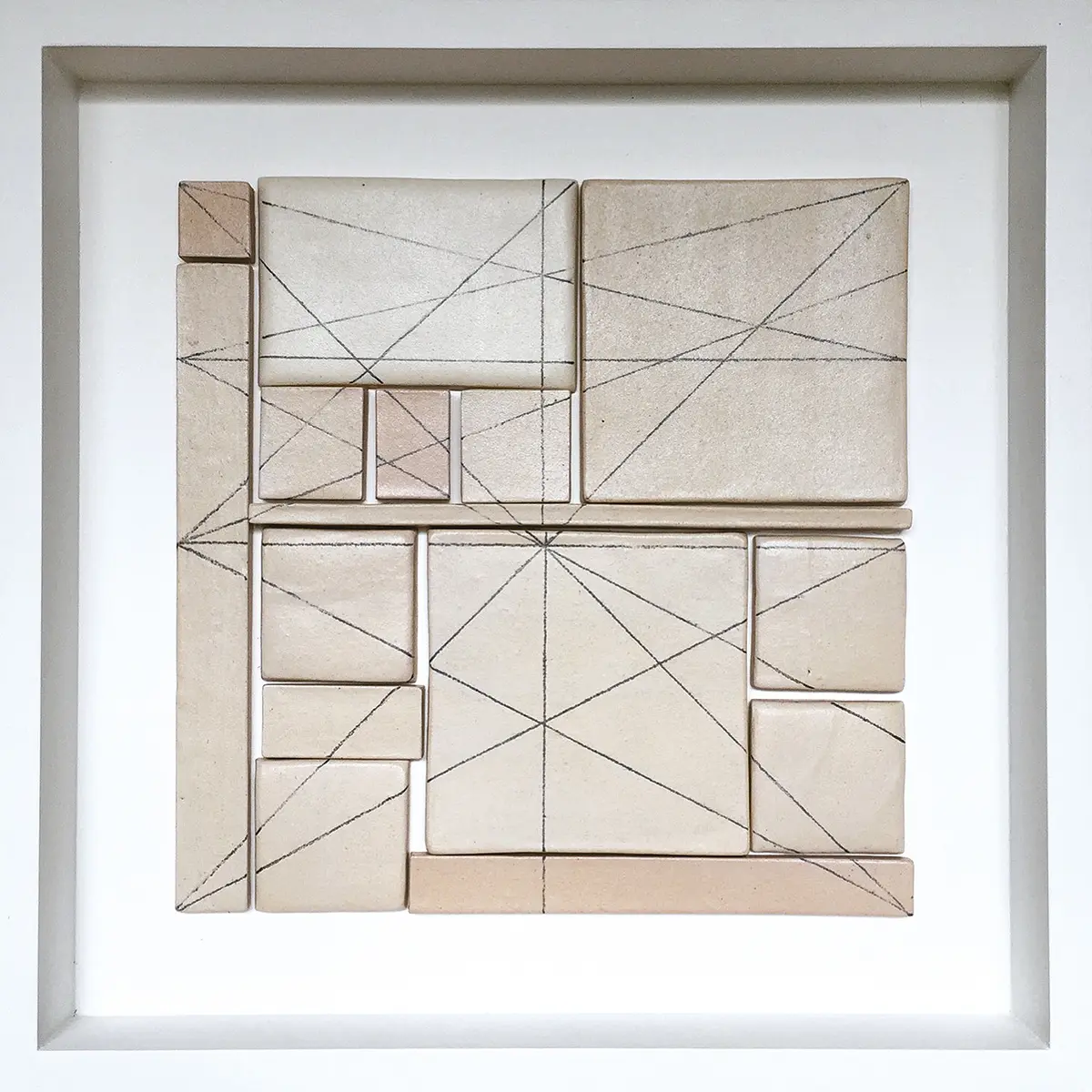
As curators Patricia Morales and Verónica Liprandi explain in their text, in the series entitled “Sketches in Stone,” “Compositions,” “Dwellings,” and of course, “Clay Canvases,” the artist “manages to move skillfully between the limits of two and three dimensions.” The first distinction to be made is in the way she handles the plane and the volume. For María Elisa Pifano, it has been a challenge to bring the clay to two-dimensionality. She does it in several ways: in “Clay Canvases,” the artist organizes the geometrical figures, either by means of black and white tracings—which bring these pieces closer to drawing—and in others, with more pictorial criteria, by applying color. In both modalities, the result is a flat image supported precisely by differentiation in shape and color between the various geometric figures. In “Compositions” and “Sketches in Stone,” on the other hand, the procedures vary. In the first series, she continues to investigate chromatic families that are harmoniously analogous. The detail here is that the figures are not traced on the support or sheet of clay but are small volumes that attached to that plane. This results in a relief.
In “Sketches in Stone,” the idea of composition in relief between different figures is maintained, except that the figures or the attached elements are “linked” by linear lines made with ceramic pencil. Another distinctive feature of this series is that the artist does not use glazes here. The resulting color, after the firing, is that of natural clay, which appears in multiple shades. This is due to the various chemical components present in the different types of clay used. “Dwellings”, on the other hand, are proper volumetric pieces. They look like architectural constructions in which shape and space prevail. Finally, the mural entitled Circles and Squares stands out not only for its technical virtuosity and the contrast of geometric figures in positive/negative, but, as the curators point out, for its “reminiscences of the iconic psychedelic environments of the sixties.”
All of the above is evidence of the rigor and creativity of María Elisa Pifano’s ceramic work. Her aim: to transform clay into canvas, to turn it into stone. In short, they are pieces that express two essential aspects: harmony and beauty.
SUSANA BENKO