Through art history, we can observe the relationship between landscape and painting, and between humans and nature. In the Renaissance, when man became the center of the world, he turned nature into an object of knowledge and domination. In the painting of that epoch, the landscape was only a backdrop, a decorative element in the innumerable portraits that emphasized the character and physiognomy of individuals. This situation changed with Giorgione’s The Tempest: the first landscape painting in which nature is a protagonist. Then came the seventeen-century Dutch landscape artists who turned the natural environment into the central theme of their paintings, inaugurating a new genre, along with the still life. In these seventeenth-century works, which celebrated the communion of man and the natural world, the changing beauty of the sky was discovered, leaving a legacy of admiration and respect. The Romantics were the first to feel a rupture between humans and nature due to the advent of the Modern Age. In both painting and poetry, powerful images were created to provoke both fascination and nostalgia. Now that we are so far from the nineteenth century, we can verify that the Romantic sentiment was well-grounded. The current neoliberal vision, “wild capitalism,” overpopulation, or the legal and illegal exploitation of land resources are exterminating nature and turning us into witnesses of a catastrophe.
María Cristina Cortés has been a landscape painter throughout her career. In her attentive observation of the natural world, her work has evolved similarly to the historical landscape painting mentioned above. In her first works, she captured the beauty of the Sabanero landscape, which has a particular kind of light: both soft and cold. The somewhat spectral light fell on herds of cows quietly grazing near ponds that absorbed the last rays of daylight. Her landscapes gradually became contaminated: lagoons and ponds began to fill up with garbage; water, once crystalline, became a muddy substance; then, the forests dried up and were filled with residues that inspired a series of drawings in which she began experimenting with collages. Finally, she arrived at her current series, which she aptly titled “Desmadre” (Disaster).
As Simon Ortega notes, her current landscapes “use images that refer to the excess or lack of water, to reflect on different ways of seeing nature.” Since her earliest works, water has been an auspicious element to explore the reflections of light, and it still is the case in the waterlogged landscapes of today, where she plays with perspective and looks at the world from above. The horizon line has disappeared, and the water has spread over the canvas, covering and flooding it. In these vast surfaces, the houses had sunk and turned into planes of color that produce a vibration, which reminds me of Kandinsky’s words when he alluded to the chromatic experience in terms of sound and musical equivalences.
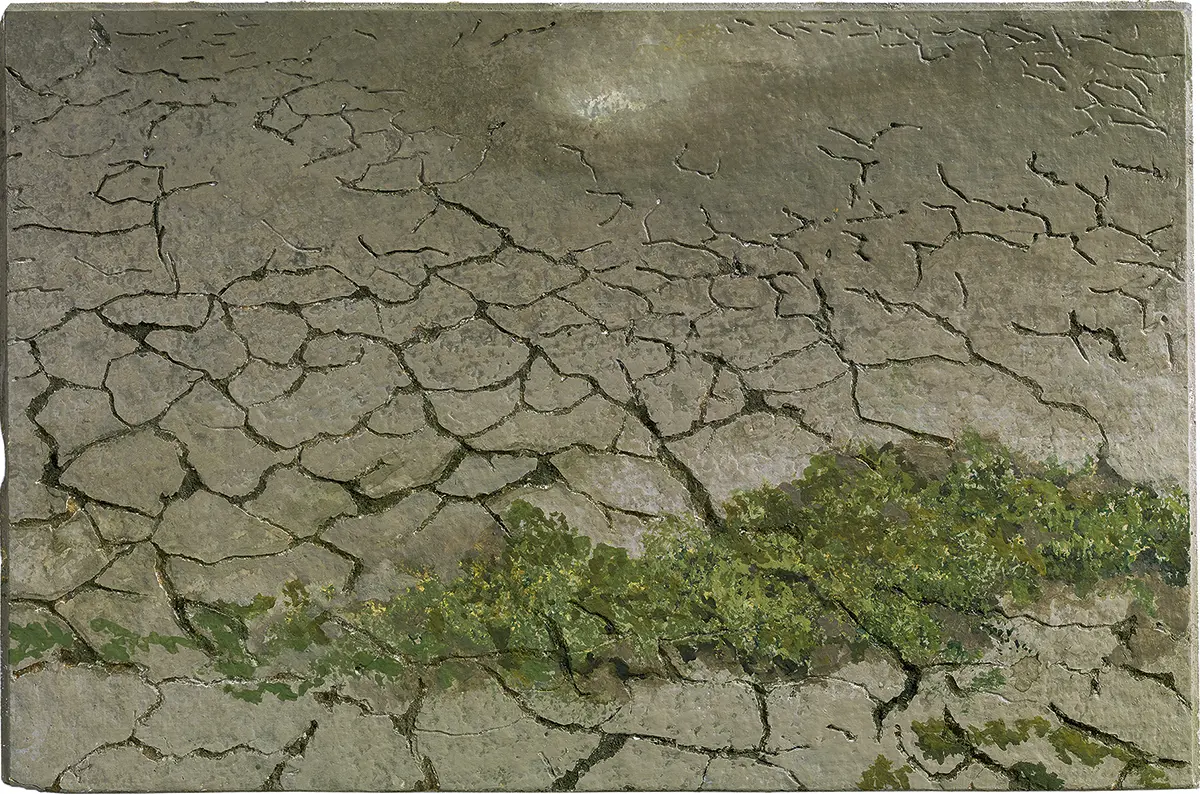
In the works that show a lack of water, the texture takes center stage to reveal the cracked, barren land, through daring perspectives that place the gaze at ground level, so that the rough earth comes to the foreground, overwhelming us. These smaller format paintings were done on sheets of Celotex, a kind of cardboard that was used for the preparation of ceilings and are vestiges of her demolished childhood home. As Andrés Gaitán notes, in these works, “one ruin appeals to another ruin.” This support is related to memory and affections, opening up to multiple readings. But I am interested in highlighting the experimental nature of her work: it’s as if the landscape were being transformed before her eyes—whether by drought, fires, or floods—and requiring new forms of representation. On these dried sheets deteriorated by the passage of time, María Cristina Cortés used an engraving technique. With a burin, she drew, one by one, the cracks of the earth, generating a crusty texture that adds tactile effects to these arid landscapes, which at times can be seen either as abstract paintings or as the most truthful representation of dry and cracked earth.
Despite tackling nature’s “desmadre” and taking us to an apocalyptic landscape, in María Cristina Cortés’ paintings, the light continues to illuminate the world. It falls on the water to become color and pictorial matter, or on rough yellow, ocher and gray textures—sometimes bordered by pools of a dying green—to offer changing and surprising light phenomena that affirm the relevance of painting and the landscape genre.
MARTA RODRÍGUEZ