If one had to single out one deeply frustrated sector in contemporary Cuba, it would have to be the architects’ guild. On the island rarely anything is built and what little is done is reserved for foreign investment, with its essentially disrespectful proposals. But Cuba had its avant-garde in the fields of architecture and design during the 1960s and 1970s. During that period, the impersonal schematism of “socialist realism” was avoided by resignifying the styles and codes of the 1950s modernism with a marked tropical and third-world vocation: elegant, full of sensualism, and utopian, coupled with the use of local materials and references. These projects, protected by patrons with political weight, were interrupted when Cuba became institutionalized and began importing Soviet housing blocks. Thus, our architects and designers fell into ostracism because their “tastes were bourgeois.” Mass construction was prioritized to the detriment of signature design and architecture, which was coined as elitist.
“The Decorator’s House,” a solo show by Marco Castillo for the 13th Havana Biennial in his personal studio and at UTA Artist Space, in Los Angeles—curated by Abel González and Neville Wakefield respectively—is structured as a tribute to that generation of architects and interior designers confined to teaching positions: the cruel courtesy of censorship. Armed with an arduous body of research, Marco Castillo tried to penetrate the minds of these professionals to apprehend their creative logic and the context that produced them, as well as their drawing styles.
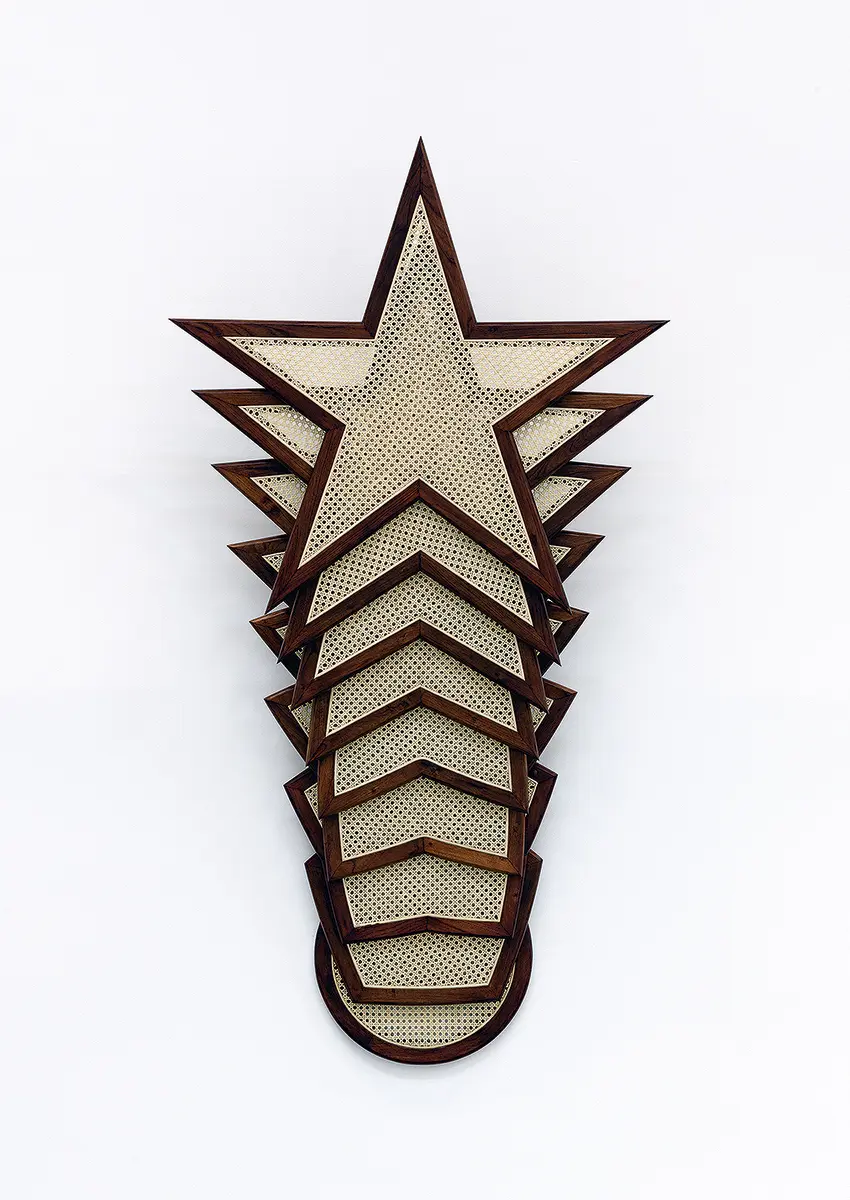
“The Decorator’s House” arises from that fascination and the idea of a truncated project. The exhibition is composed of a series of “sculptures” and notebooks with stars, circles, and graphic symbols that cancel the utilitarian nature of design to enter the self-sufficient terrain of the artistic object. And by using wood as a distinctive material that belongs to a tradition, Castillo is also returning to a key element in the seminal work of Los Carpinteros, the artistic group to which he belonged for many years.
These pieces—inevitably graphic and made of caning, wood, and latticework—may appear at first glance to be explosions and births of constellations; decorative, of course; fragments of a science fiction film scattered in a space that seems strange and familiar at the same time. Here the use of the star “that illuminates and kills” fulfills its function by formalizing, cooling, and solemnizing—from its hurtful triumphalism—a supposedly warm homage. It also fits like a glove to address censorship, “historical chances” or cycles of “cultural and aesthetic deaths.” A metamorphosis—the path from the circle to the star—of a graphic and formal appearance, is an ideal leitmotif to talk about ideological emptying, banalization, and symbolic death.
The title of each work bears a proper name: a zero-degree deconstruction or reduction based on the design of emblematic works by prominent authors of the period known as Modern Regionalism. Once we walk through what we think is the entire exhibition, the coda appears: Generation, a short film made in collaboration with Cuban filmmaker Carlos Lechuga. This film works autonomously if you want it to, but it also furnishes the exhibition with the necessary warmth to complete Castillo’s tribute.
The silent characters of Generation are young artists of the current Havana context interacting in an emblematic house of Havana’s 1950s architecture. Lechuga’s camera managed to capture the “environmental design” of insular authorship twice over. In addition, the Hellenic constitution of each person, as a metaphor for a classic period that has already disappeared; their gestures, partly sophisticated and partly candid; the costumes, and especially the chosen theme—Pólvora mojada (Wet Gunpowder), a 1970s Cuban hit song interpreted by the “very musical” Beatriz Márquez—make Generation the touchstone of our sensibilities in this exhibition. All that familiarity, full of nostalgia—beyond the final realism where everyone is thrown into the void—which this film manages to encompass, redirected our position towards an emotional space that, until then, was dominated by a rational exercise and a respectful but distant homage. It was impossible not to cry.
“The Decorator’s House” constitutes a “feel the local” action that is inserted in the current trends of local restoration, not so as to be fashionable, but for reasons of intellectual and poetic justice. It joins other recent tributes, such as Isaac Julien’s homage to Lina Bo Bardi and Brazilian modernism, “The Parallel Utopia,” an exhibition curated by Iván de la Nuez and Atelier Morales, and all the research on moral modulator, and on pragmatic and disobedient architectural exercises carried out by Ernesto Oroza during a long period of his career (latticework, for example, has been key in his objects). Attention, curators: in all of this, an exhibition awaits.
ELVIA ROSA CASTRO